


New Zealand Dollar meets US inflation data near its 2026 low
- NZD/USD bounces to just under 0.5500 after Monday's new low for 2026.
- RBNZ holds at 2.75% while a December Fed hike is priced above 95%.
- US PCE inflation and GDP are due Wednesday, then markets shut for Thanksgiving.
US inflation data on Wednesday is the last major scheduled release before Thanksgiving for a New Zealand Dollar that set its low for 2026 on Monday. NZD/USD fell to just under 0.5450 before recovering to just under 0.5500. The bounce came as the US Dollar gave back Monday's gain.
The Reserve Bank of New Zealand (RBNZ) has raised its cash rate twice this year, to 2.75%, and held there on October 28. The Fed's rate is 3.75%-4.00%, with a December 9 hike priced above 95%. A gap of at least a full point that is priced to widen is why the New Zealand Dollar has fallen about 9% from its late-August high just under 0.6000.
The US Dollar rose on Monday when Nvidia (NVDA) reinstated Chief Executive Huang and US stocks rallied, and the Dollar Index reached its highest since April 2025. It gave back nearly all of that as the rally in artificial intelligence (AI) shares reversed, and NZD/USD turned up from its low. New Zealand's economy is sluggish and its labour market is weakening, and the RBNZ has held while the Fed is priced to hike.
On the calendar
At 13:30 GMT on Wednesday, the US reports October's Personal Consumption Expenditures Price Index (PCE), third-quarter Gross Domestic Product (GDP) as revised, and the week's jobless claims. The figures feed the Fed's December 9 decision and the odds of another hike in January, which traders put near 59%, and that is the US side of the rate gap with New Zealand. Thanksgiving closes US markets on Thursday, and Friday's US session is a short one.
On the charts
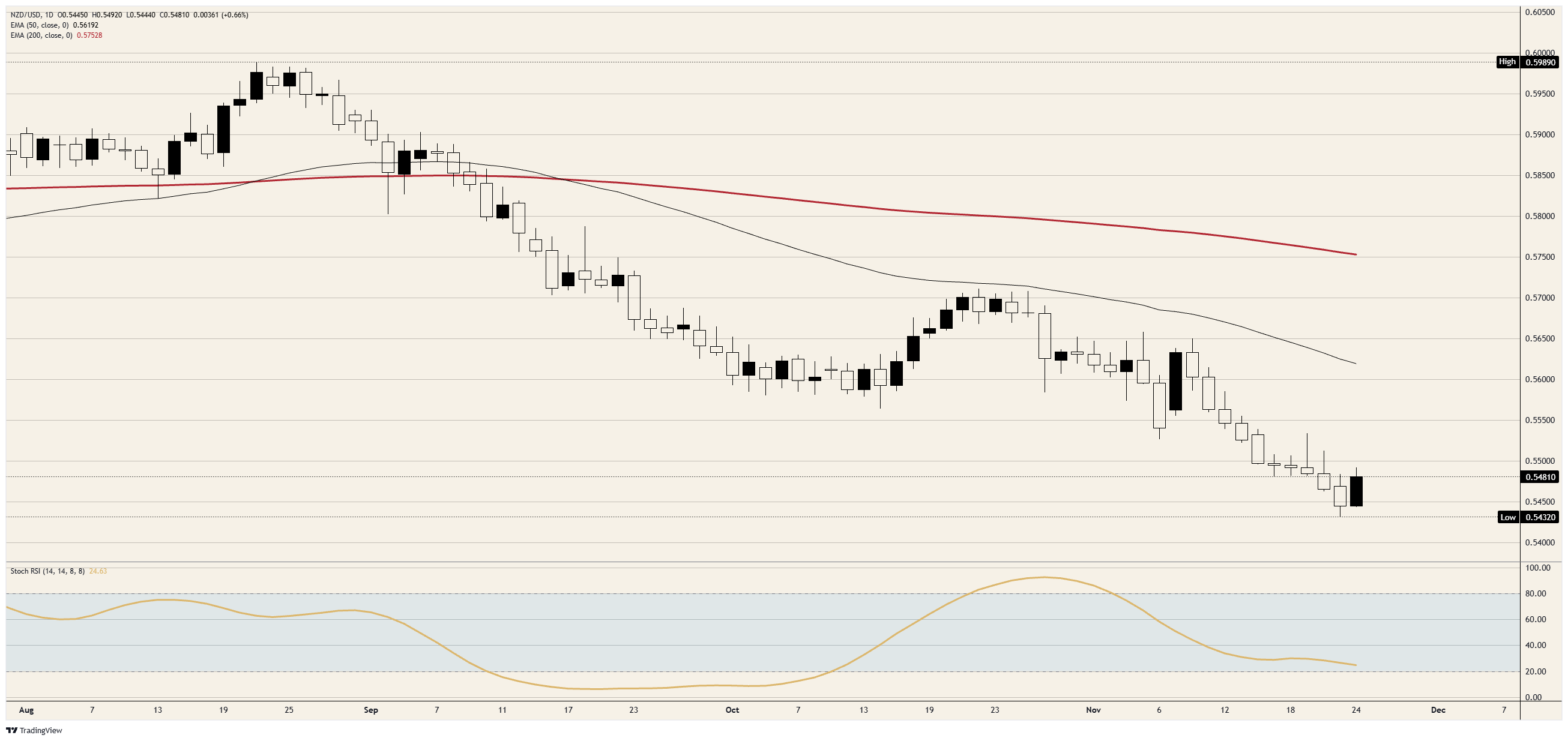
Monday's low is about 11% below the late-January high near 0.6100, and nothing on a chart running back to November 2025 is lower. The 200-day Exponential Moving Average (EMA) is near 0.5750 and the 50-day is just above 0.5600, both falling. Daily momentum is close to oversold.
NZD/USD daily chart
New Zealand Dollar FAQs
The New Zealand Dollar (NZD), also known as the Kiwi, is a well-known traded currency among investors. Its value is broadly determined by the health of the New Zealand economy and the country’s central bank policy. Still, there are some unique particularities that also can make NZD move. The performance of the Chinese economy tends to move the Kiwi because China is New Zealand’s biggest trading partner. Bad news for the Chinese economy likely means less New Zealand exports to the country, hitting the economy and thus its currency. Another factor moving NZD is dairy prices as the dairy industry is New Zealand’s main export. High dairy prices boost export income, contributing positively to the economy and thus to the NZD.
The Reserve Bank of New Zealand (RBNZ) aims to achieve and maintain an inflation rate between 1% and 3% over the medium term, with a focus to keep it near the 2% mid-point. To this end, the bank sets an appropriate level of interest rates. When inflation is too high, the RBNZ will increase interest rates to cool the economy, but the move will also make bond yields higher, increasing investors’ appeal to invest in the country and thus boosting NZD. On the contrary, lower interest rates tend to weaken NZD. The so-called rate differential, or how rates in New Zealand are or are expected to be compared to the ones set by the US Federal Reserve, can also play a key role in moving the NZD/USD pair.
Macroeconomic data releases in New Zealand are key to assess the state of the economy and can impact the New Zealand Dollar’s (NZD) valuation. A strong economy, based on high economic growth, low unemployment and high confidence is good for NZD. High economic growth attracts foreign investment and may encourage the Reserve Bank of New Zealand to increase interest rates, if this economic strength comes together with elevated inflation. Conversely, if economic data is weak, NZD is likely to depreciate.
The New Zealand Dollar (NZD) tends to strengthen during risk-on periods, or when investors perceive that broader market risks are low and are optimistic about growth. This tends to lead to a more favorable outlook for commodities and so-called ‘commodity currencies’ such as the Kiwi. Conversely, NZD tends to weaken at times of market turbulence or economic uncertainty as investors tend to sell higher-risk assets and flee to the more-stable safe havens.
Artigos Recomendados


