


New Zealand Dollar underperforms as NZ inflation cools down
- New Zealand Dollar trades lower against its peers due to softer-than-expected NZ Q3 CPI data.
- New Zealand CPI rose 0.7% in Q3, slower than 0.8% estimates and the previous quarter reading of 1.5%.
- A recovery move in the US Dollar has also weighed on the Kiwi pair.
The New Zealand Dollar (NZD) trades lower against its major currency peers on Thursday. The antipodean is down 0.25% to near 0.5679 against the US Dollar (USD) in the European session.
New Zealand Dollar Price Today
The table below shows the percentage change of New Zealand Dollar (NZD) against listed major currencies today. New Zealand Dollar was the weakest against the Japanese Yen.
| USD | EUR | GBP | JPY | CAD | AUD | NZD | CHF | |
|---|---|---|---|---|---|---|---|---|
| USD | 0.14% | 0.10% | -0.82% | -0.11% | 0.27% | 0.42% | -0.39% | |
| EUR | -0.14% | -0.05% | -0.95% | -0.29% | 0.12% | 0.27% | -0.57% | |
| GBP | -0.10% | 0.05% | -0.92% | -0.25% | 0.16% | 0.31% | -0.50% | |
| JPY | 0.82% | 0.95% | 0.92% | 0.69% | 1.08% | 1.20% | 0.41% | |
| CAD | 0.11% | 0.29% | 0.25% | -0.69% | 0.39% | 0.55% | -0.28% | |
| AUD | -0.27% | -0.12% | -0.16% | -1.08% | -0.39% | 0.13% | -0.67% | |
| NZD | -0.42% | -0.27% | -0.31% | -1.20% | -0.55% | -0.13% | -0.78% | |
| CHF | 0.39% | 0.57% | 0.50% | -0.41% | 0.28% | 0.67% | 0.78% |
The heat map shows percentage changes of major currencies against each other. The base currency is picked from the left column, while the quote currency is picked from the top row. For example, if you pick the New Zealand Dollar from the left column and move along the horizontal line to the US Dollar, the percentage change displayed in the box will represent NZD (base)/USD (quote).
What has weakened the New Zealand Dollar?
Softer-than-expected New Zealand (NZ) Q3 Consumer Price Index (CPI) data has weighed on the Kiwi dollar.
Strategists at Brown Brothers Harriman (BBH) note that NZ Q3 CPI “undershot expectations,” with headline CPI rising “0.7% q/q vs. 1.5% in Q2, below the 0.8% rise forecast by consensus and RBNZ.”
Despite the downside surprise, BBH argues that “above target inflation and still elevated oil prices argue for additional RBNZ rate hikes.” They highlight that “the swaps curve price in 85% odds of a 25bps RBNZ rate hike to 3.00% on October 28 and more than 100bps of tightening over the next twelve months to 3.75% - near the upper end of the RBNZ’s estimated neutral range of 2.20%-4.10%.”
Meanwhile, recovery signs in the US Dollar have also weighed on the Kiwi pair. The US Dollar Index (DXY), which gauges the Greenback’s value against six major currencies, bounces back to near 101.66 after revisiting the three-week low near 101.45.
Going forward, investors will focus on the flash US S&P Global PMI data for October, which is scheduled for Friday.
NZD/USD Technical Analysis
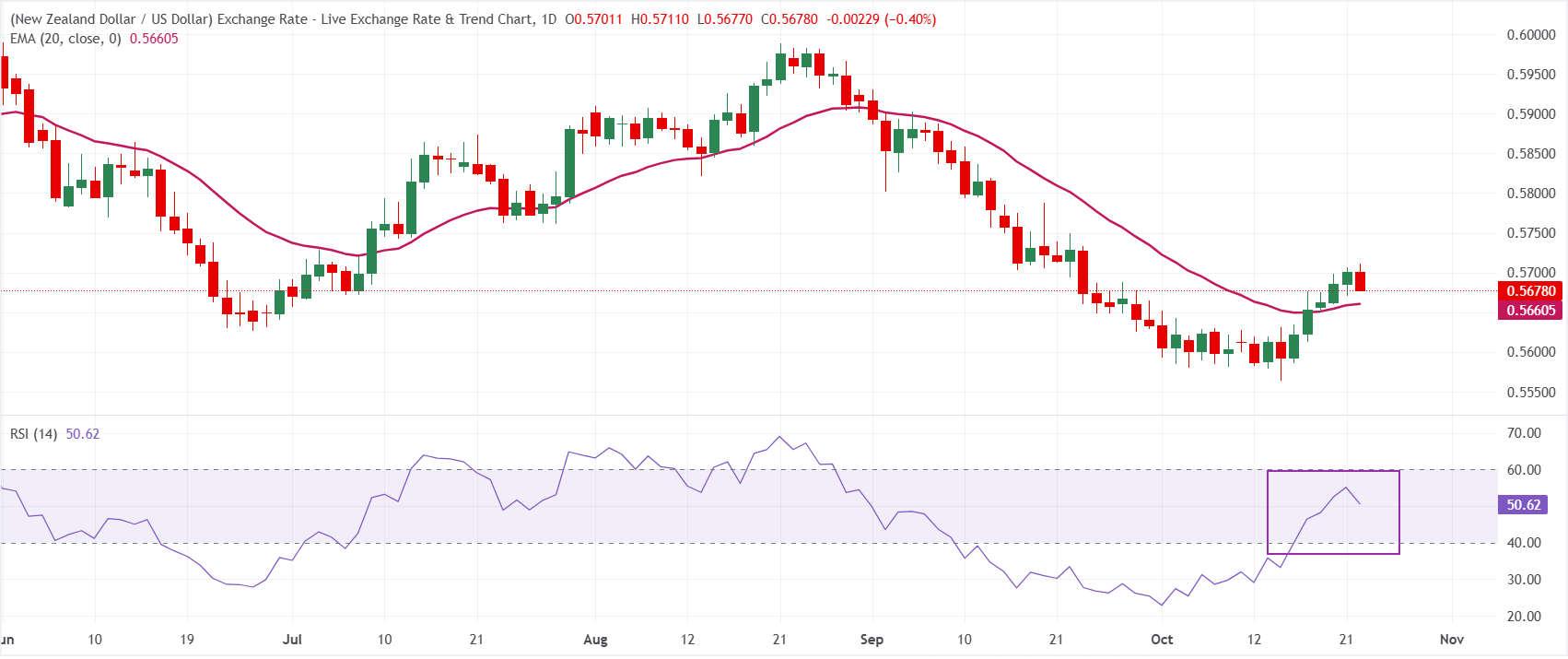
NZD/USD trades at 0.5678 at the time of writing. The pair has reclaimed the 20-day exponential moving average (EMA) at 0.5661, shifting the near-term bias to a mild bullish tone as price now holds above this short-term trend gauge. The Relative Strength Index (RSI) near 51 on the daily chart has turned back to neutral-to-positive territory, suggesting that downside pressure has eased and that the pair could extend its recovery while it remains supported above the EMA.
On the downside, initial support is defined by the 20-day EMA at 0.5661, where a break would undermine the nascent constructive bias and reopen the recent lows. As long as NZD/USD stays above this moving average, buyers are likely to defend dips, leaving the focus on whether the pair can build a base for a more sustained rebound in the sessions ahead.
(The technical analysis of this story was written with the help of an AI tool. Know more.)
Economic Indicator
Consumer Price Index (QoQ)
The Consumer Price Index (CPI), released by Statistics New Zealand on a quarterly basis, measures changes in the price of goods and services bought by New Zealand households. The CPI is a key indicator to measure inflation and changes in purchasing trends. The QoQ reading compares prices in the reference quarter to the previous quarter. A high reading is seen as bullish for the New Zealand Dollar (NZD), while a low reading is seen as bearish.
Read more.Last release: Wed Oct 21, 2026 21:45
Frequency: Quarterly
Actual: 0.7%
Consensus: 0.8%
Previous: 1.5%
Source: Stats NZ
With the Reserve Bank of New Zealand's (RBNZ) inflation target being around the midpoint of 2%, Statistics New Zealand’s quarterly Consumer Price Index (CPI) publication is of high significance. The trend in consumer prices tends to influence RBNZ’s interest rates decision, which in turn, heavily impacts the NZD valuation. Acceleration in inflation could lead to faster tightening of the rates by the RBNZ and vice-versa. Actual figures beating forecasts render NZD bullish.
Artigos Recomendados


