


EUR/GBP Price Forecast: Downtrend remains firm despite deeply oversold RSI
- EUR/GBP struggles near its lowest level since June 2025 as French fiscal risks weigh on sentiment.
- The pair remains below its 50-, 100- and 200-day SMAs, reinforcing the bearish outlook.
- Sellers target the 0.8400 psychological mark, although oversold conditions could limit further losses.
EUR/GBP reverses earlier gains on Tuesday as fiscal and political concerns in France limit the Euro’s (EUR) upside, while the technical picture also suggests sellers remain dominant. At the time of writing, the cross trades around 0.8445, near its lowest level since June 2025, after reaching an intraday high of 0.8457.
Euro Price Today
The table below shows the percentage change of Euro (EUR) against listed major currencies today. Euro was the strongest against the US Dollar.
| USD | EUR | GBP | JPY | CAD | AUD | NZD | CHF | |
|---|---|---|---|---|---|---|---|---|
| USD | -0.28% | -0.29% | -0.32% | -0.30% | -0.27% | -0.46% | -0.32% | |
| EUR | 0.28% | -0.02% | -0.05% | -0.01% | -0.01% | -0.18% | -0.03% | |
| GBP | 0.29% | 0.02% | -0.04% | -0.03% | 0.01% | -0.18% | -0.01% | |
| JPY | 0.32% | 0.05% | 0.04% | 0.02% | 0.04% | -0.16% | 0.01% | |
| CAD | 0.30% | 0.00% | 0.03% | -0.02% | 0.03% | -0.17% | -0.01% | |
| AUD | 0.27% | 0.00% | -0.01% | -0.04% | -0.03% | -0.20% | -0.04% | |
| NZD | 0.46% | 0.18% | 0.18% | 0.16% | 0.17% | 0.20% | 0.17% | |
| CHF | 0.32% | 0.03% | 0.01% | -0.01% | 0.00% | 0.04% | -0.17% |
The heat map shows percentage changes of major currencies against each other. The base currency is picked from the left column, while the quote currency is picked from the top row. For example, if you pick the Euro from the left column and move along the horizontal line to the US Dollar, the percentage change displayed in the box will represent EUR (base)/USD (quote).
Pound support builds as EUR/GBP seen anchored in tight range despite UK budget risk
Analysts at ING have turned more constructive on the Pound, noting that they have "lowered our EUR/GBP forecast and now expect the pair to trade in a 0.84-0.85 range for at least several more months." They argue that "idiosyncratic risks surrounding the euro are unlikely to fade anytime soon," while the BoE "has sent a clear enough signal that it is prepared to hike," creating a supportive backdrop for GBP.
At the same time, ING flags the forthcoming "UK budget on 28 October" as "a potential risk for sterling, as markets are pricing in little fiscal concern." Even so, the bank points out that "Chancellor John Healey and Prime Minister Andy Burnham have appeared mindful of market sensitivities," and stresses that "while the budget will be closely scrutinised, we do not currently expect it to trigger significant bond volatility or leave a lasting negative mark on GBP."
Traders look ahead to the UK’s August Gross Domestic Product (GDP) report on Thursday, followed by the final Eurozone inflation reading for September on Friday. These releases, alongside comments from European Central Bank (ECB) and Bank of England (BoE) officials throughout the week, could trigger some price swings over the coming days.
Technical analysis
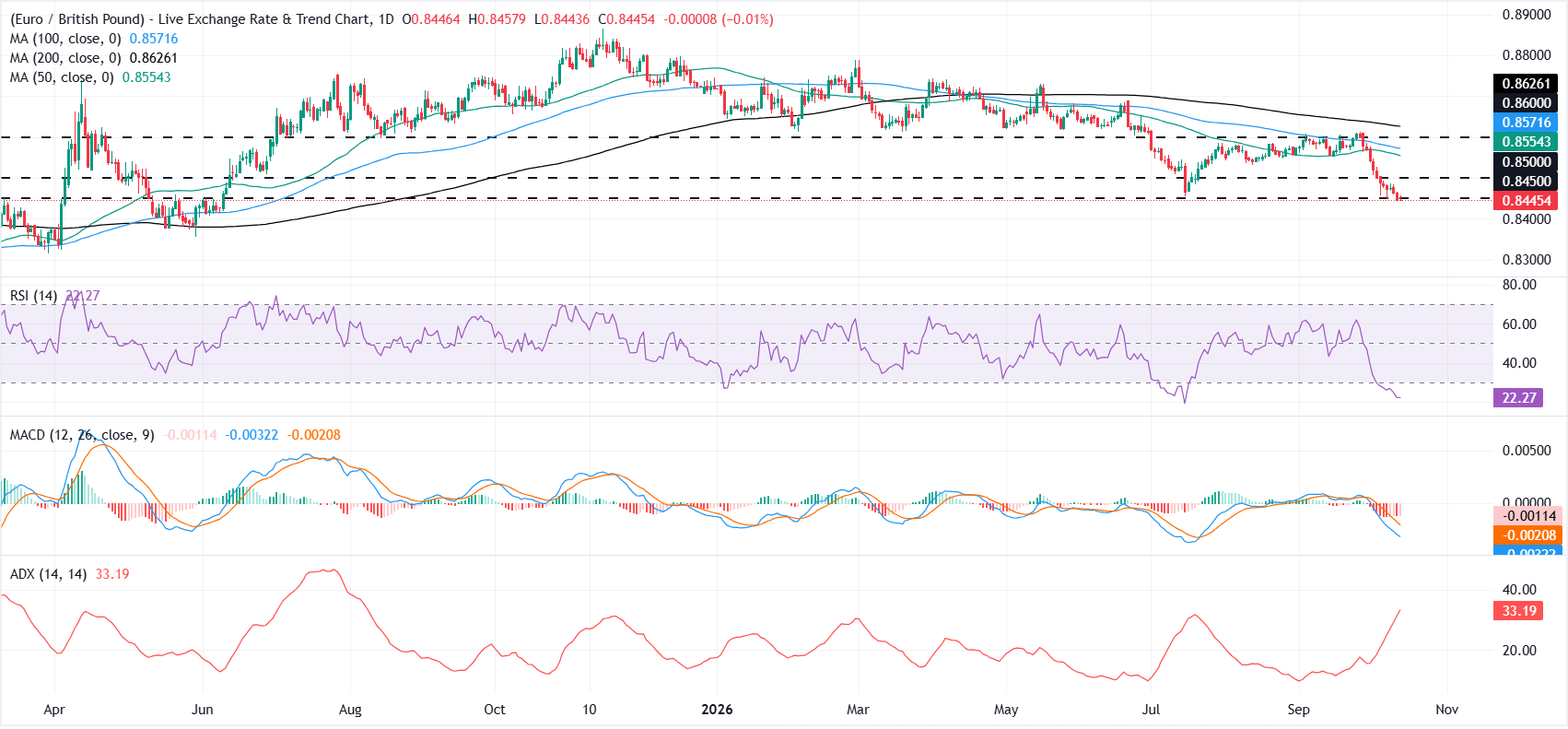
EUR/GBP has reversed sharply after testing 0.8600 in late September, slipping below the 50-day and 100-day Simple Moving Averages (SMAs). The 200-day SMA sits further overhead, reinforcing the bearish structure.
Momentum remains weak, with the Relative Strength Index (RSI) near 22 signalling deeply oversold conditions, while the Moving Average Convergence Divergence (MACD) remains in negative territory. The Average Directional Index (ADX) around 33 points to a strong prevailing downtrend, although oversold conditions leave room for a short-term recovery.
On the topside, initial resistance appears just above the market at the 0.8450 horizontal level, followed by a stronger barrier at 0.8500. Beyond these, the 50-day SMA at 0.8554 and the 100-day SMA at 0.8572 form a dense technical zone ahead of the 0.8600 horizontal line, with the 200-day SMA at 0.8626 marking a more strategic hurdle. On the downside, a further decline could bring the 0.8400 psychological mark into focus as the next support level.
(The technical analysis of this story was written with the help of an AI tool. Know more.)
Euro FAQs
The Euro is the currency for the 20 European Union countries that belong to the Eurozone. It is the second most heavily traded currency in the world behind the US Dollar. In 2022, it accounted for 31% of all foreign exchange transactions, with an average daily turnover of over $2.2 trillion a day. EUR/USD is the most heavily traded currency pair in the world, accounting for an estimated 30% off all transactions, followed by EUR/JPY (4%), EUR/GBP (3%) and EUR/AUD (2%).
The European Central Bank (ECB) in Frankfurt, Germany, is the reserve bank for the Eurozone. The ECB sets interest rates and manages monetary policy. The ECB’s primary mandate is to maintain price stability, which means either controlling inflation or stimulating growth. Its primary tool is the raising or lowering of interest rates. Relatively high interest rates – or the expectation of higher rates – will usually benefit the Euro and vice versa. The ECB Governing Council makes monetary policy decisions at meetings held eight times a year. Decisions are made by heads of the Eurozone national banks and six permanent members, including the President of the ECB, Christine Lagarde.
Eurozone inflation data, measured by the Harmonized Index of Consumer Prices (HICP), is an important econometric for the Euro. If inflation rises more than expected, especially if above the ECB’s 2% target, it obliges the ECB to raise interest rates to bring it back under control. Relatively high interest rates compared to its counterparts will usually benefit the Euro, as it makes the region more attractive as a place for global investors to park their money.
Data releases gauge the health of the economy and can impact on the Euro. Indicators such as GDP, Manufacturing and Services PMIs, employment, and consumer sentiment surveys can all influence the direction of the single currency. A strong economy is good for the Euro. Not only does it attract more foreign investment but it may encourage the ECB to put up interest rates, which will directly strengthen the Euro. Otherwise, if economic data is weak, the Euro is likely to fall. Economic data for the four largest economies in the euro area (Germany, France, Italy and Spain) are especially significant, as they account for 75% of the Eurozone’s economy.
Another significant data release for the Euro is the Trade Balance. This indicator measures the difference between what a country earns from its exports and what it spends on imports over a given period. If a country produces highly sought after exports then its currency will gain in value purely from the extra demand created from foreign buyers seeking to purchase these goods. Therefore, a positive net Trade Balance strengthens a currency and vice versa for a negative balance.
Artigos Recomendados


