


The Australian Dollar bides its time between Beijing and Washington
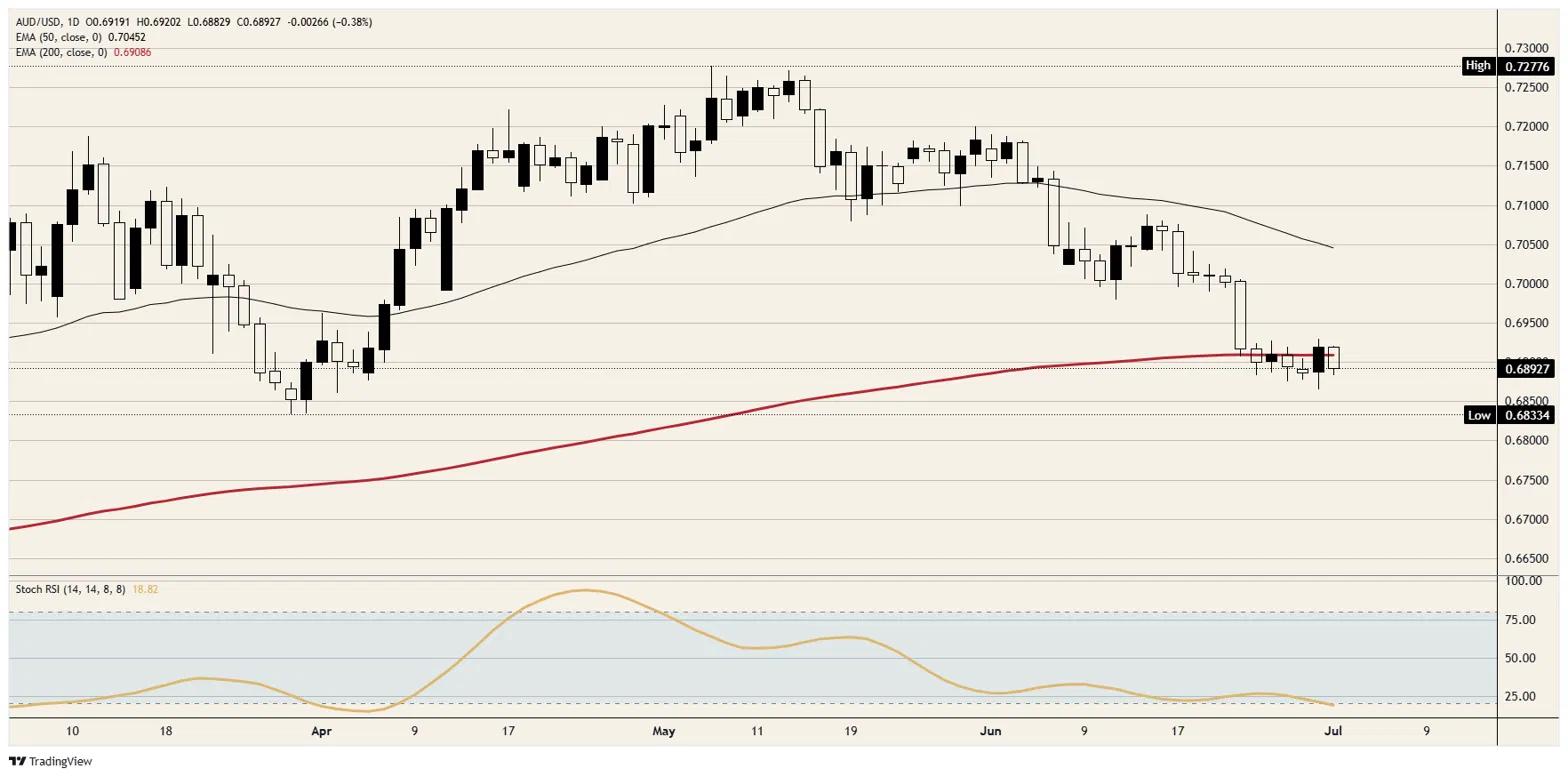
- AUD/USD spent the session pinned to its 200-day moving average, going nowhere in a tight range.
- The pair is trading as a proxy for Chinese demand and the broad US Dollar rather than on anything local.
- Australian trade figures and US payrolls later this week are the catalysts that decide the next move.
The Australian Dollar has spent the past two weeks doing very little, and that stillness is the whole story. After a steep slide from the 0.7200 area in mid-June, AUD/USD has settled onto its 200-day Exponential Moving Average (EMA) near 0.6900 and stopped there, coiling into a range so tight it reads less like a base than like a currency waiting to be told what to do. The temptation is to call this consolidation a bottom; the more honest read is that the Aussie has run out of its own reasons to move.
Along for someone else's ride
Strip away the technicals and the Aussie's problem is that it has nothing domestic to trade. The Reserve Bank of Australia (RBA) is not the swing factor this week; Chinese demand and the broad US Dollar are. That leaves AUD/USD moving on the export data out of Australia and, more importantly, on whatever the US labour market prints on Thursday, which makes the pair a leveraged bet on other people's numbers rather than its own.
Pinned to the 200-day line
The technical structure does nothing to relieve the paralysis; if anything, it deepens it. Price is glued to the 200-day EMA near 0.6900 while the 50-day EMA slopes lower overhead around 0.7050, capping any rebound before it starts. The Stochastic Relative Strength Index (Stoch RSI) is buried below 20, deep in oversold territory, which in a downtrend is as often a sign of persistent weakness as a bounce signal. Until the Aussie can close back above the 0.7000 handle and reclaim that falling average, oversold means little.
The catalysts that break the range
The range will not last, and the calendar says why. Australian trade figures for May land overnight, around 1:30 GMT, a read on Chinese demand that matters more for the Aussie than for most currencies, with the balance seen widening. Domestic Purchasing Managers Index (PMI) surveys follow on Thursday, both hovering just below the 50 line that separates expansion from contraction. The heavier hitter is US Nonfarm Payrolls (NFP) at 12:30 GMT on Thursday, brought forward from Friday by the US holiday, with consensus looking for roughly 110K against a prior 172K. Today's private payrolls already undershot, and a soft headline on Thursday would pressure the Dollar and hand the Aussie a bounce it cannot generate itself.
Levels to watch
Resistance: The 0.7000 handle is the first hurdle, reinforced by the falling 50-day EMA around 0.7050; a daily close above both is the minimum needed to argue the slide has stalled. Beyond that, the 0.7100 area caps the larger recovery.
Support: The recent shelf near 0.6850 is the line that matters; lose it on a closing basis and the 0.6800 handle comes back into view, with little structural support beneath.
Bias: Neutral to bearish while the Aussie stays capped below 0.6900 and its 200-day average. A daily close under 0.6850 opens the downside toward the June lows, and only a reclaim of the 0.7000 handle together with the 50-day EMA turns the structure higher. Oversold momentum alone is not a reason to buy a currency this reliant on other people's data.
AUD/USD daily chart
Australian Dollar FAQs
One of the most significant factors for the Australian Dollar (AUD) is the level of interest rates set by the Reserve Bank of Australia (RBA). Because Australia is a resource-rich country another key driver is the price of its biggest export, Iron Ore. The health of the Chinese economy, its largest trading partner, is a factor, as well as inflation in Australia, its growth rate and Trade Balance. Market sentiment – whether investors are taking on more risky assets (risk-on) or seeking safe-havens (risk-off) – is also a factor, with risk-on positive for AUD.
The Reserve Bank of Australia (RBA) influences the Australian Dollar (AUD) by setting the level of interest rates that Australian banks can lend to each other. This influences the level of interest rates in the economy as a whole. The main goal of the RBA is to maintain a stable inflation rate of 2-3% by adjusting interest rates up or down. Relatively high interest rates compared to other major central banks support the AUD, and the opposite for relatively low. The RBA can also use quantitative easing and tightening to influence credit conditions, with the former AUD-negative and the latter AUD-positive.
China is Australia’s largest trading partner so the health of the Chinese economy is a major influence on the value of the Australian Dollar (AUD). When the Chinese economy is doing well it purchases more raw materials, goods and services from Australia, lifting demand for the AUD, and pushing up its value. The opposite is the case when the Chinese economy is not growing as fast as expected. Positive or negative surprises in Chinese growth data, therefore, often have a direct impact on the Australian Dollar and its pairs.
Iron Ore is Australia’s largest export, accounting for $118 billion a year according to data from 2021, with China as its primary destination. The price of Iron Ore, therefore, can be a driver of the Australian Dollar. Generally, if the price of Iron Ore rises, AUD also goes up, as aggregate demand for the currency increases. The opposite is the case if the price of Iron Ore falls. Higher Iron Ore prices also tend to result in a greater likelihood of a positive Trade Balance for Australia, which is also positive of the AUD.
The Trade Balance, which is the difference between what a country earns from its exports versus what it pays for its imports, is another factor that can influence the value of the Australian Dollar. If Australia produces highly sought after exports, then its currency will gain in value purely from the surplus demand created from foreign buyers seeking to purchase its exports versus what it spends to purchase imports. Therefore, a positive net Trade Balance strengthens the AUD, with the opposite effect if the Trade Balance is negative.
Artigos Recomendados


