


USD/INR hits record high amid absence of US-India trade deal
- The Indian Rupee falls to near 90.86 against the US Dollar amid uncertainty surrounding the US-India trade deal.
- So far, FIIs have remained net sellers on all trading days of December.
- Investors await India’s retail CPI and the US NFP data for November.
The Indian Rupee (INR) extends its decline against the US Dollar (USD) on Friday, with the USD/INR pair hitting fresh all-time highs at 90.86. The Indian currency continues to underperform its peers as investors remain anxious over whether the United States (US) and India will reach a trade deal in the near term.
No major outcome has come out of the two-day meeting between Deputy US Trade Representative Rick Switzer and his team, and top negotiators from India, keeping uncertainty over the US-India trade deal intact.
A slight optimism built on the US-India trade pact outlook on Wednesday when US Trade Representative Jamieson Greer stated, while testifying before the Senate Appropriations Committee, that the latest offer by New Delhi is the "best ever" the US has seen, while keeping the claim that India is a “tough nut to crack”. However, sentiment over the Indian Rupee is expected to remain bogged down unless a deal is announced.
On comments by US Trade Representative Greer, Commerce and Industry Minister Piyush Goyal stated on Thursday that Washington should sign the bilateral deal if it is very happy with the offer. "His happiness is very much welcome. And, I do believe that if they are very happy, they should be signing on the dotted lines,” Goyal said, PTI reported.
It seems that the Indian equity market will continue to witness outflows from overseas investors unless a trade deal between the US and India is announced. Foreign Institutional Investors (FIIs) have remained net sellers so far in all trading days of December, and have offloaded stake worth Rs. 18,491.29 crore.
Daily digest market movers: US Dollar outperforms Indian Rupee ahead of India’s retail CPI data
- The Indian Rupee underperforms the US Dollar even as the latter is expected to close in red for the third straight week. At the time of writing, the US Dollar Index (DXY), which tracks the Greenback’s value against six major currencies, strives to regain ground after posting a fresh seven-week low of 98.13 on Thursday.
- The US Dollar has been under pressure since Wednesday when the Federal Reserve (Fed) ruled out the possibility of a pause in the ongoing monetary-easing campaign despite inflationary pressures remaining well above the 2% target.
- The Fed’s dot plot showed that policymakers collectively see the Federal Fund Rate heading to 3.4% by the end of 2026, signaling that there will be one interest rate cut next year. However, Fed Chair Jerome Powell clarified that the bar of another interest rate cut is very high, and we are close to the upper range of neutrality, a level that neither stimulates nor restricts the economy.
- Before the monetary policy announcement, market participants anticipated the Fed to signal that it is done with trimming interest rates, following a 25-basis-point (bps) reduction to 3.50%-3.75%.
- Going forward, investors will pay close attention to the US Nonfarm Payrolls (NFP) data for fresh cues on the interest rate outlook. The impact of the official employment data will be significant on market expectations for the Fed’s monetary policy outlook, as the central bank has reduced borrowing rates in its last three meetings due to downside labor market risks.
- In Friday’s session, the USD/INR pair will be influenced by India’s retail Consumer Price Index (CPI) data for November, which will be published at 10:30 GMT. India’s retail inflation is expected to have grown by 0.7% on an annualized basis, faster than 0.25% in October.
Technical Analysis: USD/INR approaches 91.00
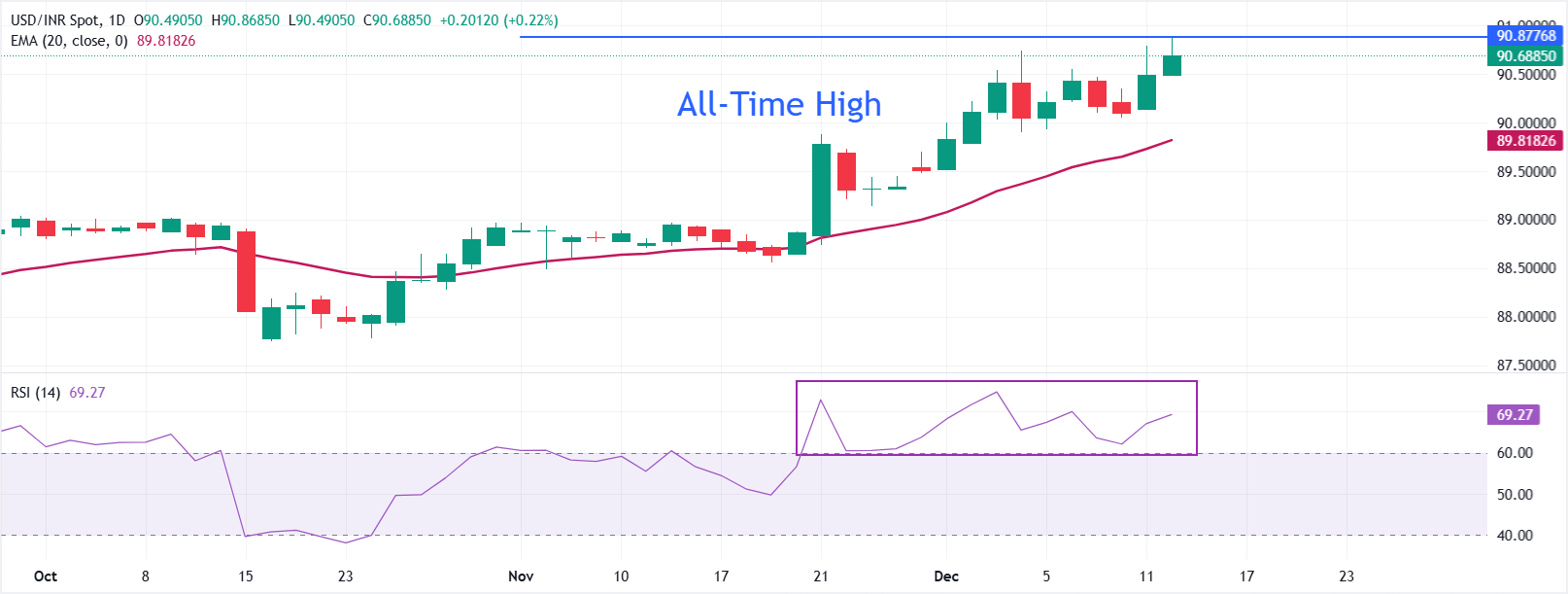
In the daily chart, USD/INR trades at 90.6885. The 20-day Exponential Moving Average (EMA) at 89.8183 rises and stays beneath the spot price, keeping the short-term uptrend intact and supporting dip-buying interest.
Price action remains above the moving average, suggesting the advance is being tracked by trend followers.
The 14-day Relative Strength Index (RSI) at 69.27 edges toward overbought, confirming firm bullish momentum while hinting at risk of fatigue on further gains.
The bias stays firm as long as USD/INR holds above the rising 20-day EMA, with pullbacks expected to be absorbed near the average. A decisive break above the fresh all-time high of 90.86 could lead to further advancement towards 92.00.
RSI hovering just below 70 signals strong but stretched momentum; a push above 70 could trigger consolidation, while sustained readings below that threshold would maintain an orderly grind higher. A daily close back under the 20-day EMA would soften the tone and open room for a deeper retracement towards the December 1 low at 89.51.
Indian Rupee FAQs
The Indian Rupee (INR) is one of the most sensitive currencies to external factors. The price of Crude Oil (the country is highly dependent on imported Oil), the value of the US Dollar – most trade is conducted in USD – and the level of foreign investment, are all influential. Direct intervention by the Reserve Bank of India (RBI) in FX markets to keep the exchange rate stable, as well as the level of interest rates set by the RBI, are further major influencing factors on the Rupee.
The Reserve Bank of India (RBI) actively intervenes in forex markets to maintain a stable exchange rate, to help facilitate trade. In addition, the RBI tries to maintain the inflation rate at its 4% target by adjusting interest rates. Higher interest rates usually strengthen the Rupee. This is due to the role of the ‘carry trade’ in which investors borrow in countries with lower interest rates so as to place their money in countries’ offering relatively higher interest rates and profit from the difference.
Macroeconomic factors that influence the value of the Rupee include inflation, interest rates, the economic growth rate (GDP), the balance of trade, and inflows from foreign investment. A higher growth rate can lead to more overseas investment, pushing up demand for the Rupee. A less negative balance of trade will eventually lead to a stronger Rupee. Higher interest rates, especially real rates (interest rates less inflation) are also positive for the Rupee. A risk-on environment can lead to greater inflows of Foreign Direct and Indirect Investment (FDI and FII), which also benefit the Rupee.
Higher inflation, particularly, if it is comparatively higher than India’s peers, is generally negative for the currency as it reflects devaluation through oversupply. Inflation also increases the cost of exports, leading to more Rupees being sold to purchase foreign imports, which is Rupee-negative. At the same time, higher inflation usually leads to the Reserve Bank of India (RBI) raising interest rates and this can be positive for the Rupee, due to increased demand from international investors. The opposite effect is true of lower inflation.
(The technical analysis of this story was written with the help of an AI tool)
Artigos Recomendados


