


Dow Jones Industrial Average adds 90 points as Iran ceasefire hopes lift stocks
- S&P 500 and Nasdaq Composite notch fresh records on Iran deal optimism.
- Israel and Lebanon agree to a 10-day ceasefire, a key precondition for US-Iran talks.
- Initial jobless claims fall 11K to 207K, biggest weekly decline since February.
- TSMC posts record Q1 profit, reinforcing the AI capex trade.
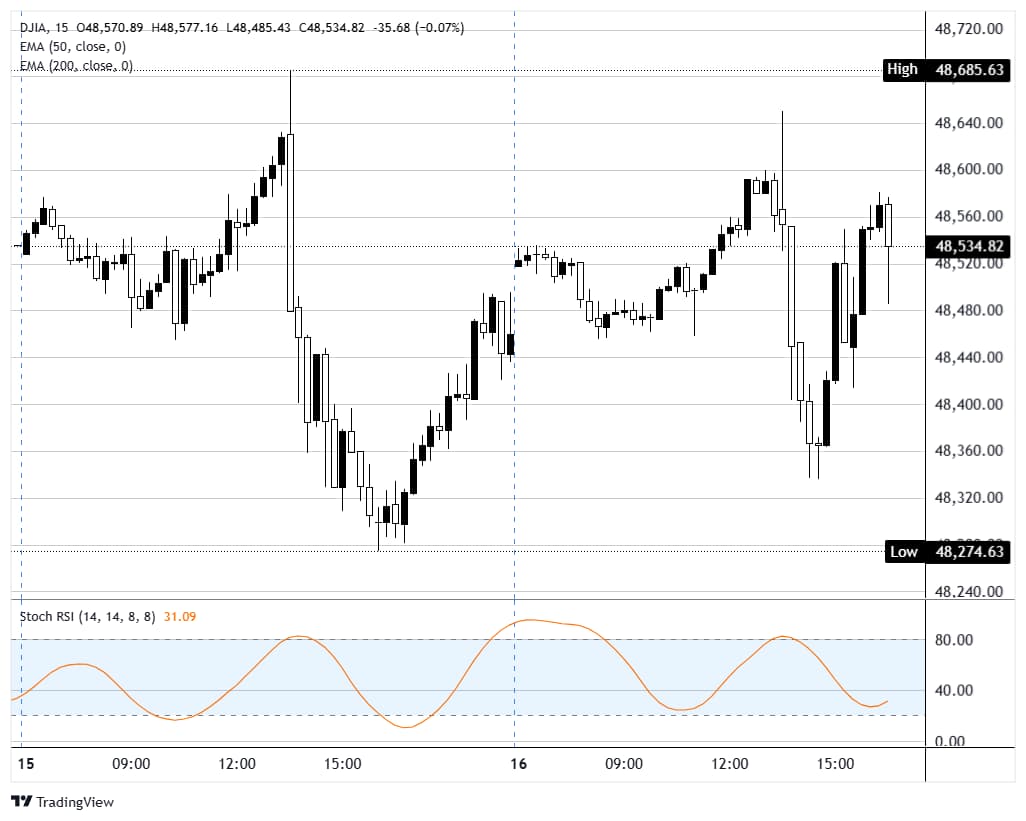
The Dow Jones Industrial Average added about 90 points, or 0.2%, to climb above 48,500 on Thursday, as Wall Street extended its weekly rally on growing confidence that the US-Iran war is moving toward resolution. The S&P 500 rose 0.3% to notch another record high above 7,000, while the tech-heavy Nasdaq Composite gained 0.4% to set a fresh all-time peak. The DJIA traded in a wide intraday range, dipping to a session low near 48,275 before recovering into the close. For the week, the S&P 500 has climbed more than 3% and the Nasdaq more than 5%, while the Dow has advanced more than 1%.
Ceasefire developments drive the bid, but cracks are showing
Stocks got their latest leg higher after President Donald Trump confirmed he spoke with Lebanese President Joseph Aoun and Israeli Prime Minister Benjamin Netanyahu, announcing a 10-day ceasefire set to begin at 21:00 GMT. The pause in Israeli operations in Lebanon has been flagged by the speaker of Iran's parliament as a key condition for formal US-Iran negotiations, and a second round of talks is reportedly under discussion. However, Israeli officials are reportedly irate after Trump made the announcement mid-call, before Netanyahu's security cabinet had voted on the proposal. One senior Israeli official told Axios that "Trump pushed this ceasefire through," and Israel has maintained that its forces will remain in the self-declared "security zone" south of the Litani River. Implementation risk is real, and any breakdown at or shortly after the 21:00 GMT start would likely take the wind out of the risk-on trade into Friday's session.
Jobless claims surprise to the downside
Initial jobless claims fell by 11K to 207K in the week ended April 11, the largest weekly drop since February, according to the Bureau of Labor Statistics (BLS). The prior week was revised down by 1K to 218K. Continuing claims rose by 31K to 1.818 million in the week ended April 4. The data points to continued labor market resilience, with layoffs staying historically contained despite the economic drag from the conflict. The print reinforces the view that the Federal Reserve (Fed) has room to stay patient on rates as it assesses the war's impact on growth, with economists at Sage Advisory flagging the risk of a couple of sub-2% GDP quarters ahead.
Earnings rotation hits Dow components
Corporate results drove sharp single-stock moves under the index surface. Abbott Laboratories (ABT) slid roughly 4% after cutting its annual profit guidance, citing the drag from its $23 billion acquisition. Charles Schwab (SCHW) dropped nearly 4% despite posting a record Q1 profit, with guidance and the details failing to clear a high bar. On the upside, PepsiCo (PEP) rose 0.3% after beating on earnings and revenue, while Bank of New York Mellon (BK) gained 1.3% on a solid set of results. The dispersion kept the Dow's gain modest relative to the S&P 500 and Nasdaq, where tech-related names continued to pull harder.
AI trade gets another green light from TSMC
Taiwan Semiconductor Manufacturing Company (TSMC) reported a record Q1 net profit of T$572.5 billion, up 58% YoY and comfortably ahead of consensus, with revenue climbing 35% YoY. Management also guided 2026 capex toward the upper end of its previously announced $52 billion to $56 billion range. The print validated the AI infrastructure spending thesis underpinning the Nasdaq's 11-session win streak into midweek and supported megacap tech into Thursday's close. Netflix (NFLX) reports after the bell, the next test for the high-multiple growth cohort.
DJIA futures and Friday setup
DJIA futures were little changed in after-hours trade, trading near 48,760 and pointing to a flat open. S&P 500 and Nasdaq 100 futures were similarly quiet, each up around 0.1%. With no top-tier US data on the Friday calendar, the overnight tone will hinge on reaction to Netflix earnings and any further headlines out of the Middle East. A confirmed second round of US-Iran talks would likely keep the risk-on bid in place, while holes in the Israel-Lebanon ceasefire, given Israel's reluctance to pull forces back from southern Lebanon, are the near-term risk to watch.
Dow Jones 15-minute chart
Dow Jones FAQs
The Dow Jones Industrial Average, one of the oldest stock market indices in the world, is compiled of the 30 most traded stocks in the US. The index is price-weighted rather than weighted by capitalization. It is calculated by summing the prices of the constituent stocks and dividing them by a factor, currently 0.152. The index was founded by Charles Dow, who also founded the Wall Street Journal. In later years it has been criticized for not being broadly representative enough because it only tracks 30 conglomerates, unlike broader indices such as the S&P 500.
Many different factors drive the Dow Jones Industrial Average (DJIA). The aggregate performance of the component companies revealed in quarterly company earnings reports is the main one. US and global macroeconomic data also contributes as it impacts on investor sentiment. The level of interest rates, set by the Federal Reserve (Fed), also influences the DJIA as it affects the cost of credit, on which many corporations are heavily reliant. Therefore, inflation can be a major driver as well as other metrics which impact the Fed decisions.
Dow Theory is a method for identifying the primary trend of the stock market developed by Charles Dow. A key step is to compare the direction of the Dow Jones Industrial Average (DJIA) and the Dow Jones Transportation Average (DJTA) and only follow trends where both are moving in the same direction. Volume is a confirmatory criteria. The theory uses elements of peak and trough analysis. Dow’s theory posits three trend phases: accumulation, when smart money starts buying or selling; public participation, when the wider public joins in; and distribution, when the smart money exits.
There are a number of ways to trade the DJIA. One is to use ETFs which allow investors to trade the DJIA as a single security, rather than having to buy shares in all 30 constituent companies. A leading example is the SPDR Dow Jones Industrial Average ETF (DIA). DJIA futures contracts enable traders to speculate on the future value of the index and Options provide the right, but not the obligation, to buy or sell the index at a predetermined price in the future. Mutual funds enable investors to buy a share of a diversified portfolio of DJIA stocks thus providing exposure to the overall index.
추천 기사


