


SanDisk Plunges Over 40% in a Month, Faces Another 20% Drop to Test $60 Support Before 2027
TradingKey - SanDisk has plunged over 40% in the past month and could tumble another 20% by year-end to test $60.
On November 24 Eastern Time, SanDisk (SNDK) tumbled roughly 6% to around $82, basically wiping out the prior day's gains and extending its one-month drop to 44%. Driven by the narrative of Jensen Huang's return to Nvidia (NVDA), AI concept stocks surged across the board on November 23, with SanDisk tracking the rally with a gain of over 10%.
SanDisk's stock plunge of over 40% in the past month was not caused by a single event, but rather by a confluence of factors: expectations that NAND storage market conditions and pricing have peaked, capital outflows from the AI computing power and hardware sectors, and positioning and valuation repricing triggered by an 8-for-1 stock split that took effect on November 20.
Over the past month, the AI computing and semiconductor sectors experienced severe volatility, including a sharp pullback in early November, research institutions lowering medium- to long-term AI chip capital expenditure forecasts, and correlated selling pressure across the sector brought on by executive turmoil at Nvidia. As a key player in the AI data center storage and NAND supply chain, SanDisk, after having accumulated substantial gains earlier, became a prime target for portfolio trimming and deleveraging.
In addition, softening NAND pricing and mounting supply-demand concerns for 2027 have also dealt a heavy blow to SanDisk's share price. The market has taken a bearish outlook on NAND flash memory, noting that spot prices have staged a significant pullback and that contract price gains could slow or even turn flat to slightly lower in early 2027. Meanwhile, reduced procurement by some Chinese buyers has stoked concerns that the supply-demand imbalance is narrowing; furthermore, investors worry that profit margins will face compression once SanDisk's long-term contracts expire or demand cools.
SanDisk officially executed an 8-for-1 stock split after the market close on November 19. Although a stock split in itself does not alter a company's fundamental value, the substantial reduction in the nominal share price before and after the split attracted intense turnover from short-term traders and swing capital, which exacerbated price volatility and selling pressure amid bearish market sentiment.
Following Nvidia's surge of more than 30%, tech stocks have slipped back into a correction or faced mounting macroeconomic headwinds. High-volatility storage stocks suffered broad-based reductions, with shares of Micron, SK Hynix, and others falling one after another. If SanDisk's stock breaks below the key $80 level, its recent low, accompanied by heavy selling volume, it will quickly head toward the $60 mark, which represents the lower boundary of the consolidation platform formed in the first quarter of this year.
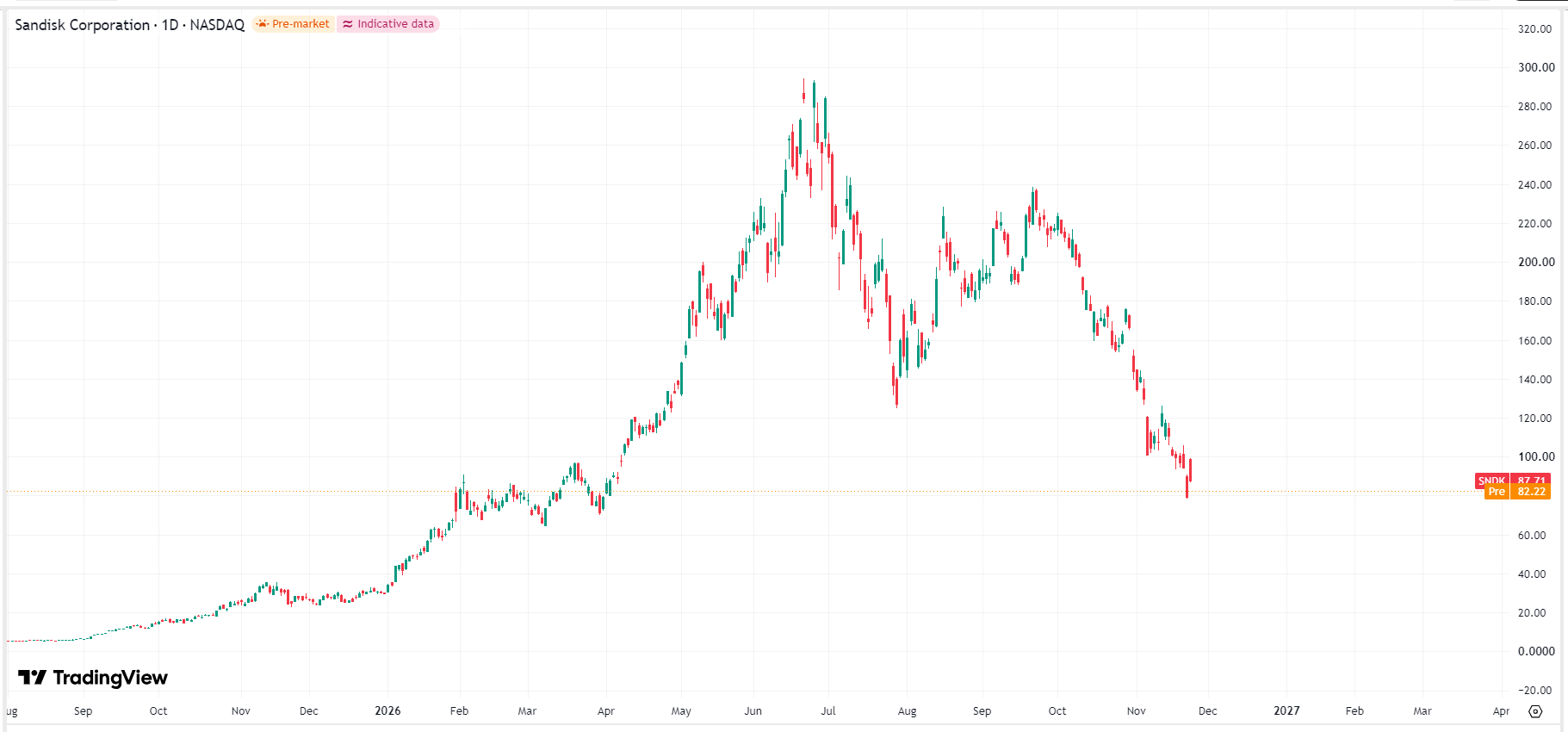 SanDisk stock chart, Source: TradingView
Recommended Articles


