


This Index Just Did Something It Hasn't Done Since 2009. Is It Time To Buy?
Key Points
The S&P 500 was down roughly 0.8% in October, but the Invesco S&P 500 Equal Weight ETF gained 5%.
It's the biggest monthly outperformance for equal-weight since 2009.
But what does it mean for investing in stocks right now?
- Motley Fool Issues Rare "Total Conviction" Buy Alert ›
With tech stocks having fallen by roughly 10% from their all-time high in early October, a historic gap has opened between that sector and the rest of the market.
The equal-weight version of the S&P 500 just had its single best monthly outperformance of the traditional index in more than 17 years. It returned 5% in October, compared with a loss of around 0.8% for the S&P 500.
Missed Nvidia in 2009? This Rare Signal Is Flashing Again. In 2009, a "Double Down" signal flashed for a little-known chipmaker called Nvidia. For the first time in years, that same "Total Conviction" signal is flashing for a company 1/100th the size of Nvidia. Continue »
Obviously, this kind of dichotomy doesn't exist without a major shift in the U.S. equity market. The decline in tech and the "Magnificent Seven" stocks is the biggest catalyst. But more than 70% of S&P 500 components were actually up on the month. There's also a much larger rotation happening below the surface.

Source: Getty Images.
Equal-weight S&P 500 is now the leader in 2026
On October 7, the Invesco S&P 500 Equal Weight ETF (NYSEMKT: RSP) was trailing the Vanguard S&P 500 ETF by nearly 4% on a year-to-date basis. As of the end of October, it's leading by roughly 3.6%. So this has been a significant shift away from big tech, which had accounted for around 39% of the S&P 500.
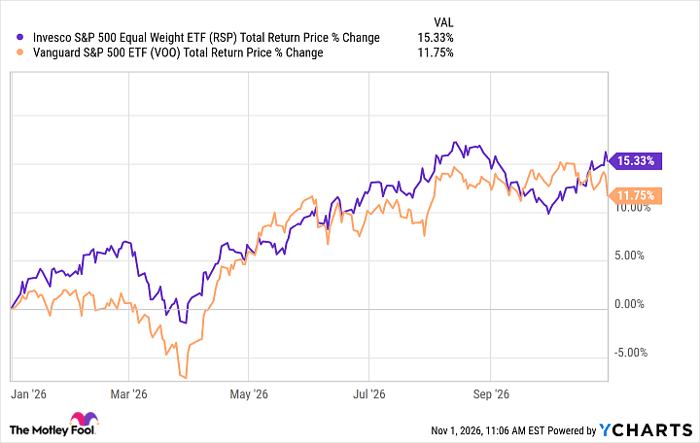
RSP Total Return Price data by YCharts
It'd be easy to see what's happening in tech and say that the U.S. equity market is selling off. But it isn't. You just need to see where the returns are coming from.
The Vanguard Information Technology ETF and the Vanguard Communication Services ETF, which includes NVIDIA, Microsoft, Apple, Alphabet, Meta Platforms, and Broadcom, were the only two S&P 500 sectors that were negative in October. The rest were positive, some significantly so.
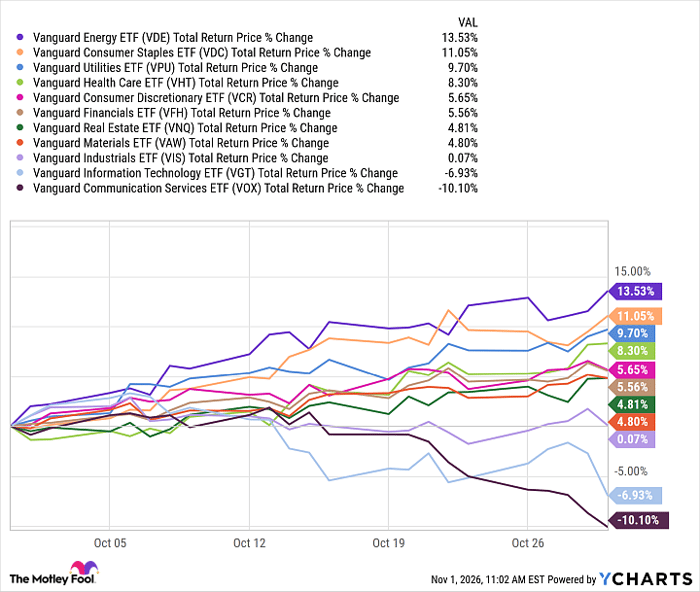
VDE Total Return Price data by YCharts
I think the biggest story is what was leading last month. The top four performing sectors were energy, consumer staples, utilities, and healthcare.
Energy stocks continue to perform strongly, with Brent crude oil prices flirting with $120 a barrel. The other three sectors are all considered defensive equities. The positive overall performance of the Invesco S&P 500 Equal Weight ETF shows that investors are still buying stocks. But they're unquestionably rotating into more conservative, non-growth areas of the market.
This rally looks different from 2009
When this last occurred 17 years ago, the whole market was in the process of recovering from the financial crisis. The S&P 500 bottomed out one month earlier, and it wasn't surprising to see small-caps outperforming large-caps. It's a pattern we often see in the early stages of a recovery cycle. The turnaround from the COVID bear market in the latter half of 2020 is a good example.
We're not in a recovery cycle today. We're just in an environment where a handful of major tech stocks have been pulling the indexes higher. Whenever you have that kind of top-heavy concentration, the S&P 500 is vulnerable to a sharp pullback whenever the theme that's been driving them higher starts to cool. That looks like the point we're at now with the AI boom. The heavy capex spending that got investors excited about a year ago is raising investors' concerns now.
In terms of speculating about how the market could progress from here, I believe a 2009 environment would produce a higher likelihood of an extended run for the equal-weight S&P 500. It could still happen in 2026, but it just takes a change in investor sentiment to kill the rally.
How to invest in the S&P 500 right now
Tech stocks have been leading the market pretty much non-stop since the beginning of 2023. It's not surprising that an eventual correction would happen.
But this is exactly why the argument for diversification is so strong. Whether it's just a modest addition of smaller companies via the Vanguard Total Stock Market ETF or a more dramatic shift with the Invesco S&P 500 Equal Weight ETF, taking some tech exposure off the table probably isn't a bad idea.
Plus, consider how equal-weight tends to outperform cap-weight in a recovering market or economy. The better long-term play right now could be going with the equal-weight option.
Should you buy stock in Invesco S&P 500 Equal Weight ETF right now?
Before you buy stock in Invesco S&P 500 Equal Weight ETF, consider this:
The Motley Fool Stock Advisor analyst team just identified what they believe are the 10 best stocks for investors to buy now… and Invesco S&P 500 Equal Weight ETF wasn’t one of them. The 10 stocks that made the cut could produce monster returns in the coming years.
Consider when Netflix made this list on December 17, 2004... if you invested $1,000 at the time of our recommendation, you’d have $336,195!* Or when Nvidia made this list on April 15, 2005... if you invested $1,000 at the time of our recommendation, you’d have $1,241,567!*
Now, it’s worth noting Stock Advisor’s total average return is 875% — a market-crushing outperformance compared to 208% for the S&P 500. Don't miss the latest top 10 list, available with Stock Advisor, and join an investing community built by individual investors for individual investors.
See the 10 stocks »
*Stock Advisor returns as of November 3, 2026.
David Dierking has positions in Apple, Vanguard Information Technology ETF, and Vanguard Morningstar Total Stock Market ETF. The Motley Fool has positions in and recommends Alphabet, Apple, Broadcom, Meta Platforms, Microsoft, Nvidia, and Vanguard S&P 500 ETF. The Motley Fool has a disclosure policy.
Recommended Articles


