


Prediction: A Stock Market Crash Is Coming. Here's What Investors Should Do Based on Warren Buffett's Advice.
Key Points
The S&P 500 stock market index is a stone's throw from the highest valuation in its history, which was set during the dot-com bubble in 2000.
Soaring oil prices, rising inflation, interest rate hikes, and turbulence in the artificial intelligence industry could derail the current bull market.
Warren Buffett steered Berkshire Hathaway to market-beating returns for 60 years, and he has some clear advice for navigating downturns.
- Motley Fool Issues Rare "Total Conviction" Buy Alert ›
Stocks generally trend higher over the long term, but it's getting harder to ignore the growing chorus of risks that could derail the current bull market. Neocloud companies, which operate artificial intelligence (AI) data centers, are finding it harder to access affordable funding to build more infrastructure, which could put a dent in the sales of semiconductor suppliers like Nvidia.
Moreover, rising oil prices are stoking inflation, which prompted the Federal Reserve to raise interest rates at its September meeting, and more hikes might be on the horizon. High interest rates can be a major headwind for the stock market, particularly now, when so many tech companies are borrowing money to build AI infrastructure.
Missed AI’s "Act 1"? Act 2 Could Be 15x Bigger. Most investors think they missed the AI boat because they didn't buy Nvidia in 2005. But according to our analysts, we’re only at the end of "Act 1"—the R&D phase. "Act 2" is the global rollout. Continue »
To make matters worse, the S&P 500 (SNPINDEX: ^GSPC) is trading at the second-highest valuation in its history, behind only the peak of the dot-com internet bubble in the year 2000. In my view, this leaves the index especially vulnerable to a crash, but legendary investor Warren Buffett has some excellent advice for navigating these very situations.
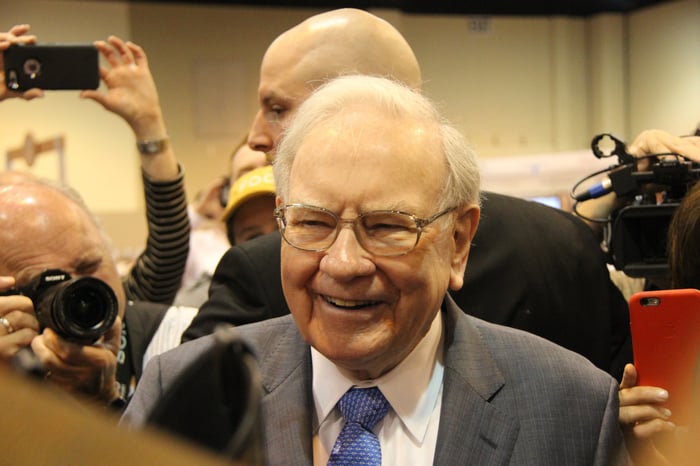
Image source: The Motley Fool.
The Fed faces another battle against inflation
A series of global geopolitical challenges are roiling the energy markets right now. The U.S. and Iran have been locked in a conflict since late February, resulting in the closure of the Strait of Hormuz waterway, through which 25% of the world's seaborne oil normally transits each day. The ongoing war between Saudi Arabia and Yemen also took a turn for the worse recently, while Ukraine and Russia continue to target one another's energy infrastructure, knocking even more supply offline.
As a result, the price of a single barrel of West Texas Intermediate crude oil has surged by 72% this year to $98, driving up the cost of gasoline, diesel, and even jet fuel. That means consumers are paying more for every product that travels by truck, boat, or plane, which includes groceries, retail goods, and more.
This is stoking inflation in a very big way. In fact, the Consumer Price Index (CPI) rose at an annualized rate of 3.7% in September, substantially higher than the Federal Reserve's 2% target. The Fed raised the federal funds rate (overnight interest rates) by 25 basis points at its September meeting to put the brakes on the economy and cool prices down, and chairman Kevin Warsh warned there might be more hikes to come.
Rising interest rates could derail this bull market
The Fed's last rate-hiking cycle spanned from March 2022 to August 2023, when policymakers were trying to tame the previous surge in inflation. The S&P 500 suffered a bear market decline of 20% during that period, and history could repeat.
Rising interest rates are bad for stocks for a few reasons. First, they force consumers to allocate more of their household income to debt repayments, leaving less room for discretionary spending. Second, high rates make companies think twice about borrowing money to fund their expansion plans, limiting their growth potential. These two factors hurt corporate earnings, and earnings drive stock prices over the long term.
Third, rising interest rates increase the yield on risk-free assets like cash and government Treasury bonds, giving investors an alternative to stocks. These assets are very popular during periods of uncertainty, because they give investors a guaranteed return.
The S&P 500 is trading at a Shiller cyclically adjusted price-to-earnings (CAPE) ratio of 40.9 as I write this (Oct. 22), a shade below its all-time high of 44.2 from the peak of the dot-com bubble in 2000. Personally, I don't think seasoned investors will be lining up to pay a premium for stocks in this environment, and some might even use this as a chance to cash in their gains from the last few years. As a result, the perfect storm might be brewing.
Here is Warren Buffett's advice
Warren Buffett served as the CEO of the Berkshire Hathaway holding company from 1965 to 2025. Had you invested just $500 in Berkshire stock when he took the helm and never sold, it would have been worth a whopping $24 million by the time he stepped down. The same investment in the S&P 500 would have grown to just $199,851 over the same period, so Buffett had a knack for picking winning stocks.
In his 1986 letter to Berkshire's shareholders, Buffett said, "We simply attempt to be fearful when others are greedy, and be greedy only when others are fearful." Simply put, he would buy stocks aggressively during downturns in the broader market, because he knew the upward trend would always prevail over the long term.
Buffett also consistently reminded investors that stocks aren't just financial instruments that move up and down -- they represent real businesses with real fundamentals. A person wouldn't sell their house on a whim just because its value dropped during a given year, so selling a stock for the same reason makes very little sense. As long as the underlying business is healthy, a decline in stock price should be used as an opportunity to buy more.
As a result, while stock market turbulence can be unnerving, investors might want to get ready to put some money to work.
Should you buy stock in S&P 500 Index right now?
Before you buy stock in S&P 500 Index, consider this:
The Motley Fool Stock Advisor analyst team just identified what they believe are the 10 best stocks for investors to buy now… and S&P 500 Index wasn’t one of them. The 10 stocks that made the cut could produce monster returns in the coming years.
Consider when Netflix made this list on December 17, 2004... if you invested $1,000 at the time of our recommendation, you’d have $355,124!* Or when Nvidia made this list on April 15, 2005... if you invested $1,000 at the time of our recommendation, you’d have $1,296,254!*
Now, it’s worth noting Stock Advisor’s total average return is 901% — a market-crushing outperformance compared to 210% for the S&P 500. Don't miss the latest top 10 list, available with Stock Advisor, and join an investing community built by individual investors for individual investors.
See the 10 stocks »
*Stock Advisor returns as of October 25, 2026.
Anthony Di Pizio has no position in any of the stocks mentioned. The Motley Fool has positions in and recommends Berkshire Hathaway and Nvidia. The Motley Fool has a disclosure policy.
Recommended Articles


