


Greg Abel Says Every Point of BNSF Profit Margin Adds About $230 Million of Cash Flow for Berkshire Hathaway
Key Points
Berkshire’s railroad business is being eyed as an opportunity for margin improvement.
CEO Greg Abel has even identified the specific benefit this operation’s overhaul could produce.
The eventual net impact to the conglomerate’s bottom line is quite sizeable too.
- Motley Fool Issues Rare "Total Conviction" Buy Alert ›
You likely know that Berkshire Hathaway (NYSE: BRKA) (NYSE: BRKB) is ultimately a massive insurance operation that owns a combination of publicly traded stocks and privately owned enterprises (like Duracell, Clayton Homes, and flooring company Shaw). What's less obvious is just how much cash these wholly owned businesses generate every year. In 2025, Berkshire's private companies produced $44.5 billion in operating earnings.
Even more surprising is where a sizable chunk of it comes from. Although insurance is (usually) its single-biggest cash cow, Berkshire Hathaway's railroad BNSF -- you may know it better as Burlington Northern Santa Fe -- accounts for more than 10% of the conglomerate's total operating income.
Missed AI’s "Act 1"? Act 2 Could Be 15x Bigger. Most investors think they missed the AI boat because they didn't buy Nvidia in 2005. But according to our analysts, we’re only at the end of "Act 1"—the R&D phase. "Act 2" is the global rollout. Continue »
And CEO Greg Abel expects that number to grow for the foreseeable future.

Berkshire Hathaway CEO Greg Abel. Image source: Getty Images.
It's clearly on Abel's mind, and for good reason
How do we know Abel is eyeing something bigger and better for BNSF? In his first-ever letter to Berkshire shareholders published in February, Warren Buffett's replacement plainly stated about the railroad, "The team recognizes the significance of this opportunity, and we will be disappointed if we do not deliver a substantial improvement over the next few years." He even offered specific numbers, explaining, "Each one-percentage-point improvement in operating margin generates approximately $230 million of incremental operating cash flow for our owners."
For perspective on that figure, BNSF's 2025 revenue was $23.5 billion. With a 34.5% operating margin, that amounts to about $8.1 billion in operational cash flow from this one business.
And there's opportunity ahead to be sure. While intermediate-term growth outlooks for the entire domestic rail industry are only in the mid-single digits, more efficiency, like that BNSF began achieving last year, will translate into a better bottom line. These efforts are already making a positive impact.
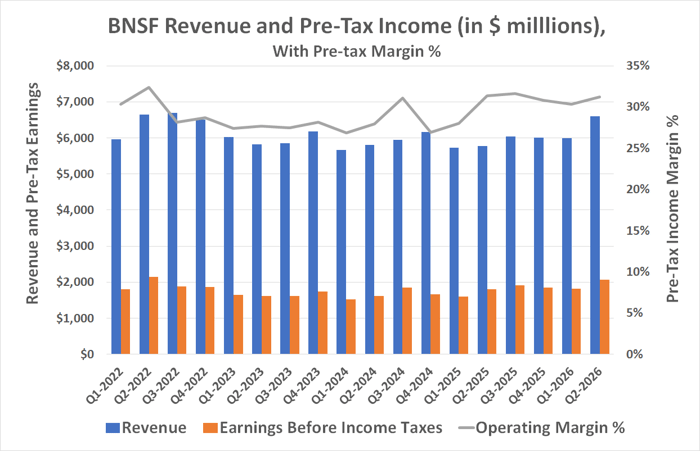
Data source: Berkshire Hathaway. Chart by author.
Rival railroads point to what's possible
As for what's realistic here, obviously nobody owns a functioning crystal ball. We do, however, know that rival railroad Union Pacific (NYSE: UNP) is turning roughly 40% of its revenue into operating earnings right now, while CSX's (NASDAQ: CSX) operating margin rate is in the ballpark of 38%, pointing to what's possible. If BNSF can pump up its operating margins on its current revenue by just three percentage points to CSX's levels, that's roughly $700 million in additional annual pretax income.
And that's without any revenue growth whatsoever. If revenue can also grow at a 3% annual rate, BNSF's contribution to Berkshire Hathaway's bottom line could approximately double within five years, putting it in the ballpark of $10 billion per year. That's not chump change.
Readily addressable opportunity with immediate impact
Of course, the conglomerate's other privately owned businesses, such as Berkshire Hathaway Energy and the recently acquired homebuilder Taylor Morrison, are also being managed to maximize profit growth.
Improving BNSF's fiscal performance, however, looks like the low-hanging fruit to pick right now, with the most immediate potential for near-term impact. Don't be surprised to see more of the narrative regarding Berkshire focusing on this particular business for the foreseeable future.
It's another reason to be bullish on this conglomerate at this time, even if it's not the primary one.
Should you buy stock in Berkshire Hathaway right now?
Before you buy stock in Berkshire Hathaway, consider this:
The Motley Fool Stock Advisor analyst team just identified what they believe are the 10 best stocks for investors to buy now… and Berkshire Hathaway wasn’t one of them. The 10 stocks that made the cut could produce monster returns in the coming years.
Consider when Netflix made this list on December 17, 2004... if you invested $1,000 at the time of our recommendation, you’d have $370,440!* Or when Nvidia made this list on April 15, 2005... if you invested $1,000 at the time of our recommendation, you’d have $1,330,110!*
Now, it’s worth noting Stock Advisor’s total average return is 924% — a market-crushing outperformance compared to 212% for the S&P 500. Don't miss the latest top 10 list, available with Stock Advisor, and join an investing community built by individual investors for individual investors.
See the 10 stocks »
*Stock Advisor returns as of October 22, 2026.
James Brumley has no position in any of the stocks mentioned. The Motley Fool has positions in and recommends Berkshire Hathaway. The Motley Fool recommends Union Pacific. The Motley Fool has a disclosure policy.
Recommended Articles


