


What the Latest Fed Decision Means for Costco, Walmart, Target, and Home Depot
Key Points
Inflation sits at 3.7% according to September’s CPI, and more Fed rate hikes seem likely in 2026 and possibly into 2027.
Higher interest rates could be continuing bad news for Home Depot stock, which is already down 24% in the past year.
Continued high inflation could be bullish for Costco and Walmart, but bad for price-sensitive customers at Target who might be more motivated to “trade down.”
- Motley Fool Issues Rare "Total Conviction" Buy Alert ›
When interest rates go up, that tends to be bad news for stocks. But not all stocks are affected the same way by rising rates. At their most recent meeting of the Federal Open Market Committee (FOMC) on Sept. 16, the central bankers hiked the benchmark federal funds rate by 0.25 percentage points. Inflation in September came in slightly hotter than expected, with a year-over-year CPI increase of 3.7%. That suggests that the Fed might hike rates again in 2026, as the FOMC will meet two more times this year, on Oct. 28 and Dec. 9.
When the Fed hikes interest rates, its goal is often to slow inflation -- and tap the brakes on economic growth. This can have negative effects on job growth, borrowing costs, and consumer spending. Some retail stocks might suffer more from a consumer spending slowdown than others. A few important retail stocks to watch right now are Costco (NASDAQ: COST), Home Depot (NYSE: HD), Target (NYSE: TGT), and Walmart (NASDAQ: WMT).
Missed AI’s "Act 1"? Act 2 Could Be 15x Bigger. Most investors think they missed the AI boat because they didn't buy Nvidia in 2005. But according to our analysts, we’re only at the end of "Act 1"—the R&D phase. "Act 2" is the global rollout. Continue »
Here's how these four retail stocks have performed since the federal funds rate hike on Sept. 16:
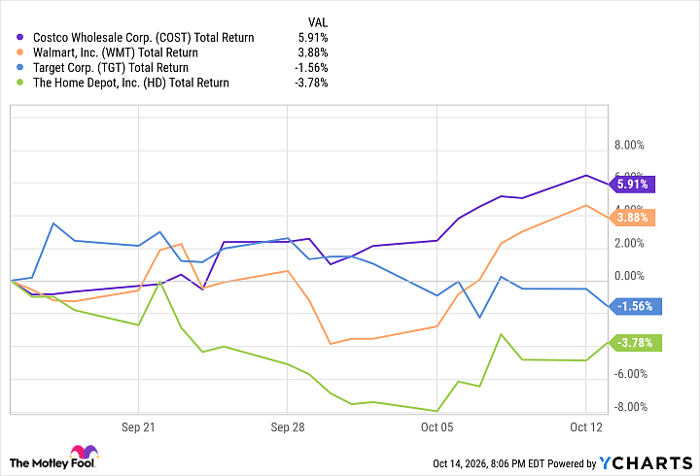
COST Total Return Level data by YCharts.
A 25-basis-point rate hike is unlikely to be a game changer for any stock. But some companies are more rate-sensitive than others. All four of these retailers have distinct strengths and vulnerabilities that would come into play in a rising interest-rate environment.
Let's look at which of these retail stocks are more likely to be winners if the Fed hikes interest rates again in 2026, and which might be losers.

Image source: Getty Images.
Costco: Affluent consumers unfazed by higher gas prices
Costco might be better positioned than most retailers to thrive in an environment of higher inflation and rising interest rates. That's because Costco's membership model creates a high level of customer loyalty, and the retailer tends to be popular with higher-income customers. According to a June YouGov survey, 11% of Americans in households with gross incomes of $150,000 or more do most of their food and other grocery shopping at Costco. These more affluent households are likely to be less bothered by high inflation.
A major factor in the Fed hiking interest rates is inflation driven by higher gas prices. The latest CPI index for gasoline was up 9.1% year over year in September 2026. Higher gas prices could hurt some retailers more than others, as consumers are compelled to dedicate more of their take-home pay to filling their tanks.
But Costco might be relatively safe from the effects of high gas prices. As of 2025, about 10% of its total net sales came from gasoline. In the company's September quarterly earnings report, CEO Ron Vachris said Costco's gasoline business had a "record year" and that in its fiscal year 2026, it achieved an all-time high rate of "penetration of U.S. member households that purchased gas."
Costco stock has gained about 118% in the past five years, but over the past year, it underperformed the S&P 500 index (SNPINDEX: ^GSPC), rising only 3.75%.
Verdict: Bullish. Costco is likely to be a relatively strong retail performer, even with additional Fed rate hikes.
Home Depot: Vulnerable to a sluggish housing market and consumer credit
Fed rate hikes don't directly affect mortgage rates, which are tied to the yield on the 10-year Treasury bond. But the fact that the Fed is hiking short-term interest rates will likely be reflected in higher bond yields on longer-term debt as well. That means more expensive mortgages, more expensive consumer credit, fewer people taking out home loans and home equity loans -- and less money being spent at home improvement stores like Home Depot.
Home Depot's stock price has declined by about 14.1% over the past five years and by about 24% over the past year. And if interest rates stay high or rise, it is probably going to stay in a slump. With higher mortgage rates and a struggling housing market, fewer people are going to spend big on new kitchens and bathrooms.
Verdict: Bearish. Until interest rates decline and the housing market gets unstuck, Home Depot shares are likely to keep going sideways -- or worse.
Target: Price-sensitive consumers could threaten this company's turnaround
Target CEO Michael Fiddelke started his job on Feb. 1, and he's tasked with turning the chain around after years of sluggish sales and declining share prices. Fiddelke's plan focuses on refreshing Target's stores and improving its merchandise. So far, it seems to be working: The company's stock is up about 59% year to date.
But continued high inflation could be a bigger threat to Target than to Costco. Although Target cut prices on thousands of items in 2026, its customer base could be less loyal than Costco's and more prone to trade down to lower-priced merchandise -- or switch to competitors like Walmart that might be perceived as lower cost.
Verdict: Bearish. One or two Fed rate hikes won't unravel Target's turnaround. But if inflation-weary consumers get more aggressive about bargain hunting, that could be bad news for this "cheap chic" retailer.
Walmart: Opportunity to attract more high-income customers
America's largest retailer is known for low prices. Walmart's customer base tends to be middle-income and lower-income shoppers who want value for their money. Unfortunately, those customers seem to be struggling due to high inflation.
On its most recent quarterly earnings call on Aug. 20, Walmart reported U.S. comparable sales growth of 2.6%, which was weaker than analysts had expected. The company's shares gained an impressive 149% over the past five years, but only 8.4% in the past year -- less than the S&P 500.
But if the Fed keeps hiking interest rates in its bid to bring inflation back in check, there could also be an opportunity for Walmart to expand its market share among more affluent households. On the Aug. 20 earnings call, Walmart CEO John Furner said that "we continue to see growth from higher-income households." If more affluent consumers get fed up with high prices at their usual stores and start to "trade down" to Walmart, that could be good news for this company's investors.
Verdict: Bullish. But only if Walmart can attract more sales from price-sensitive affluent shoppers "trading down" than it loses from lower-income customers who cut back on shopping altogether.
Should you buy stock in Walmart right now?
Before you buy stock in Walmart, consider this:
The Motley Fool Stock Advisor analyst team just identified what they believe are the 10 best stocks for investors to buy now… and Walmart wasn’t one of them. The 10 stocks that made the cut could produce monster returns in the coming years.
Consider when Netflix made this list on December 17, 2004... if you invested $1,000 at the time of our recommendation, you’d have $380,579!* Or when Nvidia made this list on April 15, 2005... if you invested $1,000 at the time of our recommendation, you’d have $1,359,789!*
Now, it’s worth noting Stock Advisor’s total average return is 931% — a market-crushing outperformance compared to 212% for the S&P 500. Don't miss the latest top 10 list, available with Stock Advisor, and join an investing community built by individual investors for individual investors.
See the 10 stocks »
*Stock Advisor returns as of October 16, 2026.
Ben Gran has no position in any of the stocks mentioned. The Motley Fool has positions in and recommends Costco Wholesale, Home Depot, Target, and Walmart. The Motley Fool has a disclosure policy.
Recommended Articles


