


Not Nvidia. Not Cisco. This Is the AI Networking Stock Quietly Wiring Every Data Center
Key Points
Arista makes high-speed Ethernet switches that direct traffic through data centers.
Data centers need faster connections to keep expensive GPUs working at full capacity.
- 10 stocks we like better than Arista Networks ›
When investors think about artificial intelligence (AI) infrastructure, Nvidia is often at the top of the list. Nvidia has become the world's largest company thanks to its vaunted graphics processing units (GPUs), which are considered indispensable for training and running AI models.
Another side of the coin is Cisco Systems, a blue chip tech company that makes switches, routers, and other equipment that moves information through data centers.
Missed AI’s "Act 1"? Act 2 Could Be 15x Bigger. Most investors think they missed the AI boat because they didn't buy Nvidia in 2005. But according to our analysts, we’re only at the end of "Act 1"—the R&D phase. "Act 2" is the global rollout. Continue »
But there's another company that deserves attention: Arista Networks (NYSE: ANET). And while it may not attract the same attention as Nvidia, Arista is becoming a core AI infrastructure play by helping solve one of the biggest challenges facing data centers.
Image source: The Motley Fool.
What does Arista Networks do?
AI data centers rely on thousands of graphics processing units (GPUs) working together to train and run complex artificial intelligence models. But all that computing power doesn't mean much if the processors can't communicate quickly enough. Massive amounts of data need to move between chips, servers, and storage systems, and slow connections can create bottlenecks that drag down the entire operation.
Arista's role is to make high-speed Ethernet switches that direct traffic through data centers, ensuring information gets where it needs to go without slowing everything down. Arista also develops networking software, including its Extensible Operating System (EOS), that helps operators manage those connections and keep their networks running efficiently.
As AI models become larger and more demanding, data centers need faster connections to keep those expensive GPUs working -- after all, having the most powerful processors is a waste of money if the underlying infrastructure doesn't allow them to work to capacity. And that's exactly the problem Arista is helping its customers solve.
In June, Arista introduced its 7060XE7 Series, a new generation of Ethernet networking equipment designed for AI infrastructure. The systems support connections running at 1.6 terabits per second, with up to approximately 100 terabits per second of total system bandwidth. Arista also says its support for linear pluggable optics can reduce interconnect power consumption by approximately 60% compared with traditional pluggable optics.
That's an important consideration for data center operators already dealing with enormous electricity demands. Faster networking is valuable, but reducing the power required to move information can also help control operating expenses.
Arista is expanding its role in AI infrastructure
Arista isn't simply selling faster switches. The company is working to make Ethernet a larger part of how AI computing systems communicate.
On Oct. 7, Arista announced a new rack-scale networking architecture developed with technology partners including Advanced Micro Devices, Broadcom, Meta Platforms, Microsoft, and Qualcomm.
Its Etherlink SU-144 design supports connections among up to 144 AI accelerators within a single-hop network, with an architecture that scales across racks to support up to 1,024 accelerators.
The distinction matters because Arista is moving beyond connecting separate servers and data center racks. It's developing technology that allows large groups of AI processors to communicate more closely, using Ethernet as an alternative to proprietary networking systems.
That could give cloud providers greater flexibility when choosing computing equipment and building new AI systems.
Arista stock hasn't disappointed
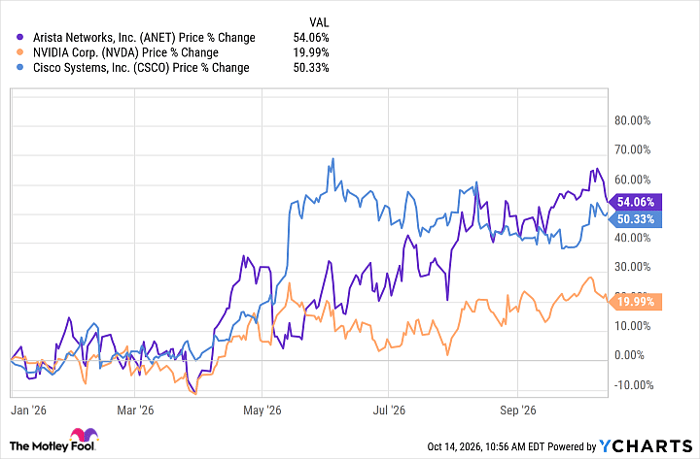
While Nvidia and Cisco may get more attention, Arista stock has outperformed both so far this year, rising 54% versus a 50% jump for Cisco and a 20% gain for Nvidia.
Revenue in the second quarter was $3.03 billion, up 37.7% from a year ago and 12.1% sequentially. Net income was $1.21 billion, up from $888 million a year ago, and diluted earnings per share was $0.95 versus $0.70 in Q2 2025.
ANET data by YCharts
"Customers see networking as the central nervous system for infrastructure from the client to campus to data and AI centers," CEO Jayshree Ullal said.
The company is planning to report its third-quarter earnings on Nov. 3, and has issued guidance for revenue of $3.3 billion and diluted net income between $1.06 and $1.08 per share.
Arista Networks is an AI stock worth owning
Nvidia remains a major force in AI computing, and Cisco is a formidable networking competitor. Arista also faces competition from proprietary networking technologies and the risk that major cloud customers will develop their own equipment.
But Arista has a compelling role in the AI build-out. Its equipment addresses a problem that becomes more demanding as companies deploy additional processors -- moving enormous amounts of data quickly, reliably, and without wasting electricity.
Investors don't have to own the company that makes the GPUs to benefit from the expansion of AI infrastructure spending. Arista offers a viable way to participate through the networking equipment that helps put all that computing power to work.
Should you buy stock in Arista Networks right now?
Before you buy stock in Arista Networks, consider this:
The Motley Fool Stock Advisor analyst team just identified what they believe are the 10 best stocks for investors to buy now… and Arista Networks wasn’t one of them. The 10 stocks that made the cut could produce monster returns in the coming years.
Consider when Netflix made this list on December 17, 2004... if you invested $1,000 at the time of our recommendation, you’d have $380,579!* Or when Nvidia made this list on April 15, 2005... if you invested $1,000 at the time of our recommendation, you’d have $1,359,789!*
Now, it’s worth noting Stock Advisor’s total average return is 931% — a market-crushing outperformance compared to 212% for the S&P 500. Don't miss the latest top 10 list, available with Stock Advisor, and join an investing community built by individual investors for individual investors.
See the 10 stocks »
*Stock Advisor returns as of October 15, 2026.
Patrick Sanders has positions in Nvidia. The Motley Fool has positions in and recommends Advanced Micro Devices, Arista Networks, Broadcom, Cisco Systems, Meta Platforms, Microsoft, Nvidia, and Qualcomm. The Motley Fool has a disclosure policy.
Recommended Articles


