


Tesla's Elon Musk Might Have Gone Back on His Word, but It's Working in China
Key Points
China's automotive market is spiraling this year, and its brutal price war doesn't seem to be easing.
Tesla's wholesales in China have reversed due to a surge in exports.
Beijing threw a curve ball announcing it would reduce the rebate for EV exports next year.
- These 10 stocks could mint the next wave of millionaires ›
Rewind to 2019 when Tesla (NASDAQ: TSLA) broke ground on its Giga Shanghai. Musk made it pretty clear at the time the factory was to produce more affordable versions of the Model 3 and Y for China. Sometime later, Tesla's CEO added, "Affordable cars must be made on same continent as customers." Things haven't quite gone according to plan thanks to China's domestic automakers rapidly developing their electric vehicle (EV) technology and a brutal price war that has forced all automakers to go back to the drawing board. Despite the change of plans, Tesla's exports from China are surging, and it's absolutely the right move. But there are a couple of things for investors to know.
The right call, right?
Fast-forward to today. Tesla sold 381,088 vehicles in China through the first three quarters of 2026, a nearly 12% decline from the prior year, according to data from the CPCA. In a flip-flop of growth, however, Tesla's exports from Giga Shanghai have more than doubled to 361,972 vehicles, nearly matching its domestic sales in the country. Through September, Tesla's exports as a share of wholesale jumped 2,000 basis points, or 20 percentage points, to 49%. Thanks to growth in Tesla's exports, even amid the brutal domestic Chinese automotive market, Tesla China's total wholesale volume jumped nearly 23% to 743,060 compared to the prior year.
Missed Nvidia in 2009? This Rare Signal Is Flashing Again. In 2009, a "Double Down" signal flashed for a little-known chipmaker called Nvidia. For the first time in years, that same "Total Conviction" signal is flashing for a company 1/100th the size of Nvidia. Continue »
To be fair, while the explosive exports growth is just what the doctor ordered for Tesla in China, it's also the lowest domestic retail sales through the first nine months the EV maker has posted over the past four years. This also isn't just a Tesla problem, and the pain has been felt across the board with more and more Chinese brands racing to leave the market and expand overseas, especially as hybrids can avoid some of the tariffs Europe set for Chinese EVs.
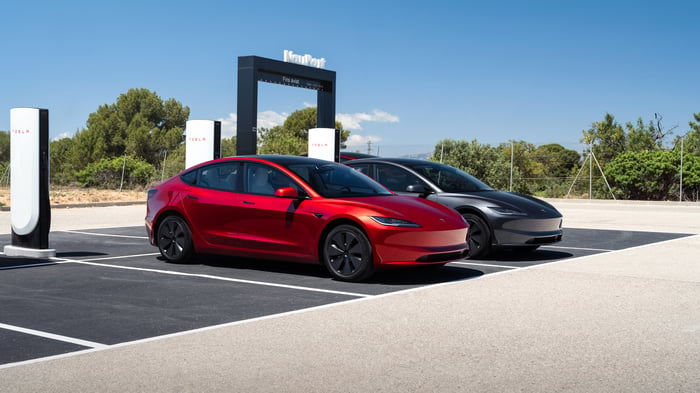
Image source: Tesla.
Making things a little awkward for everyone involved is that Beijing recently announced it will cut the tax rebate on EV exports next year. China's Ministry of Finance and State Taxation Administration announced the export rebate on new energy vehicles (NEVs), which include full EVs as well as plug-in hybrids, will drop from 13% to 9% on April 1, 2027, essentially making every Tesla export 4% less valuable to the company. A rebate cut of 4% might not sound alarming, but it will either equate to Tesla eating hundreds of millions of dollars or passing on price increases to its destination market.
What it all means
It might depend on whether you're a glass half-full investor or a glass half-empty investor. On one hand, Tesla has absolutely salvaged its Giga Shanghai production capacity and wholesale numbers. On the other hand, its actual business in China's market is still hurting. It's an important distinction for investors because while China's domestic auto market is in decline this year, it's also fair to say that Tesla is struggling to keep up with the accelerated vehicle launches by China's automakers, which have roughly halved the development time for a new vehicle.
For investors, this is what you can likely expect going forward. Because the rebate cut rate depends on the customs declaration date, it would make sense for Tesla to ship as many vehicles as possible from Giga Shanghai during the fourth quarter and the first quarter of 2027. That should mean two more solid quarters of wholesale Tesla China numbers before the realization hits that the year-over-year comparisons will likely look ugly for a while, and Tesla will find itself in a tough spot between raising prices overseas where Chinese brands are already undercutting on price, reduce production capacity in China, which hurts profitability, or continue with the status quo and just eat the margin loss from the rebate cut.
Missed AI’s "Act 1"? Act 2 Could Be 14x Bigger
Most investors think they missed the AI boat because they didn't buy Nvidia in 2005.
But according to our analysts, we’re only at the end of "Act 1"—the R&D phase. "Act 2" is the global rollout, a massive technology build-out that Google’s CEO says could be more profound than fire or electricity.
While everyone watches the chip designers, one "backbone" company provides the critical technology that Nvidia and AMD literally cannot function without. We’ve detailed this under-the-radar player in our new AI Playbook.
Continue »
Daniel Miller has no position in any of the stocks mentioned. The Motley Fool has positions in and recommends Tesla. The Motley Fool has a disclosure policy.
Recommended Articles


