


JPMorgan Stock Forecast: Wall Street Boom Sets Up Another Strong Earnings Test
JPMorgan Chase (NYSE: JPM) is off to a good start in October, with activity in investment banking and trading accelerating, consumer credit still looking good, and the bank set to report third quarter results on October 13. JPM closed October 5 at $332.38 with a market capitalization of approximately $883.5 billion.
What I find interesting is the breadth of the earnings engine. Capital markets activity has rebounded sharply, loan balances are still growing, net interest income is still elevated, and the bank is still returning more capital to shareholders. The key question for Q3 is, can JPMorgan keep these unusually strong returns and not have expenses and credit costs begin to increase more than revenue?
Investment Banking and Trading Look Strong Heading Into Q3
The key question for Q3 is, can JPMorgan keep these unusually strong returns and not have expenses and credit costs begin to increase more than revenue?
The most important fresh update came from co-President Doug Petno on September 15. Petno mentioned that JPMorgan expected investment-banking fees and Markets revenue to rise in the mid- to high-teens percentages year over year in Q3. Petno also mentioned that the M&A pipeline is extremely strong and that board members and management teams are becoming more confident.
Petno's update was important because it signaled that cap markets (which consist of investment banking and sales and trading businesses) were already a significant earnings driver in Q2. Investment-banking fees rose 30% year over year, and total Markets revenue rose 35% year over year. Equity Markets revenue rose 86% year over year, and Fixed Income Markets revenue rose 6% year over year.
I think the biggest signal would be the cap markets revenues continuing to rise in the mid to high teens, especially after the strong results they posted in Q2. The mid to high teens outlook would signal that the recovery in M&A, underwriting and trading is becoming more long-lasting as opposed to being a one-quarter spike.
Q2 Produced a Record $21.2 Billion Profit
JPMorgan reported a record net income of $21.2 billion for the quarter ending June 2026, representing a 41% increase from the prior year’s quarter. Diluted EPS was $7.70 for the quarter. The record net income was bolstered by a number of significant items including a $4.6 billion net gain related to JPMorgan’s sale of Visa shares, and additional $1.0 billion of gains related to equity investments.
Excluding the aforementioned significant items, net income was $16.9 billion, or $6.14 per share. Overall, firm wide managed revenues increased by 27% to $58.0 billion. Excluding the significant items, firm wide managed revenues increased by 15%.
JPMorgan also reported a 24% return on equity (ROE) and 29% return on tangible common equity (ROTCE). Excluding the significant items, ROTCE was 23%. These returns help explain the continued premium valuation of JPMorgan stock relative to many of the other U.S. banks.
Net Interest Income Remains a Major Earnings Support
Net interest income, excluding Markets, was $23.7 billion for Q2, an increase of 4% from the prior year. Management revised the full year 2026 NII outlook, excluding Markets, to approximately $96.5 billion, with total firmwide NII including Markets expected to be roughly $105.5 billion.
Beyond a doubt, the pace of interest rate change is the most important driver of NII, but it’s not straightforward. To the extent that asset yields rise, NII is also supported. Conversely, there is always the possibility that greater competition for deposits pushes funding costs higher. Therefore, the headline NII figure may increase, but that doesn’t mean it is supported. It is therefore important to analyze deposit betas and deposit pricing.
For Q3, the goal should be to see if deposit costs remain under control enough to allow JPMorgan to preserve the spread benefit due to the current rate environment. If funding costs rise, it would be better supported by an improvement in deposit economics.
Consumer Credit Remains Manageable
Consumer credit has not worsened to the extent that some investors had feared earlier in the credit cycle, and JPMorgan’s credit metrics reflect that. The bank reported credit costs of $2.5 billion for the quarter with approximately $2.4 billion of net charge-offs and a net reserve build of $149 million.
Management had previously estimated their card net charge-off rate to be around 3.4%, and recently reduced that estimate to be around 3.2%. Management’s reduction in the charge-off rate estimate indicates ongoing strength in consumer credit.
Although the credit metrics look largely normalized, and stress is not imminent, I would still watch loan loss metrics for lower-income consumer and card borrowers. While there is little indication that the card and loan loss metrics are stressful at this point in time, ongoing increases in interest rates and persisting inflation may erode household credit quality in the card and loan business, and impact revenue. JPMorgan’s current loan loss metrics seem largely normalized.
Capital Returns Are Getting Bigger
JPMorgan announced an increase in their dividend to $1.65 per share, up from their previous dividend of $1.50 per share. The new dividend is payable to shareholders on October 31, to shareholders of record as of the close of business on October 6.
JPMorgan also recently announced the authorization of a new $50 billion common share repurchase program. The Stress Capital Buffer remained at 2.5% through September 2027, signifying that management had considerable flexibility to return capital to shareholders.
In Q2, JPMorgan’s earnings per share was $7.70, or $6.14 excluding significant items. The strong capital position and normalization of credit losses provides management with additional avenues to create value for shareholders. The bank’s loan loss reserves seemed largely normalized.
Expenses Are the Main Operating Risk
Wall Street's strongest revenue environment also has higher costs. In Q2, JPMorgan's non-interest expenses increased to $27.3 billion, a 15% increase from the previous year, as a result of higher compensation, brokerage and distribution fees, marketing costs, technology costs, and occupation costs.
JPMorgan raised its full-year 2026 expense outlook to $107.5 billion from $105 billion after Q2. Increases in volumes and revenue-related compensation are the primary drivers of this increase, but the distinction becomes less important if expenses begin to exceed revenues.
In my view, the most important metric for Q3 is operating leverage. Strong results from Investment Banking and Trading are less valuable if most of the upside gets consumed by increasing compensation and technology expenses.
Succession Planning Remains in the Background
In June, as part of the board’s succession planning, Doug Petno and Troy Rohrbaugh were named Co-Presidents. Petno became the sole CEO of the Commercial & Investment Bank, and Rohrbaugh, the CEO of the Consumer & Community Banking.
In July, Jamie Dimon said the timeline for his departure was unchanged, and added that the board makes the final decision on the succession process. Petno later said Dimon was fully engaged in running the company.
Cristerna’s departure at the end of 2026 is also worth noting. Overall, these changes are not near-term risk to earnings, however, Dimon has led the strategy and culture of JPMorgan for the last two decades.
October 13 Earnings Are the Next Major Catalyst
JPMorgan has set October 13th as the day to release their Q3 earnings report. The conference call will take place at 8:30 a.m. ET. They will release their report before the market opens.
For this earnings report, I will pay the most attention to their investment-banking fees, the markets division, net interest income and deposits, charge-off's, loan growth, and their full-year expense outlook. I will also pay attention to management's decisions with regard to their capital-return policy.
At $332.38, JPMorgan is not a cheap bank in absolute terms, but their market cap of $883.5 billion is under $1 trillion. Continuing to assume JPMorgan's scale and positions in trading, investment banking, and consumer/asset management generate superior returns gives justification to their valuation.
JPMorgan Technical Analysis: JPM Tests Rising Trendline as $329.30 Support Comes Into Focus
JPMorgan closed October 5 at $332.38 after a sharp correction from its August peak at $366.43. Currently, I am focused on the fact that price has slipped below both moving averages and the 38.2% Fib level at $338.06, but is now testing a broader rising trendline near $329.30. Given this, the current area should be viewed as a key support area.
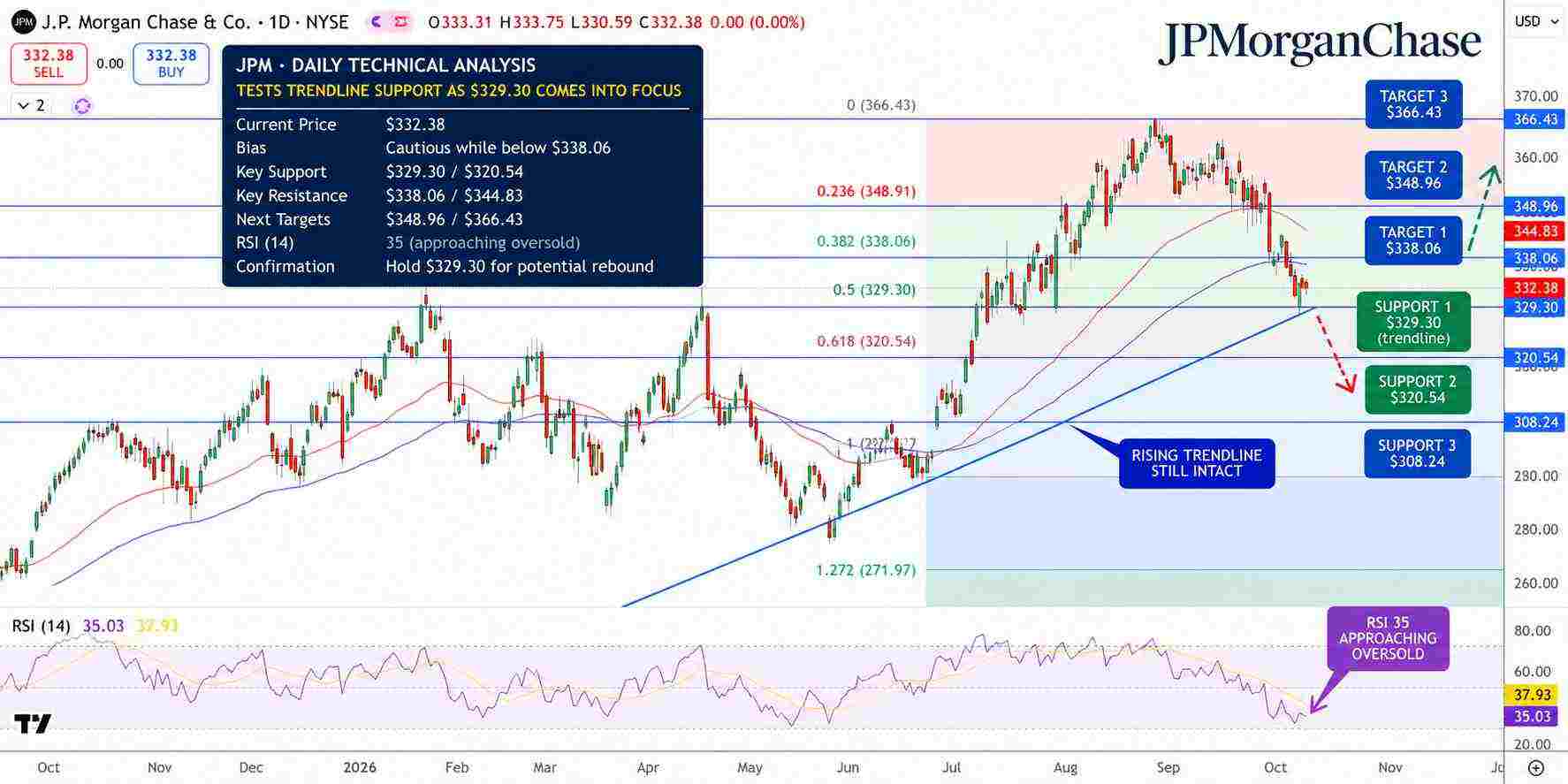
JPMorgan Stock Price Chart - Source: Tradingview
RSI is at around 35, below its signal line at 38, and approaching oversold territory. Given this, traders should be aware of sellers near the trendline, but given the situation, a rebound is also a possibility.
The immediate support is at $329.30. A daily close below the rising trendline would support the bear case and open the 61.8% Fib at $320.54. The next major support level is at $308.24.
For the bullish case to be confirmed, the 50-period moving average at $344.83 would need to be taken out. Beyond this, a stronger reversal above $348.96 would materially improve the outlook and reopen the path to the prior highs.
However, given the current position, $329.30 could provide support and a retest of the previous trend highs is a possibility.
Key Levels
• Latest completed close: $332.38
• Major support levels: $329.30, $320.54, $308.24
• Major resistance levels: $338.06 to $338.19, $344.83, $348.96
• RSI: approximately 35, weak, and near oversold
• Recovery trigger: break above $338.19
• Breakdown trigger: break below $329.30
Why is JPMorgan stock in focus now?
JPMorgan is in focus because the management team expects Q3 investment-banking fees and Markets revenue to post mid- to high-teen percentage gains from a year earlier. After a strong Q2, JPMorgan enters October 13 with elevated NII and manageable credit costs and increased capital returns.
What level confirms a stronger JPM recovery?
A daily close above $338.19 would confirm a short-term buying signal with a next target at $344.83 and $348.96. A daily close below $329.30 would negate the rising trendline and put focus on the $320.54 level.
Bottom Line
JPMorgan has several positive factors heading into Q3: the investment banking division is strong, trading has recovered, net interest income and loan growth have improved, and credit losses have remained moderate. The company also increased its share buyback program and raised its dividend. The primary risk is increasing expenses.
JPMorgan is in an uptrend, and is testing an important trendline at around $329.30. After a sharp decline from the all-time-high, there is potential for another leg up. The October 13 report will show whether the growth in securities trading and other financial services will result in more enduring earnings growth. J.P. Morgan’s valuation is justified with resilient credit quality and earnings growth potential.
Recommended Articles


