


The Pound slides back to the bottom of its range as the bond selloff resumes
- GBP/USD slips back to 1.3200, the floor of a ten-session range, as bond yields climb.
- Fed minutes show all 19 officials backed the September hike.
- Chancellor Healey's first Budget lands October 28, the day the Fed decides.
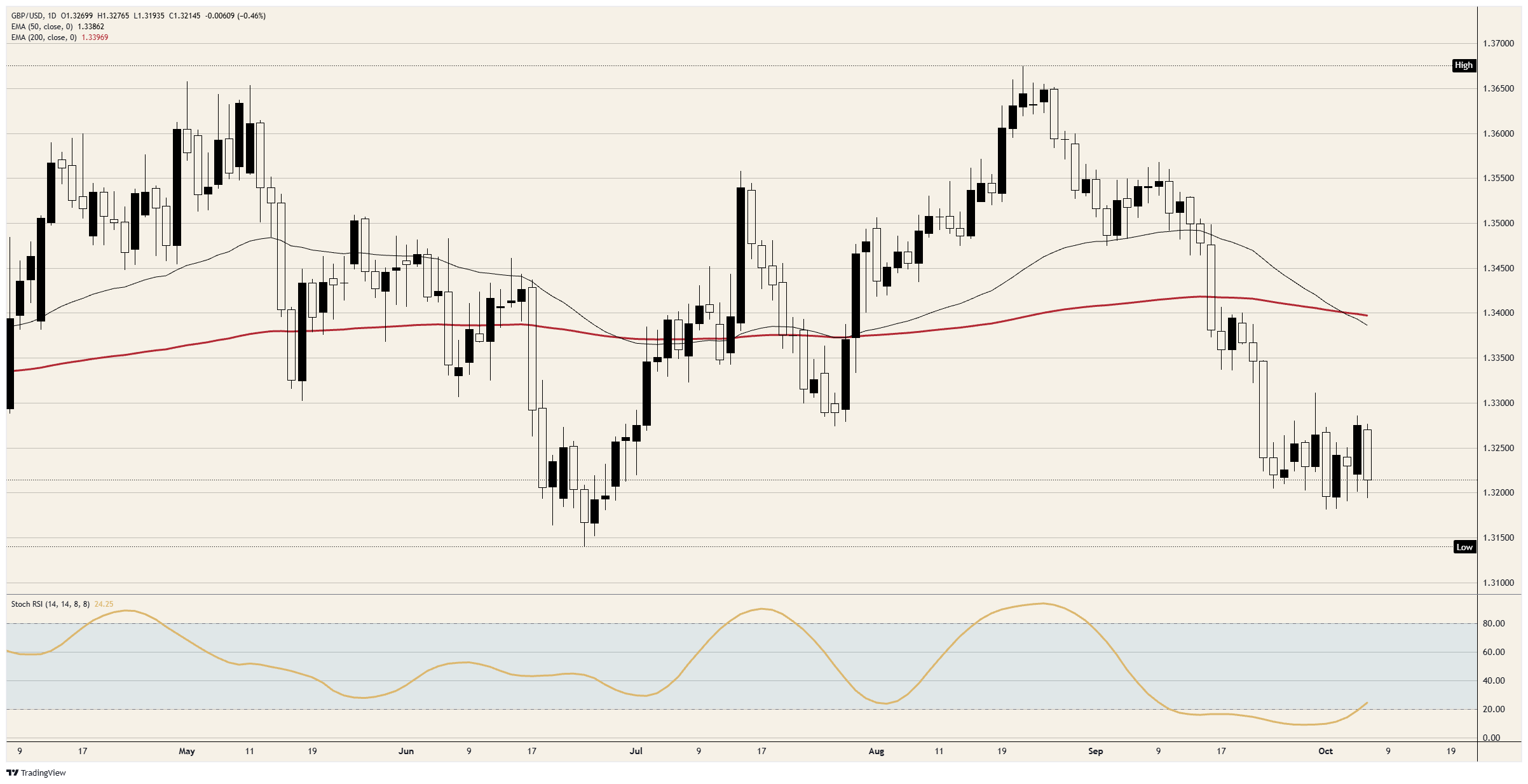
The low of every session since September 24 has come within half a cent of 1.3200, and Wednesday made it ten in a row. GBP/USD trades just above 1.3200, below the level Tuesday's rally started from.
The Dollar gained as bond yields rose again. Wednesday's 10-year Treasury auction cleared at 5.30%, the highest yield at a 10-year sale since November 2000, and higher US yields raise the return on holding Dollars.
The UK's 30-year gilt yield went back above 6%, a level it first reached on October 1 for the first time since 1998. The Pound is still at its strongest against the Euro since June 2025, so the gilt selloff is so far raising Britain's borrowing bill faster than it's lowering the Pound.
Another Fed hike by year end leaves two meetings to choose from
The minutes of the September 15-16 meeting, released on Wednesday at 18:00 GMT, showed all 19 participants backing the hike to 3.75%-4.00%. Most judged another increase likely to be appropriate by year end, and several said the current rate holds the economy back only mildly or not at all. President Trump said shortly before the release that Fed Chair Warsh is only one vote, and the minutes showed the other 18 participants backing his hike.
GBP/USD barely moved on the release. Year end leaves the Fed's October 28 and December 9 meetings, and futures put an October hike near 17% both before and after the minutes. An October move would lift US rates further above the UK's Bank Rate of 3.75% a week before the Bank of England (BoE) decides on November 5.
Budget day and Fed day are the same Wednesday
BoE external member Greene speaks on Thursday at 09:15 GMT and Deputy Governor Lombardelli at 13:00 GMT. Traders price a November hike near 80%, and a lean toward one from Lombardelli, who voted to hold on September 17, would remove most of the doubt left in that price. A week after that vote she said policy is increasingly likely to need to tighten if high energy prices persist. Brent was above $100 the day she said it and was back above $100 on Wednesday.
Fed Governor Waller speaks on Thursday at 08:30 GMT and St. Louis Fed President Musalem at 17:40 GMT, and a lean toward October from either would lift the Dollar against the Pound. Chancellor Healey's first Budget follows on October 28, the day the Fed decides and a week before the BoE, with a gap estimated at £22 billion or more to close. A Budget that sends gilt yields higher would land with the Dollar already moving on the Fed.
Levels at the edges of the Pound's range
Resistance: Wednesday's drop took GBP/USD back under 1.3250, the level Tuesday's rally broke through. 1.3300 has capped every session since September 24 except for a brief spike above it on September 30.
Support: 1.3200 has held as the floor for ten sessions, and October 1 was the only one to close a few pips under it. GBP/USD hasn't traded as low as 1.3150 since late June.
Bias: The lean is long while the floor near 1.3200 holds, with 1.3250 the first objective and 1.3300 the second. The daily Stochastic Relative Strength Index (Stoch RSI) has risen five sessions running and is back above 20, near 25, for the first time since September 10. A daily close under 1.3150 kills the long.
GBP/USD daily chart
Pound Sterling FAQs
The Pound Sterling (GBP) is the oldest currency in the world (886 AD) and the official currency of the United Kingdom. It is the fourth most traded unit for foreign exchange (FX) in the world, accounting for 12% of all transactions, averaging $630 billion a day, according to 2022 data. Its key trading pairs are GBP/USD, also known as ‘Cable’, which accounts for 11% of FX, GBP/JPY, or the ‘Dragon’ as it is known by traders (3%), and EUR/GBP (2%). The Pound Sterling is issued by the Bank of England (BoE).
The single most important factor influencing the value of the Pound Sterling is monetary policy decided by the Bank of England. The BoE bases its decisions on whether it has achieved its primary goal of “price stability” – a steady inflation rate of around 2%. Its primary tool for achieving this is the adjustment of interest rates. When inflation is too high, the BoE will try to rein it in by raising interest rates, making it more expensive for people and businesses to access credit. This is generally positive for GBP, as higher interest rates make the UK a more attractive place for global investors to park their money. When inflation falls too low it is a sign economic growth is slowing. In this scenario, the BoE will consider lowering interest rates to cheapen credit so businesses will borrow more to invest in growth-generating projects.
Data releases gauge the health of the economy and can impact the value of the Pound Sterling. Indicators such as GDP, Manufacturing and Services PMIs, and employment can all influence the direction of the GBP. A strong economy is good for Sterling. Not only does it attract more foreign investment but it may encourage the BoE to put up interest rates, which will directly strengthen GBP. Otherwise, if economic data is weak, the Pound Sterling is likely to fall.
Another significant data release for the Pound Sterling is the Trade Balance. This indicator measures the difference between what a country earns from its exports and what it spends on imports over a given period. If a country produces highly sought-after exports, its currency will benefit purely from the extra demand created from foreign buyers seeking to purchase these goods. Therefore, a positive net Trade Balance strengthens a currency and vice versa for a negative balance.
Recommended Articles


