


This Under-the-Radar Growth Stock Is Down 55%, but Wall Street Is Still Bullish. Here's Why.
Key Points
Workiva develops software that helps large organizations aggregate data for the purpose of managing their regulatory compliance obligations.
The company is integrating artificial intelligence into its products to make them more powerful than ever.
Workiva stock is attractively valued, and the majority of the analysts tracked by 'The Wall Street Journal' have assigned it a buy rating.
- 10 stocks we like better than Workiva ›
Workiva (NYSE: WK) developed a portfolio of software products to help organizations manage their reporting and regulatory compliance obligations. That isn't exactly a glamorous mission, which is why its stock tends to fly under the radar compared to many others in the software space.
However, Workiva recently started leveraging artificial intelligence (AI) to make its products more powerful than ever, which is helping to attract high-spending enterprises at a rapid pace. In fact, its fastest growing customer cohorts are now the ones spending the most money.
Missed Nvidia in 2009? This Rare Signal Is Flashing Again. In 2009, a "Double Down" signal flashed for a little-known chipmaker called Nvidia. For the first time in years, that same "Total Conviction" signal is flashing for a company 1/100th the size of Nvidia. Continue »
Despite Workiva's progress, its stock is trading 55% below its all-time high, which was set during 2021 when the last tech boom drove its valuation to an unsustainable height. But that might be an opportunity for investors, because the majority of the analysts tracked by The Wall Street Journal have assigned the stock a buy rating, and none recommend selling. Read on.

Image source: Getty Images.
AI is transforming Workiva's product suite
Managers inside large organizations are under growing pressure to accurately compile data from across dozens, or even hundreds of the digital applications that are necessary to run their day-to-day operations. This can be a time consuming and error-prone process when critical data is manually transferred to a central location for the purposes of crafting regulatory filings or executive reports.
Workiva's software streamlines that process by plugging into every major third-party system of record, productivity application, and storage platform, and autonomously aggregating all of their data onto one dashboard which effectively becomes the organization's single source of truth. Managers can then use Workiva's ready-made templates to rapidly compile filings and reports, saving them untold amounts of time while significantly reducing errors.
Workiva is now weaving AI into its platform in a few different ways to enhance its capabilities. The company designed an AI agent to assist with the tie-out process, which is when managers verify the accuracy of the numbers in their reports. The agent automates that process by autonomously flagging discrepancies and providing an AI-generated explanation for every instance. AI can read and compare data much faster than humans, so this is an extremely powerful tool.
Then there is the benchmarking agent. It will scan the publicly available regulatory filings of competing companies to identify key differences in how certain disclosures are handled. This allows managers to quickly determine if any critical information is missing from their own filings, or whether they can cover certain topics (like risk factors or financial disclosures) in a better way.
Steady revenue growth and improving profitability
Workiva generated $502.6 million in total revenue during the first half of 2026 (to June 30), which was a 19% increase from the year-ago period. I believe the company could have delivered even faster growth, but management was more focused on improving the bottom line by keeping costs like marketing and research and development in check.
Workiva's total operating expenses increased by less than 2% in the first half of the year. Since revenue grew at a much faster pace, more money flowed to the bottom line as profit, resulting in a generally accepted accounting principles (GAAP) net income of $32.4 million for the period. That was a big positive swing from the $40.7 million net loss the company produced in the first half of last year.
After excluding one-off and non-cash expenses like stock-based compensation, Workiva also generated an adjusted (non-GAAP) net income of $99.6 million, a whopping 416% increase from the year-ago period.
But Workiva continues to attract hordes of high-spending enterprises, despite moderating its marketing and other costs. The company had 6,750 total customers as of June 30, an increase of just 4% from the year-ago period. But the number of customers with annual contract values of at least $100,000 grew at a much faster pace of 20%, while those with annual contract values of at least $500,000 soared by 33%.
I think Wall Street's bullishness is justified
The Wall Street Journal tracks 13 analysts who cover Workiva stock, and nine have assigned it a buy rating. Three others are in the overweight (bullish) camp, while one recommends holding. None recommend selling.
The analysts have an average price target of $89.80, pointing to a potential upside of 26% in Workiva stock over the next 12 months (based on its closing price of $71 last Friday, Oct. 2). But the Street-high target of $105 implies an even greater potential return of 48%.
Based on Workiva's valuation, I think both targets are achievable. Its stock is trading at a price-to-sales (P/S) ratio of just 4.2, a steep discount to its five-year average of 7.6. It's also much cheaper than the technology-heavy Nasdaq-100 index which has a P/S ratio of 6.5.
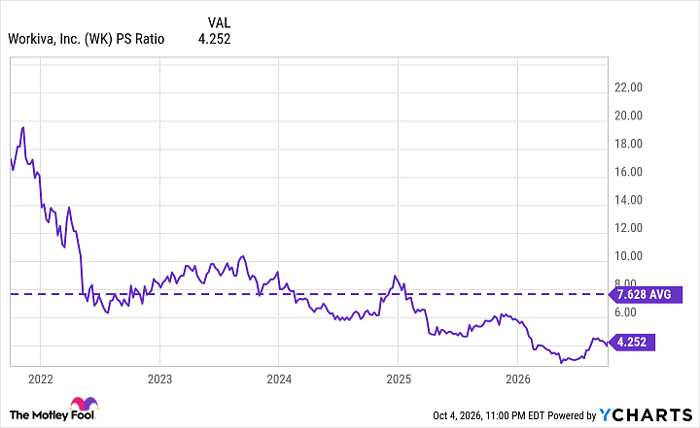
WK PS Ratio data by YCharts
Workiva stock would have to climb by a whopping 81% just to match its five-year average P/S ratio, and that doesn't account for any future revenue growth, so even more upside might be possible. In fact, the company believes it can deliver $2 billion in annualized revenue by 2030, almost double its current level.
As a result, I think this under-the-radar stock could be a great addition to any diversified portfolio.
Should you buy stock in Workiva right now?
Before you buy stock in Workiva, consider this:
The Motley Fool Stock Advisor analyst team just identified what they believe are the 10 best stocks for investors to buy now… and Workiva wasn’t one of them. The 10 stocks that made the cut could produce monster returns in the coming years.
Consider when Netflix made this list on December 17, 2004... if you invested $1,000 at the time of our recommendation, you’d have $370,440!* Or when Nvidia made this list on April 15, 2005... if you invested $1,000 at the time of our recommendation, you’d have $1,470,022!*
Now, it’s worth noting Stock Advisor’s total average return is 955% — a market-crushing outperformance compared to 215% for the S&P 500. Don't miss the latest top 10 list, available with Stock Advisor, and join an investing community built by individual investors for individual investors.
See the 10 stocks »
*Stock Advisor returns as of October 7, 2026.
Anthony Di Pizio has no position in any of the stocks mentioned. The Motley Fool has positions in and recommends Workiva. The Motley Fool has a disclosure policy.
Recommended Articles


