


Meet the Dividend King That's Down 50% and Yields More Than It Has in Years
Key Points
Hormel Foods' stock lost more than half its value over the past five years.
The dividend yield of nearly 5.7% appears to be an all-time high.
Hormel is a Dividend King that some analysts believe is undervalued.
- 10 stocks we like better than Hormel Foods ›
While it tends to be a rewarding long-term strategy, dividend investing requires some trade-offs. Most notably, investors looking for steady, growing equity income will likely wind up embracing stocks with slower growth profiles than, say, a hot artificial intelligence (AI) stock.
That's certainly true of the largest consumer staples companies by market cap, a group that's home to some of the most dependable dividend payers on the market, but one that, broadly speaking, lacks exhilarating returns. Another rub with some dividend stocks is that, despite perceived safety, they deliver negative returns.
Missed AI’s "Act 1"? Act 2 Could Be 15x Bigger. Most investors think they missed the AI boat because they didn't buy Nvidia in 2005. But according to our analysts, we’re only at the end of "Act 1"—the R&D phase. "Act 2" is the global rollout. Continue »
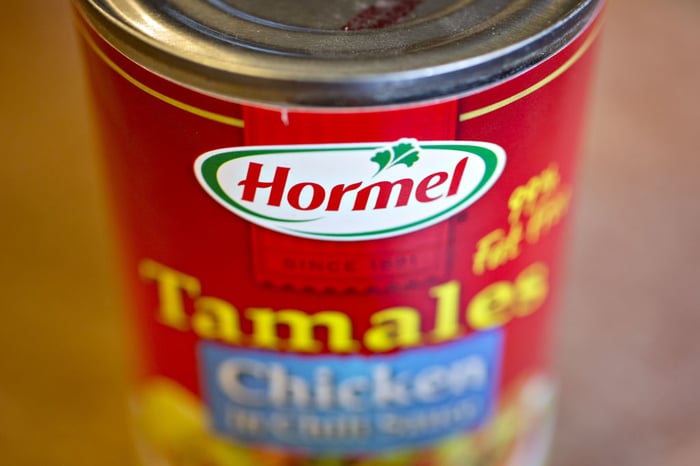
Hormel's dividend is high, but the stock may be a rebound candidate. Image source: Getty Images.
Of late, that's been the case with Hormel Foods (NYSE: HRL). Down 50.5% over the past five years, the Spam maker is delivering spam to investors' portfolios, pushing its dividend yield to nearly 5.7%, as of Oct. 2. That's a multiyear high, maybe a record. Still, this stock may also be a credible rebound candidate.
The good, the bad, and the ugly of Hormel stock
Obviously, the "ugly" is that shares of the SKIPPY peanut butter maker have lost more than half their value over the past five years, including a 14.6% decline this year.
As with some other old-guard food stocks, Hormel has been punished by consumers who are prioritizing healthier options. To be fair, Hormel's product portfolio isn't bereft of healthy fare, but there are perceptions, some with merit, that canned beef stew and chili don't exactly qualify as healthy eating.
On a more positive note, shifting consumer tastes aren't altering Hormel's dividend dynamics. With a payout increase streak spanning 61 years, the Jennie-O maker is a Dividend King, or one of the companies that have raised dividends for at least 50 straight years. Relevant to investors considering this stock a long-term play that can find its groove back are points such as some market observers viewing Hormel as a value play and as a company committed to maintaining its status as a dividend royalty.
Investors considering sinking their teeth into Hormel have other positives to consider. For example, over 40 of the company's products rank first or second in their respective categories. Second, protein consumption is still highly fashionable. In fact, some professional investors note that consumers who use weight-loss drugs consume three times as much protein as their peers who aren't taking those pharmaceuticals, suggesting that Hormel may be an underappreciated play on the GLP-1 boom.
On the protein-related front, Hormel recently paid almost $1.1 billion for Brakebush Brothers, a chicken company. Some analysts believe Hormel is getting a good deal, particularly because chicken is the fastest-growing protein segment.
The interest rate quagmire
High interest rates are a headwind for the Hormel thesis, not because the company carries unmanageable debt. It doesn't. Rather, the issue is that as of Oct. 2, 10-year Treasury yields were flirting with 5.3%. Some investors see a number like that and may say to themselves, "Why would I bother with the Hormels of the world when I can get a 5%-plus yield on lower-risk U.S. government debt?"
There's merit in that perspective, but it also requires a trade-off. That is taking on too much safety while missing out on a potential Hormel rebound, which could be ushered in by the company's moves to shed underperforming businesses and renew its emphasis on its top-performing brands.
Should you buy stock in Hormel Foods right now?
Before you buy stock in Hormel Foods, consider this:
The Motley Fool Stock Advisor analyst team just identified what they believe are the 10 best stocks for investors to buy now… and Hormel Foods wasn’t one of them. The 10 stocks that made the cut could produce monster returns in the coming years.
Consider when Netflix made this list on December 17, 2004... if you invested $1,000 at the time of our recommendation, you’d have $364,023!* Or when Nvidia made this list on April 15, 2005... if you invested $1,000 at the time of our recommendation, you’d have $1,467,933!*
Now, it’s worth noting Stock Advisor’s total average return is 948% — a market-crushing outperformance compared to 214% for the S&P 500. Don't miss the latest top 10 list, available with Stock Advisor, and join an investing community built by individual investors for individual investors.
See the 10 stocks »
*Stock Advisor returns as of October 7, 2026.
Todd Shriber has no position in any of the stocks mentioned. The Motley Fool has no position in any of the stocks mentioned. The Motley Fool has a disclosure policy.
Recommended Articles


