


Warren Buffett Has Only Recommended 1 Investment in Over 60 Years, and It's Never Lost Money (but There's a Catch)
Key Points
Berkshire Hathaway’s pillar, Warren Buffett, retired as CEO on Dec. 31.
Despite decades of doling out investing wisdom, Buffett has only recommended one investment “for most people.”
The investment Buffett recommends has never lost money if held for 20 years.
- 10 stocks we like better than S&P 500 Index ›
This has been a year of significant change for the trillion-dollar company that Warren Buffett helped build. The Oracle of Omaha, who oversaw a greater-than-6,000,000% outperformance of the benchmark S&P 500 (SNPINDEX:^GSPC) while at Berkshire Hathaway (NYSE:BRKA)(NYSE:BRKB), retired as the company's CEO on Dec. 31. He also stepped down as chairman of the board in mid-September.
In his more than 60 years at Berkshire Hathaway, Buffett doled out no shortage of investing wisdom. Books have been compiled containing his quotes and unwritten investing rules.
Missed Nvidia in 2009? This Rare Signal Is Flashing Again. In 2009, a "Double Down" signal flashed for a little-known chipmaker called Nvidia. For the first time in years, that same "Total Conviction" signal is flashing for a company 1/100th the size of Nvidia. Continue »

Image source: Getty Images.
But over his more than six decades at Berkshire, the one thing he never did was offer individual stock suggestions. In fact, he rarely made recommendations... save for one. It just so happens this one recommendation has never lost money, but there's an important catch if you, too, hope to profit from it.
The Oracle of Omaha's only investment recommendation has crushed it over the long run
In the weeks following the COVID-19 crash (February-March 2020), Berkshire Hathaway held its first-ever virtual shareholder meeting. While the situation was unique, Warren Buffett was as candid and focused on the long-term as ever. This included offering the only investment recommendation he's made while at Berkshire. Said the Oracle of Omaha:
In my view, for most people, the best thing to do is own the S&P 500 index fund... You're dealing with something fundamentally advantageous, in my view, in owning stocks. I will bet on America the rest of my life.
Technically, S&P 500 index funds didn't begin trading on U.S. exchanges until the debut of the State Street SPDR S&P 500 ETF Trust (NYSEMKT:SPY) in January 1993. But when backtested for more than a century, buying and holding an S&P 500-tracking fund has been a foolproof strategy.
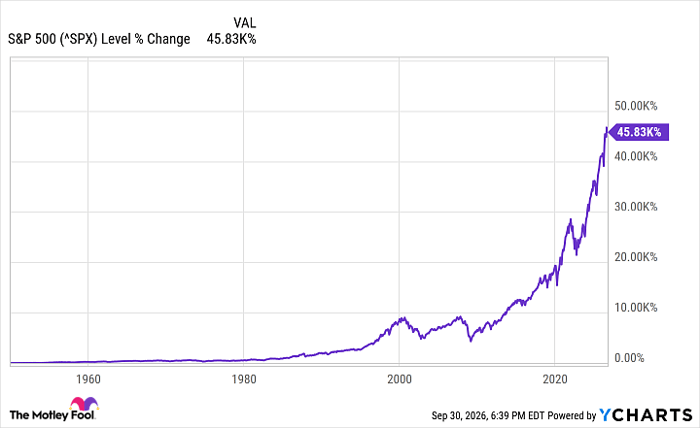
^SPX data by YCharts
Every year, analysts at Crestmont Research publish a data set that calculates the rolling 20-year total returns, including dividends, of the S&P 500 since 1900. Given that the S&P wasn't incepted until 1923, researchers had to track the performance of its components in other major indexes back to 1900.
Crestmont's data set shows that all 107 rolling 20-year periods it examined generated a positive average annual return. In other words, no matter how dire things appeared for the stock market, investors would have, hypothetically, made money if they held an S&P 500-tracking fund for 20 years.

Image source: Getty Images.
One low-cost S&P 500 index fund to rule them all
Although U.S. investors have several S&P 500 index funds to choose from, including the State Street SPDR S&P 500 ETF Trust, one stands head and shoulders above the rest: the Vanguard S&P 500 ETF (NYSEMKT:VOO).
Although the Vanguard S&P 500 ETF and the State Street SPDR S&P 500 ETF Trust have the same goal of attempting to mirror the performance of the S&P 500, there's one notable difference between the two: their net expense ratios.
The expense ratio is the fee an investor pays that goes toward management, marketing, and administrative costs. While the State Street SPDR S&P 500 ETF Trust has a reasonably low gross expense ratio of 0.0945%, the Vanguard S&P 500 ETF features an ultra-low expense ratio of 0.03%.
A six-basis-point difference might not sound like much, but when you're dealing with a large investment or a multidecade time frame, the Vanguard S&P 500 ETF is ideal for helping investors retain and grow their capital.
Should you buy stock in S&P 500 Index right now?
Before you buy stock in S&P 500 Index, consider this:
The Motley Fool Stock Advisor analyst team just identified what they believe are the 10 best stocks for investors to buy now… and S&P 500 Index wasn’t one of them. The 10 stocks that made the cut could produce monster returns in the coming years.
Consider when Netflix made this list on December 17, 2004... if you invested $1,000 at the time of our recommendation, you’d have $361,650!* Or when Nvidia made this list on April 15, 2005... if you invested $1,000 at the time of our recommendation, you’d have $1,437,517!*
Now, it’s worth noting Stock Advisor’s total average return is 936% — a market-crushing outperformance compared to 213% for the S&P 500. Don't miss the latest top 10 list, available with Stock Advisor, and join an investing community built by individual investors for individual investors.
See the 10 stocks »
*Stock Advisor returns as of October 5, 2026.
Sean Williams has no position in any of the stocks mentioned. The Motley Fool has positions in and recommends Berkshire Hathaway and Vanguard S&P 500 ETF. The Motley Fool has a disclosure policy.
Recommended Articles


