


Social Security's Trump Bump-Led 2027 COLA Will Be One of the Largest in 35 Years, but It May Financially Cripple America's Leading Retirement Program
Key Points
The final data point needed to calculate Social Security’s 2027 cost-of-living adjustment (COLA) will be revealed in just 10 days, on Oct. 14.
A pair of President Donald Trump’s policies should provide a sizable boost to Social Security benefits in 2027.
Unfortunately, there’s a steep price to pay for larger-than-normal Social Security raises.
- The $23,760 Social Security bonus most retirees completely overlook ›
Get your calendars out, because the big day for Social Security's more than 71 million traditional beneficiaries is right around the corner. On Oct. 14, the U.S. Bureau of Labor Statistics will release the September inflation report, providing the final data point needed to calculate Social Security's 2027 cost-of-living adjustment (COLA).
Social Security's COLA is effectively a raise given to beneficiaries to offset the effects of inflation (rising prices) over the last year. For example, if a basket of hundreds of goods and services (regularly purchased by retirees) increases in cost by 2%, Social Security benefits would need to rise by 2% as well to avoid a loss of purchasing power.
Missed Nvidia in 2009? This Rare Signal Is Flashing Again. In 2009, a "Double Down" signal flashed for a little-known chipmaker called Nvidia. For the first time in years, that same "Total Conviction" signal is flashing for a company 1/100th the size of Nvidia. Continue »
While most Social Security raises over the last 35 years have been relatively modest, that's not what's on the menu for 2027, courtesy of President Donald Trump. Unfortunately, larger monthly Social Security checks via a "Trump bump" come at a steep cost for a retirement program that's already struggling.

Image source: Official White House Photo by Shealah Craighead, courtesy of the National Archives.
Social Security's 2027 raise should be among the largest since 1993
Social Security beneficiaries receiving an annual benefit boost to match inflation is nothing new. Since the Consumer Price Index for Urban Wage Earners and Clerical Workers became the inflation-measuring yardstick for the program in 1975, prices have risen (i.e., a COLA has been passed along) in all but three years (2010, 2011, and 2016).
When the U.S. economy is growing, it's perfectly normal for businesses to have modest pricing power over their goods and services. Even the Federal Reserve's long-term inflation target is 2%, not 0%, because it understands the importance of businesses possessing some degree of pricing power.
The prevailing inflation rate is currently well above this long-term 2% target. While the artificial intelligence infrastructure build-out is, in part, to blame for persistently elevated inflation, rising consumer prices can be primarily attributed to two of President Trump's policies.
The first is Trump's tariff and trade policy, which is impacting consumer prices for a second consecutive year. Last year, the president's "Liberation Day" tariffs modestly boosted Social Security's 2026 COLA. When duties are added to unfinished imported goods, such as steel, it can increase production costs for U.S. manufacturers, who then pass these higher costs on to consumers.
Price changes over last year (August CPI report)
— Charlie Bilello (@charliebilello) September 11, 2026
Fuel Oil: +52.0%
Gasoline: +27.4%
Gas Utilities: +4.4%
Electricity: +3.8%
Apparel: +3.6%
Overall CPI: +3.4%
Food away from home: +3.4%
Shelter: +3.0%
Medical Care: +2.5%
Transportation: +2.4%
Food at home: +2.2%
New Cars: +0.6%…
In late July 2026, the Trump administration reimposed sweeping global tariffs, ranging from 10% to 12.5%, on more than 80 countries. The same dynamics that lifted consumer prices, and thus Social Security's COLA, last year should have a repeat effect in 2027.
The other driver of inflation is the Iran war. Iran closed the Strait of Hormuz after fighting began on Feb. 28, halting the maritime movement of a fifth of the world's crude oil supply. This action sent gas and diesel prices soaring, with trailing 12-month inflation reaching a three-year high of 4.2% in May.
Based on the effects of these two policies, The Senior Citizens League (TSCL), a nonpartisan senior advocacy group, and independent Social Security and Medicare policy analyst Mary Johnson, expect Social Security checks to rise by 3.5% in 2027.
Both estimates came out after the release of the August inflation report on Sept. 11. Since then, gas and diesel prices have soared, making an even higher cost-of-living adjustment likely.
If Social Security's Trump bump-led 2027 COLA matches TSCL's and Johnson's projections of 3.5%, it would tie for the sixth-largest raise over the last 35 years. But if surging fuel prices in September lift the final figure to, say, 3.7% next year, it would represent the fifth-largest raise since 1993.

Image source: Getty Images.
A historic Trump bump threatens to accelerate the timeline to sweeping benefit cuts
On the one hand, there's no denying that Social Security beneficiaries enjoy seeing their monthly checks grow from one year to the next. If benefits do increase by 3.5% next year, the average retired-worker beneficiary would see their monthly payout climb by about $73.
Unfortunately, there's a steep price to be paid for outsize Social Security raises.
Entering 2026, America's leading retirement program wasn't on the best financial footing. The annual Social Security Board of Trustees Report has been warning of a long-term unfunded obligation (i.e., a 75-year funding shortfall) since 1985. This projected cash shortfall has reached a staggering $29.3 trillion through the year 2100.
But there's a more immediate concern for retired workers and survivor beneficiaries. The latest Trustees Report estimates that the Old-Age and Survivors Insurance trust fund (OASI) will exhaust its asset reserves by the fourth quarter of 2032. The OASI's asset reserves represent the excess income built up since inception that's invested in special-issue, interest-bearing government bonds, as required by law.
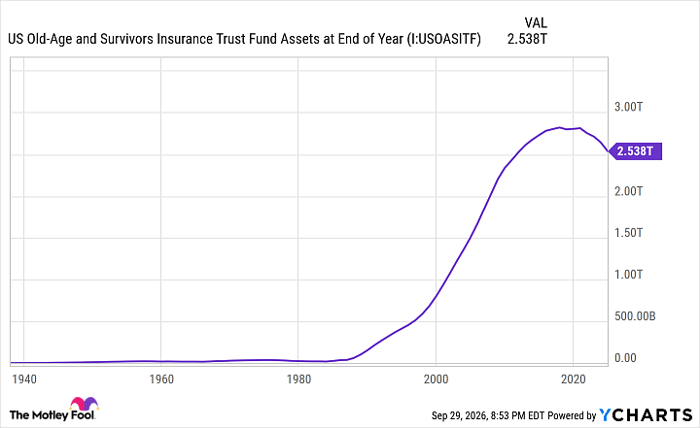
US Old-Age and Survivors Insurance Trust Fund Assets at End of Year data by YCharts
The good news is that Social Security isn't in any danger of halting benefits or going bankrupt. Over 91% of the program's income derives from the 12.4% payroll tax on earned income (wages and salaries, but not investment income). As long as Americans keep working and paying their taxes, there will be money to disburse to eligible beneficiaries.
However, if and when the OASI's asset reserves are depleted, sweeping benefit cuts of up to 22% may be necessary for retired workers and survivors of deceased workers. This projected event is only six years away.
The Trustees Report accounts for a laundry list of variables when making its short- and long-term financial projections. Chief among them are annual cost-of-living adjustments. The Trustees expect annual Social Security raises will be modest. The Trump bump-led 2027 COLA is on track to be considerably higher than what the Trustees Report models.
While recipients enjoy bigger Social Security checks, larger annual COLAs risk draining the OASI's asset reserves even faster than forecast. In short, a historic Trump bump may accelerate the need for sweeping benefit cuts.
The $23,760 Social Security bonus most retirees completely overlook
If you're like most Americans, you're a few years (or more) behind on your retirement savings. But a handful of little-known "Social Security secrets" could help ensure a boost in your retirement income.
One easy trick could pay you as much as $23,760 more... each year! Once you learn how to maximize your Social Security benefits, we think you could retire confidently with the peace of mind we're all after. Join Stock Advisor to learn more about these strategies.
View the "Social Security secrets" »
The Motley Fool has a disclosure policy.
Recommended Articles


