


Big Tech Will Spend $735 Billion on Data Centers. This Boring Electrical Contractor Collects the Checks.
Key Points
Big tech's massive data center spending is shifting infrastructure bottlenecks from chips to electricity, cooling, and skilled labor.
Quanta Services is well-positioned to benefit through its energy-infrastructure expertise and massive skilled workforce.
Robust demand is fueling strong earnings and backlog growth.
- 10 stocks we like better than Quanta Services ›
Hyperscalers are going all-in on artificial intelligence (AI). Amazon, Microsoft, Alphabet, and Meta Platforms are expected to spend a combined $735 billion on data centers this year, and this may be just the beginning. PwC estimates global investment in AI infrastructure could reach a staggering $31.6 trillion by 2050.
All that computing power needs electricity, cooling, and a company with the expertise to deliver it. As hyperscalers race to build AI infrastructure, the biggest constraints are shifting from chips to power access and skilled labor. That puts Quanta Services (NYSE: PWR) in an enviable position to collect the checks. Here's what investors need to know.
Missed Nvidia in 2009? This Rare Signal Is Flashing Again. In 2009, a "Double Down" signal flashed for a little-known chipmaker called Nvidia. For the first time in years, that same "Total Conviction" signal is flashing for a company 1/100th the size of Nvidia. Continue »
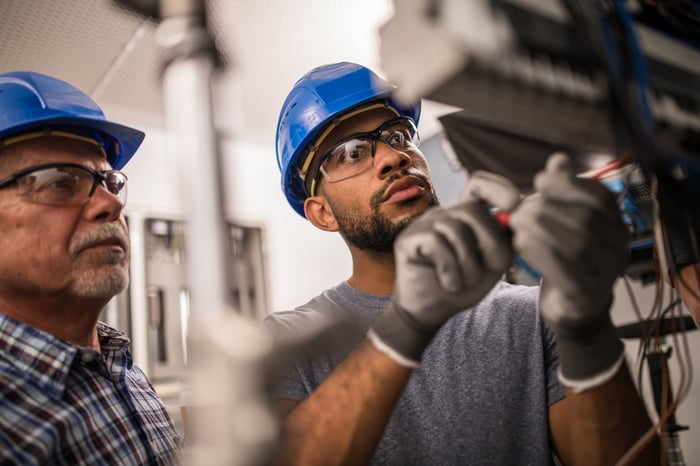
Image source: Getty Images.
Quanta Services is perfectly positioned to facilitate the data center build-out
Besides chips, hyperscalers need energy. That requires high-voltage electrical, mechanical, and grid interconnection engineering, which is Quanta Services' specialty. The company provides engineering, procurement, and construction (EPC) services, with a particular focus on electric power, renewable energy, underground utility, and other energy infrastructure.
One of the biggest factors that sets Quanta apart is its skilled labor force of 85,000 employees, which the company spends $250 million per year training. Developing a skilled trade workforce, including electricians, lineworkers, plumbers, and engineers, takes years, giving Quanta a robust competitive advantage.
The infrastructure company's revenue and backlog are surging
Quanta focuses on data center build-out outside chips, and its "balance of plant" approach aims to capture 80% of total facility capital expenditure, excluding chips. This includes high-volatility electrical and grid interconnection, cooling infrastructure, site development, and off-site prefabrication and integration. Quanta has made this possible by acquiring specialized platforms such as Cupertino Electric, Dynamic Systems, Phalcon, and Enerfab.
Quanta is seeing robust growth as data center spending rises. In the first half of 2026, Quanta earned $17.4 billion in revenue, a 34% increase from the same period last year. Meanwhile, net income surged 80% to $672 million. It finished the second quarter with a record backlog of $53 billion, with 60% of this expected to convert into revenue within the next 12 months.
Quanta Services is a top beneficiary of hyperscaler spending
The AI data center build-out is driving historic investments in infrastructure and the power solutions that make them possible, and Quanta Services is well-positioned to benefit.
Strong growth has led Quanta to raise its 2026 fiscal guidance, with management projecting full-year revenue around $39.5 billion at the midpoint and free cash flow of $2 billion to $2.5 billion. Management projects earnings per share of $16.70 at the midpoint this year, representing a 55% surge from last year.
Analysts project strong double-digit growth in the years ahead. For investors seeking exposure to the data center build-out unrelated to chips, Quanta Services is a top industrial stock to consider buying today.
Should you buy stock in Quanta Services right now?
Before you buy stock in Quanta Services, consider this:
The Motley Fool Stock Advisor analyst team just identified what they believe are the 10 best stocks for investors to buy now… and Quanta Services wasn’t one of them. The 10 stocks that made the cut could produce monster returns in the coming years.
Consider when Netflix made this list on December 17, 2004... if you invested $1,000 at the time of our recommendation, you’d have $375,240!* Or when Nvidia made this list on April 15, 2005... if you invested $1,000 at the time of our recommendation, you’d have $1,403,292!*
Now, it’s worth noting Stock Advisor’s total average return is 932% — a market-crushing outperformance compared to 211% for the S&P 500. Don't miss the latest top 10 list, available with Stock Advisor, and join an investing community built by individual investors for individual investors.
See the 10 stocks »
*Stock Advisor returns as of October 2, 2026.
Courtney Carlsen has positions in Alphabet, Meta Platforms, and Microsoft. The Motley Fool has positions in and recommends Alphabet, Amazon, Meta Platforms, Microsoft, and Quanta Services. The Motley Fool has a disclosure policy.
Recommended Articles


