


US Nonfarm Payrolls expected to soften in September
- US Nonfarm Payrolls are expected to rise by 90K in September, following August’s impressive 162K increase.
- The Unemployment Rate is forecast to hold steady at 4.1%.
- US employment data could influence the market pricing of a potential Fed interest rate hike in October.
The United States (US) Bureau of Labor Statistics (BLS) is set to release September Nonfarm Payrolls (NFP) data on Friday at 12:30 GMT.
With investors struggling to make up their minds about a potential Federal Reserve (Fed) interest rate hike in October, the underlying details of the employment report could influence how markets assess the US central bank’s policy outlook and drive the US Dollar’s (USD) valuation.
What to expect from the Nonfarm Payrolls report?
Investors expect NFP to rise by 90K in September following August’s impressive 162K increase. The Unemployment Rate is seen holding steady at 4.1%, while the monthly wage inflation, as measured by the change in Average Hourly Earnings (AHE), is projected to hold steady at 0.3%.
After the August employment data confirmed healthy labor market conditions, the Fed raised the policy rate by 25 basis points (bps) at the September meeting, as expected. In its policy statement, the US central bank noted that job gains have kept pace with the workforce, and the unemployment rate has changed little. Reiterating this sentiment, Fed Chair Kevin Warsh explained that the jobless rate remained low, while openings and hours increased, adding that “the labor side of the Fed’s remit is in good shape.”
According to TD Securities, "September NFP likely moderated to 50k, with the Unemployment Rate rising to 4.2%," following a strong August print. The bank attributes the slowdown largely to "a reversal in seasonal factors," noting that "private payrolls at 50k will likely be led by healthcare and leisure & hospitality," while "flat government will be weighed down by a reversal in local hiring." TD also expects "AHE was likely subdued at 0.1% m/m (3.0% y/y)," with the unemployment rate moving higher "along with participation." Overall, TD stresses that it would "look through dovishness in the report due to seasonal factors and rising participation," arguing that the softer headline numbers may be less meaningful for the broader policy outlook.
How will the US August Nonfarm Payrolls affect EUR/USD?
Following the Fed’s September meeting, hawkish comments from policymakers and upbeat macroeconomic data releases from the US fed into expectations for a consecutive rate increase in October and supported the USD. The S&P Global’s Manufacturing and Services Purchasing Managers’ Indexes (PMI) improved to 57 and 58.7, respectively, showing a healthy expansion in the private sector’s business activity.
Philadelphia Fed President Anna Paulson argued that they may need to raise interest rates again, explaining that even though the September hike improved the inflation-fighting stance, underlying inflation remained "stubbornly high." Similarly, Chicago Fed President Austan Goolsbee warned that future productivity gains from AI raise a “high danger of overheating now.” In addition, his emphasis on massive fiscal deficits, prolonged overshooting of the inflation target, and the need to revisit the logic of looking through supply shocks, signalled a bias toward tighter policy.
The CME FedWatch Tool’s probability of a rate hike in October rose toward 70% earlier in the week but retreated below after the US Bureau of Economic Analysis reported that the Core Personal Consumption Expenditures (PCE) Price Index, the Fed’s preferred gauge of inflation, rose 3% in August, matching July’s print and coming in well below the market expectation of 3.3%.
In the current market environment, another NFP print above 100K could revive expectations for an interest rate increase at the upcoming meeting and trigger another leg higher in the USD, causing EUR/USD to turn south heading into the weekend. Conversely, a significant negative surprise, a reading below 50K, could hurt the USD with the immediate reaction. A figure between 50K and 100K could have little impact on market pricing of the Fed’s rate outlook.
Analysts at OCBC note that “recent claims data have continued to trend lower, suggesting labour market conditions remain firm,” and warn that “the risk of an upside payrolls surprise appears to be increasing.” They argue that a “stronger-than-expected employment report would likely reinforce expectations of further Fed tightening, keep Treasury yields elevated and provide additional support for the USD,” underscoring the importance of this week’s US labour market release for the Dollar’s near-term trajectory.
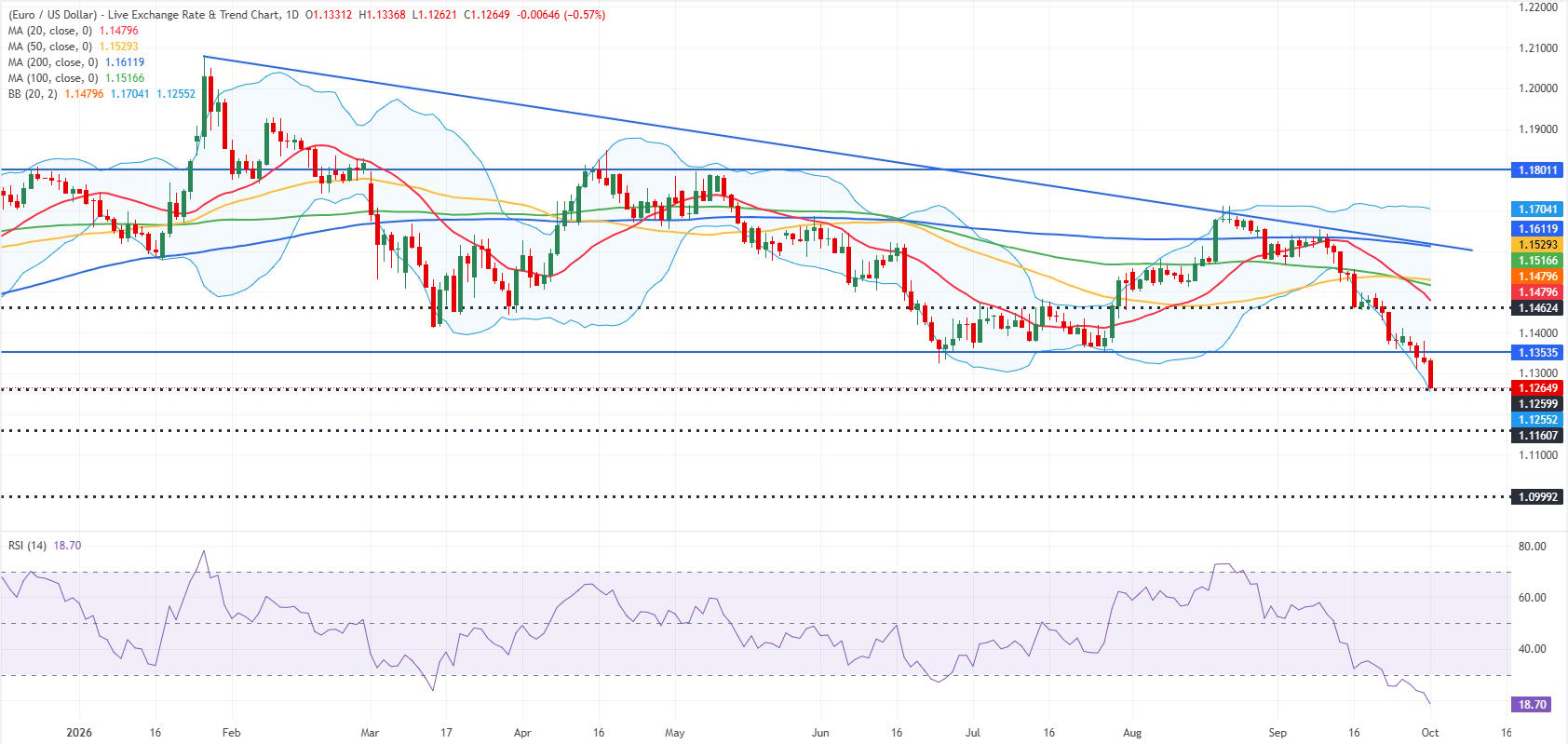
Eren Sengezer, European Session Lead Analyst at FXStreet, offers a brief technical outlook for EUR/USD:
“EUR/USD’s near-term technical outlook highlights a bearish stance as it trades well below the 100-day and 200-day Simple Moving Averages (SMA) and the descending trend line. However, the Relative Strength Index (RSI) indicator on the daily chart sits below 20, pointing to oversold conditions”
“On the downside, 1.1145 (static level) aligns as the next key support level ahead of 1.1000 (static level, round level). Looking north, the first important resistance level could be spotted at 1.1460 (static level, Bollinger Band mid-point) before 1.1520 (100-day SMA) and 1.1615 (200-day SMA, descending trend line).”
Nonfarm Payrolls FAQs
Nonfarm Payrolls (NFP) are part of the US Bureau of Labor Statistics monthly jobs report. The Nonfarm Payrolls component specifically measures the change in the number of people employed in the US during the previous month, excluding the farming industry.
The Nonfarm Payrolls figure can influence the decisions of the Federal Reserve by providing a measure of how successfully the Fed is meeting its mandate of fostering full employment and 2% inflation. A relatively high NFP figure means more people are in employment, earning more money and therefore probably spending more. A relatively low Nonfarm Payrolls’ result, on the either hand, could mean people are struggling to find work. The Fed will typically raise interest rates to combat high inflation triggered by low unemployment, and lower them to stimulate a stagnant labor market.
Nonfarm Payrolls generally have a positive correlation with the US Dollar. This means when payrolls’ figures come out higher-than-expected the USD tends to rally and vice versa when they are lower. NFPs influence the US Dollar by virtue of their impact on inflation, monetary policy expectations and interest rates. A higher NFP usually means the Federal Reserve will be more tight in its monetary policy, supporting the USD.
Nonfarm Payrolls are generally negatively-correlated with the price of Gold. This means a higher-than-expected payrolls’ figure will have a depressing effect on the Gold price and vice versa. Higher NFP generally has a positive effect on the value of the USD, and like most major commodities Gold is priced in US Dollars. If the USD gains in value, therefore, it requires less Dollars to buy an ounce of Gold. Also, higher interest rates (typically helped higher NFPs) also lessen the attractiveness of Gold as an investment compared to staying in cash, where the money will at least earn interest.
Nonfarm Payrolls is only one component within a bigger jobs report and it can be overshadowed by the other components. At times, when NFP come out higher-than-forecast, but the Average Weekly Earnings is lower than expected, the market has ignored the potentially inflationary effect of the headline result and interpreted the fall in earnings as deflationary. The Participation Rate and the Average Weekly Hours components can also influence the market reaction, but only in seldom events like the “Great Resignation” or the Global Financial Crisis.
Recommended Articles


