


Is Centrus Energy the Ultimate Pick-and-Shovel Play on the Nuclear Technology Boom?
Key Points
The nuclear fuel operator is expanding production amid the U.S. ban on Russian uranium imports.
Centrus has the only U.S. facility licensed and able to produce a crucial fuel for advanced reactors.
These reactors should come on line in the 2030s, and Centrus must undergo a costly expansion.
- 10 stocks we like better than Centrus Energy ›
Nuclear energy is making a comeback. Governments worldwide are renewing their support, with several committing to triple their nuclear capacity by 2050. Meanwhile, next-generation small modular reactors (SMRs) could begin arriving in the 2030s.
Many of these advanced reactors require a specialized fuel that remains in short supply. That's where Centrus Energy (NYSE: LEU) sees its opportunity. The company already supplies low-enriched uranium (LEU) to nuclear power operators, but its biggest growth opportunity could come from high-assay, low-enriched uranium (HALEU).
Missed AI’s "Act 1"? Act 2 Could Be 15x Bigger. Most investors think they missed the AI boat because they didn't buy Nvidia in 2005. But according to our analysts, we’re only at the end of "Act 1"—the R&D phase. "Act 2" is the global rollout. Continue »
Becoming a leading U.S. producer of this next-generation fuel could make Centrus the ultimate pick-and-shovel play on the nuclear technology boom. Here's what investors need to know.
A ban on Russian imports kick-started Centrus' domestic manufacturing
Centrus is an important player in the U.S. nuclear fuel supply chain. Currently, the company generates most of its revenue from supplying LEU to utilities operating traditional nuclear reactors in the U.S. and abroad. The company has manufacturing capabilities, but over the last decade, it has sourced this fuel globally, making it an established middleman.
However, this is all changing. In 2023, Congress passed the Prohibiting Russian Uranium Imports Act, which blocks the import of natural uranium and LEU produced in Russia or by a Russian entity. Some operators have been given limited waivers to import from Russia, but these waivers are set to expire on Jan. 1, 2028. The restrictions will remain in place until Dec. 31, 2040.
Centrus relies heavily on TENEX, a Russian state-owned entity, for its LEU. Over half of the LEU it delivers to customers in 2027 is expected to come from TENEX. Russia holds roughly 43% of global enrichment capacity, so Congress' act creates an urgent need to develop domestic nuclear fuel production.
The company is pivoting from being an intermediary to becoming a U.S. producer of these fuels. It is making a multibillion-dollar investment in its Ohio and Tennessee facilities to expand domestic enrichment capacity. In Oak Ridge, Tennessee, management is investing over $560 million to produce thousands of centrifuges. Meanwhile, it's expanding its Piketon, Ohio, centrifuge and enrichment plant to develop LEU and HALEU at scale.
HALEU is an important fuel for advanced nuclear reactors
Many next-generation nuclear reactors, including SMRs and microreactors, are designed to run on HALEU. Nine out of 10 advanced reactor designs backed by the federal government require this specialized fuel. That creates a huge opportunity for Centrus, which currently operates the only U.S. facility with both the federal license and proven technology needed to produce HALEU.
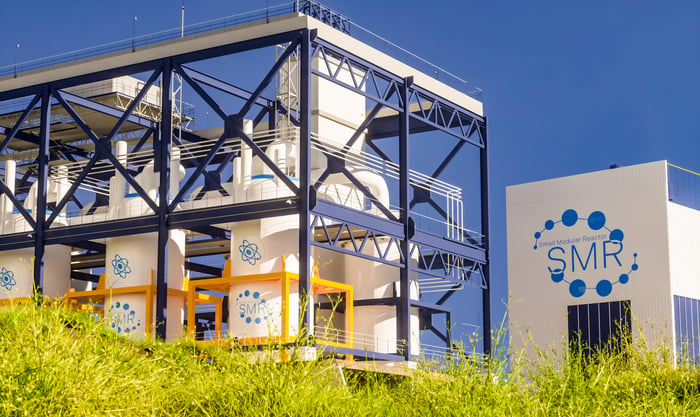
A concept image of a small nuclear reactor. Image source: Getty Images.
On July 1, Centrus finalized terms on a $900 million Department of Energy order under a production contract to build out its HALEU enrichment capacity at its Piketon facility. That expansion allows the company to produce up to one metric ton of HALEU by July 2032. This contract officially marks its pivot from a HALEU demonstration contract to a commercial enrichment operation.
Centrus has a first-mover advantage and already has customers lining up. Over the past year, management has reached supply agreements with advanced reactor developers, including X-Energy, Radiant, and Oklo, helping these nuclear technology companies secure the much-needed fuel for their SMRs and microreactors.
A pick-and-shovel play on nuclear reactor technology
One thing you should keep in mind is the timeline. The International Atomic Energy Agency forecasts that the first major SMR projects will start operation around 2030 and accelerate as the decade goes on. It will take time to scale up and expand this nuclear technology. At the same time, Centrus must also execute a costly expansion.
Despite these risks, it is uniquely positioned as a domestic nuclear fuel provider of the future. If next-generation reactors live up to their promise, Centrus could become a key pick-and-shovel stock powering America's nuclear comeback.
Should you buy stock in Centrus Energy right now?
Before you buy stock in Centrus Energy, consider this:
The Motley Fool Stock Advisor analyst team just identified what they believe are the 10 best stocks for investors to buy now… and Centrus Energy wasn’t one of them. The 10 stocks that made the cut could produce monster returns in the coming years.
Consider when Netflix made this list on December 17, 2004... if you invested $1,000 at the time of our recommendation, you’d have $384,839!* Or when Nvidia made this list on April 15, 2005... if you invested $1,000 at the time of our recommendation, you’d have $1,385,657!*
Now, it’s worth noting Stock Advisor’s total average return is 936% — a market-crushing outperformance compared to 213% for the S&P 500. Don't miss the latest top 10 list, available with Stock Advisor, and join an investing community built by individual investors for individual investors.
See the 10 stocks »
*Stock Advisor returns as of September 24, 2026.
Courtney Carlsen has positions in Centrus Energy and Oklo. The Motley Fool has no position in any of the stocks mentioned. The Motley Fool has a disclosure policy.
Recommended Articles


