


Warren Buffett Watched Alphabet's Stock Price Climb 9,000% Before He Decided to Invest. Here's Why He and Greg Abel Are Making It One of Berkshire Hathaway's Biggest Investments Now.
Key Points
Buffett has said he made a mistake not buying Alphabet earlier.
The stock is now Berkshire's third-largest position in its marketable equity portfolio.
Recent comments from Google Cloud's CEO suggest the investment is playing out as expected.
- 10 stocks we like better than Alphabet ›
Nearly 10 years ago, Warren Buffett told Berkshire Hathaway (NYSE: BRKA) (NYSE: BRKB) investors that he had made a mistake for not buying Google when he had the opportunity many years earlier. He had become quite familiar with the business because GEICO, Berkshire's consumer insurance company, was paying $10 or $11 per click for advertising on the search engine owned by Alphabet (NASDAQ: GOOG) (NASDAQ: GOOGL). At the 2017 shareholder meeting, Buffett said he'd missed the opportunity, but he wouldn't bet against Google.
The stock climbed significantly while Buffett sat on the sidelines. He finally pulled the trigger on the stock in the third quarter of last year. Since then, he and newly appointed CEO Greg Abel have plowed tens of billions into the stock, making it one of Berkshire's biggest investments. But Buffett arguably missed out on a 9,000% gain by not buying into the stock sooner.
Missed Nvidia in 2009? This Rare Signal Is Flashing Again. In 2009, a "Double Down" signal flashed for a little-known chipmaker called Nvidia. For the first time in years, that same "Total Conviction" signal is flashing for a company 1/100th the size of Nvidia. Continue »
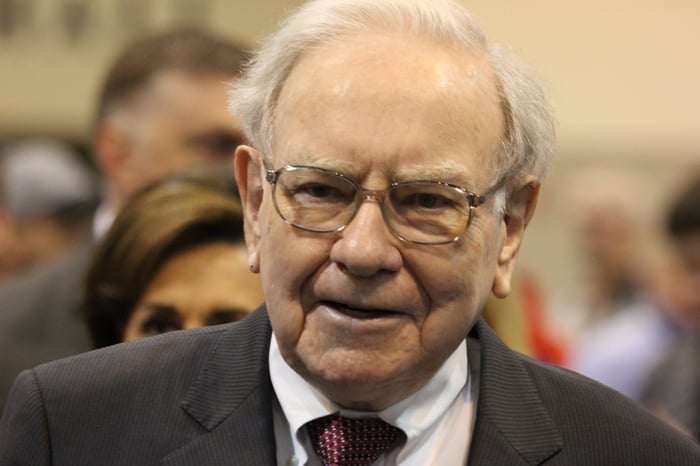
Former Berkshire Hathaway CEO Warren Buffett. Image source: The Motley Fool.
Google wasn't a stock Buffett would buy
It's hard to blame Buffett for not buying Alphabet, then known as Google, when it made its initial public offering (IPO) in 2004. Buffett historically avoids both IPO stocks and tech stocks.
Buffett thinks IPOs are typically overvalued, at least relative to many other stocks, because underwriters are incentivized to secure the highest possible price for the company issuing shares. An IPO like Google's also comes with a lot of hype and media attention that can drive prices higher without any fundamental basis.
Buffett sees tech stocks as more prone to disruption than many other industries, making it harder to establish long-term competitive advantages that can sustain high profit margins for years. In 2004, Google was less than six years old. It had just turned profitable three years prior, and while it was exhibiting strong operating earnings growth, its operating margin was contracting.
But Alphabet consistently delivered a high operating margin for its core search and display advertising business throughout the 2000s and into the 2010s. At the same time, its dominance of the digital advertising market became cemented across search and video with YouTube. The early 2010s were a prime opportunity for Buffett to buy into the company his insurance business had been using to advertise to consumers. But he didn't act.
The stock climbed quickly from there. Google initially offered shares to the public at $85 each. After splitting into two share classes in 2014 and undergoing a 20-for-1 split in 2022, the split-adjusted price is just $2.125 per share. It wasn't until the third quarter of 2025 that Buffett bought the stock, with shares trading around $200.
Why Buffett likes the stock now
In an interview earlier this year, Buffett revealed that he initiated Berkshire Hathaway's position in Alphabet. Additionally, CEO Greg Abel recently indicated that Buffett still holds a key role in making investment decisions for Berkshire's portfolio.
In discussing why he likes the stock today, Buffett described what he thinks makes a good business. It all boils down to deploying capital and earning a return significantly higher than the risk-free rate, which he views as U.S. Treasury bills. He sees that trait in the businesses Berkshire owns outright as well as the businesses it's owned stock in for years, like Coca-Cola.
What makes Alphabet different right now is the massive amounts of capital it's deploying. The company plans to spend around $200 billion in capital expenditures this year, building new data centers and outfitting them with AI servers. Buffett's comments suggest that he sees that as a great use of capital, one that can earn a high cash return.
Recent comments from Google Cloud CEO Thomas Kurian support that view. He said the average payback period on its new servers is less than two years. That doesn't account for the cost of the data center structure, which is a long-term asset with a 30-year lifespan. GPUs and other AI accelerators are said to have a lifespan of six years, so a payback period of two years means the asset will produce a cash return of around 200% over its lifetime -- a roughly 20% annualized return.
What's more, Kurian said the payback period for Google's custom TPUs is roughly half that of the average server. And as the TPU business grows faster than the overall cloud business, that suggests it could see even better returns on investment over time.
Importantly, Alphabet's long-term contracts with its biggest customers provide it with good visibility into future demand, giving it greater confidence in how much data center capacity to build. With average five-year terms and a two-year lead time on data center construction, a worst-case scenario still produces a positive return on its cash investments.
With the stock price trading for less than 17 times forward earnings expectations, it wouldn't be a surprise to see Buffett and Abel continue buying the stock in the third quarter.
Should you buy stock in Alphabet right now?
Before you buy stock in Alphabet, consider this:
The Motley Fool Stock Advisor analyst team just identified what they believe are the 10 best stocks for investors to buy now… and Alphabet wasn’t one of them. The 10 stocks that made the cut could produce monster returns in the coming years.
Consider when Netflix made this list on December 17, 2004... if you invested $1,000 at the time of our recommendation, you’d have $387,158!* Or when Nvidia made this list on April 15, 2005... if you invested $1,000 at the time of our recommendation, you’d have $1,365,749!*
Now, it’s worth noting Stock Advisor’s total average return is 932% — a market-crushing outperformance compared to 211% for the S&P 500. Don't miss the latest top 10 list, available with Stock Advisor, and join an investing community built by individual investors for individual investors.
See the 10 stocks »
*Stock Advisor returns as of September 19, 2026.
Adam Levy has positions in Alphabet. The Motley Fool has positions in and recommends Alphabet and Berkshire Hathaway. The Motley Fool has a disclosure policy.
Recommended Articles


