

If the Stock Market Crashes, History Says This 1 Investing Move Has Never Once Failed

Source The Motley Fool

Key Points

  • Bond market mayhem, surging oil prices, and AI concerns are putting pressure on the market.

  • History has proven time and again that long-term investors are more protected against risk.

  • However, it's more important than ever to choose your investments wisely.

  • 10 stocks we like better than S&P 500 Index ›

It's been a tumultuous couple of weeks for the stock market.

AI doomsday fears sent tech stocks tumbling amid renewed concerns around a bubble. Oil prices continue to drive up inflation. And, most recently, the 10-Year Treasury yield reached its highest level since 2007, triggering new recession worries.

Missed AI’s "Act 1"? Act 2 Could Be 15x Bigger. Most investors think they missed the AI boat because they didn't buy Nvidia in 2005. But according to our analysts, we’re only at the end of "Act 1"—the R&D phase. "Act 2" is the global rollout. Continue »

The S&P 500 (SNPINDEX: ^GSPC), Dow Jones Industrial Average (DJINDICES: ^DJI), and Nasdaq Composite (NASDAQINDEX: ^IXIC) are each down around 2% over the past month, and around 40% of investors expect the market to fall further in the next six months, according to the latest weekly survey from the American Association of Individual Investors.

Fortunately, history says the right strategy can protect your investments even if a market crash is looming.
Silhouette of a bear against stock market charts.

Image source: Getty Images.

A long-term outlook all but guarantees stock market success

Perhaps the single best move investors can make right now is to stay focused on the long term.

Bear markets and recessions are a normal part of the market's cycle, and trying to predict when the next drawdown will occur is next to impossible. But the longer you can stay invested, the less likely it is that you'll lose money.

Since 1919, every single one of the S&P 500's 20-year periods has ended in positive total returns, according to analysis from Crestmont Research. In other words, if you'd invested in the S&P 500 at any point over the last century and simply held your investment for two decades, you'd have made money.
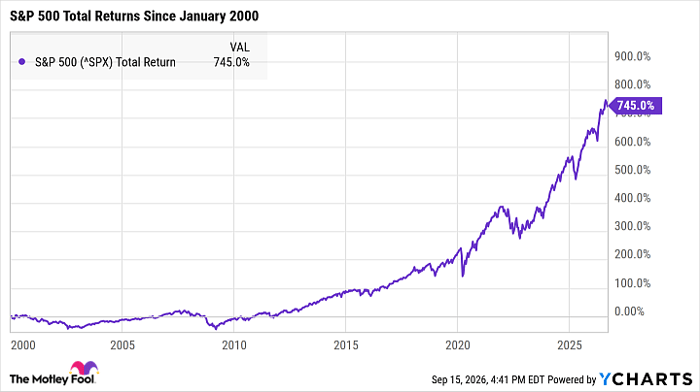
^SPX Chart

^SPX data by YCharts

The market has experienced no shortage of volatility, either. Since 2000, the stock market has survived the longest bear market on record (the dot-com bubble burst), the most severe economic downturn post-WWII (the Great Recession), and the fastest market decline in history (the COVID-19 crash).

Yet if you'd invested in an S&P 500 ETF or index fund in January 2000, you'd have earned total returns of 745% -- turning a $10,000 investment into around $84,500.

One critical caveat to building long-term wealth

Staying invested for the long haul is key to riding out periods of volatility, but it's equally important to invest in strong stocks that can handle economic rough patches.

Recessions and bear markets will test a company's strength and resilience. If a company has unreliable revenue streams, a leadership team with a questionable decision-making history, or a weak competitive advantage, it's more likely to struggle during a downturn. The weakest of these stocks may not survive at all.

Healthy companies with solid underlying business fundamentals have the greatest potential for significant long-term returns. The more of these stocks you own, the less you'll need to worry about how a market crash or recession will affect your portfolio.

Should you buy stock in S&P 500 Index right now?

Before you buy stock in S&P 500 Index, consider this:

The Motley Fool Stock Advisor analyst team just identified what they believe are the 10 best stocks for investors to buy now… and S&P 500 Index wasn’t one of them. The 10 stocks that made the cut could produce monster returns in the coming years.

Consider when Netflix made this list on December 17, 2004... if you invested $1,000 at the time of our recommendation, you’d have $420,109!* Or when Nvidia made this list on April 15, 2005... if you invested $1,000 at the time of our recommendation, you’d have $1,303,689!*

Now, it’s worth noting Stock Advisor’s total average return is 938% — a market-crushing outperformance compared to 211% for the S&P 500. Don't miss the latest top 10 list, available with Stock Advisor, and join an investing community built by individual investors for individual investors.

See the 10 stocks »

*Stock Advisor returns as of September 17, 2026.

Disclaimer: For information purposes only. Past performance is not indicative of future results.
placeholder
Fed hike odds near 90% into Wednesday's decision — how to trade the dollar, gold and the S&P 500A 0.3% monthly core CPI print has lifted the market-implied probability of a 25bp Fed hike on 16 September to roughly 86.5% ~ 90%, which would be the first increase since July 2023. Here is the decision timeline, the pricing versus the forecasts, both scenarios, and the key levels for the dollar, gold and the S&P 500.
Author  Suzie
Sep 14, Mon
A 0.3% monthly core CPI print has lifted the market-implied probability of a 25bp Fed hike on 16 September to roughly 86.5% ~ 90%, which would be the first increase since July 2023. Here is the decision timeline, the pricing versus the forecasts, both scenarios, and the key levels for the dollar, gold and the S&P 500.
placeholder
【Daily Brief】10-year Treasury yield briefly tops 5%, S&P 500 slips to 7,602 and the dollar firms at 99.3 as the Fed's decision eve beginsThe 10-year Treasury yield touched 5.014% on Monday — its first print above 5% since October 2023 — while the S&P 500 closed 0.48% lower at 7,619.98 and the dollar index firmed to 99.3. Here is the full market wrap ahead of Wednesday's FOMC decision, the dot plot and the August retail sales report, plus today's CLARITY Act Senate vote.
Author  Irene Q.
Sep 15, Tue
The 10-year Treasury yield touched 5.014% on Monday — its first print above 5% since October 2023 — while the S&P 500 closed 0.48% lower at 7,619.98 and the dollar index firmed to 99.3. Here is the full market wrap ahead of Wednesday's FOMC decision, the dot plot and the August retail sales report, plus today's CLARITY Act Senate vote.
placeholder
Silver breaks $64 as precious metals rebound — can gold hold the $4,280 line into the Fed decision?Silver has climbed back above $64 an ounce for the first time this week, leading a broad rebound across precious metals hours before the Federal Reserve delivers what is expected to be its first rate hike since 2023. Spot silver was last at $64.64, up 1.49% on the day, while gold reclaimed $4,300 and platinum and palladium both advanced. The question now is whether the bounce is a genuine turn — or a pause before the Fed's dot plot decides the next move.
Author  Suzie
23 hours ago
Silver has climbed back above $64 an ounce for the first time this week, leading a broad rebound across precious metals hours before the Federal Reserve delivers what is expected to be its first rate hike since 2023. Spot silver was last at $64.64, up 1.49% on the day, while gold reclaimed $4,300 and platinum and palladium both advanced. The question now is whether the bounce is a genuine turn — or a pause before the Fed's dot plot decides the next move.
placeholder
Bitcoin falls below $75,000 as the CLARITY Act fails in the Senate — what the vote means for cryptoThe US Senate blocked the Digital Asset Market CLARITY Act in a 49-50 procedural vote, sending Bitcoin briefly below $75,000 — its biggest one-day drop since June. Ethereum fell more than 8%, Coinbase slid 10% and $75 billion of crypto market value evaporated. Here is what the vote was, why it failed, and the levels that matter now.
Author  Suzie
23 hours ago
The US Senate blocked the Digital Asset Market CLARITY Act in a 49-50 procedural vote, sending Bitcoin briefly below $75,000 — its biggest one-day drop since June. Ethereum fell more than 8%, Coinbase slid 10% and $75 billion of crypto market value evaporated. Here is what the vote was, why it failed, and the levels that matter now.
placeholder
Dow drops 631 points as the Fed hikes — but futures are rebounding: what's next for US stocks?The Dow fell 631 points and the S&P 500 closed below 7,600 after the Fed hiked rates for the first time since 2023, with the dot plot showing 16 of 18 officials expect more tightening. Asia-session futures are already recovering — here are the levels and analyst views that decide whether 7,500 holds.
Author  Irene Q.
5 hours ago
The Dow fell 631 points and the S&P 500 closed below 7,600 after the Fed hiked rates for the first time since 2023, with the dot plot showing 16 of 18 officials expect more tightening. Asia-session futures are already recovering — here are the levels and analyst views that decide whether 7,500 holds.
goTop
quote