


South Korean Stocks Hit Record High. KOSPI Up Over 90% This Year, Should You Buy, Hold, or Exit?
TradingKey - On May 26, South Korea's benchmark KOSPI index hit 8,131 points during intraday trading on Monday, continuing to set fresh record highs and bringing its year-to-date cumulative gain to approximately 90%. Behind the market's robust performance, data simultaneously reveals a deepening structural imbalance.
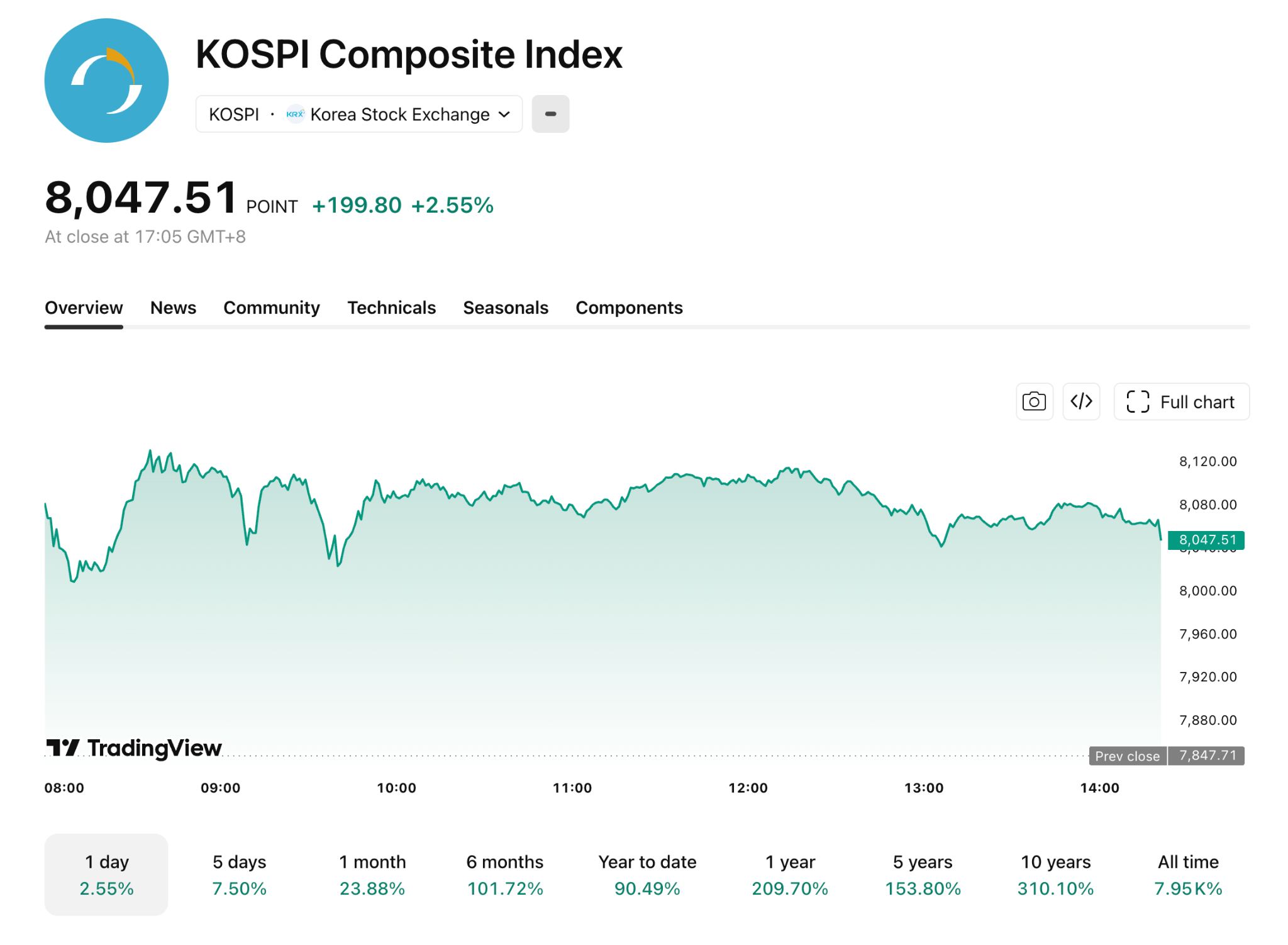
[Source: TradingView]
Samsung Electronics closed at 299,000 KRW, up 2.22%, and SK Hynix finished at 2,052,000 KRW, up 5.72%, both reaching new record closing highs. The combined weight of these two stocks in the KOSPI has surpassed 47%. Excluding these two names, the year-to-date gain of the KOSPI's remaining hundreds of constituents narrows sharply to approximately 30%, meaning the vast majority of the gains were driven by just two companies.
What is driving the KOSPI’s upward momentum?
Robust demand for AI memory chips provides the only fundamental support. Supply and demand for HBM (High Bandwidth Memory) remain tight, with Samsung Electronics and SK Hynix occupying critical positions in the global AI supply chain. Samsung Securities noted that long-term supply contracts of three to five years have locked in profits, helping the semiconductor industry escape the extreme volatility cycles of the past.
Easing geopolitical tensions have served as a short-term sentiment catalyst. On May 25, the U.S. military launched airstrikes in Iran, while an Iranian negotiating delegation arrived in Doha the same day. Both sides are nearing an agreement to extend the ceasefire by 60 days, which U.S. officials say could be signed within days. This "fighting while talking" dynamic has boosted market risk appetite, driving the KOSPI to open up nearly 3% on May 26.
Global capital and policy initiatives are providing marginal impetus. South Korea's weighting in the MSCI Emerging Markets Index rose from 15.4% to 21.7%, providing institutional inflow momentum for passive funds. The South Korean government also plans to establish a 150 trillion won public growth fund over five years, with 30 trillion won to be invested in the first year to support the KOSDAQ. However, the index's trajectory will ultimately be determined by the earnings of the two leading chipmakers and AI demand.
What are the existing risks? Concentration risk, retail leverage, and reduction in pension fund holdings.
The index is highly concentrated, with Samsung Electronics and SK Hynix accounting for a combined weight of over 47%. Should AI demand soften or either company underperform, the index faces a sharp correction.
Retail investors are utilizing high leverage, acting as counterparties to foreign sellers. As of May 22, the retail margin balance reached 36.47 trillion won, a record high in absolute terms. This margin balance is heavily concentrated in these two chip stocks, far exceeding their index weights.
This implies that if SK Hynix or Samsung Electronics shares drop 10%, maintenance margin ratios will plummet from approximately 140% to below 120%, breaching the 130%-140% warning levels typically set by brokerages. Triggered forced liquidations would then exacerbate the decline through a chain reaction.
Regarding fund flows: from May 1 to 22, retail investors net purchased roughly 11 trillion won of Samsung Electronics, while foreign investors were net sellers. Foreigners have net sold KOSPI stocks for 12 consecutive sessions. In the week of May 18 to 22, foreign investors net sold 5.35 trillion won of SK Hynix and 5.28 trillion won of Samsung Electronics.
Pension funds face passive divestment pressure. Public funds, including the National Pension Service (NPS), have been net sellers this year, largely due to passive rebalancing after surging market values led to overweight positions in domestic equities.
On May 28, the National Pension Committee will finalize its mid-term asset allocation plan. As domestic equity holdings currently exceed the target allocation range, the fund faces significant selling pressure unless targets are adjusted. The committee is considering raising the domestic equity target from 14.9% to 20% or even 25%. Chairman Kim Sung-soo noted, "We are facing an unprecedented situation with many concerns."
JPMorgan Calls for 10,000 Points
Several international investment banks maintain an optimistic stance on the South Korean stock market. Goldman Sachs ( GS) raised its 12-month target for the KOSPI to 9,000 points and maintained its "Overweight" rating; JPMorgan Chase ( JPM) raised its forecast twice in the same month, with its base case at 9,000 points and its bull case at 10,000 points. Nomura issued "Buy" ratings for Samsung Electronics and SK Hynix, raising their target prices to 590,000 KRW and 4 million KRW respectively, noting that AI inference demand is reshaping the valuation logic for memory chips.
However, some institutions expressed caution. Societe Generale pointed out that this rally was primarily driven by domestic institutions through structured products, while foreign investors were net sellers.
KOSPI Hits New High: Buy, Hold, or Exit?
This depends on the investor's risk appetite and investment horizon. From a short-term perspective, risk factors cannot be ignored: two chip stocks account for nearly 50% of the weight, retail margin balances are highly concentrated, foreign capital has seen continuous net outflows, and pension funds are facing passive rebalancing pressure. A 10% correction in stock prices could trigger large-scale forced liquidations, leading to a chain reaction of declines.
Therefore, short-term traders could gradually reduce their positions to avoid the risk of a stampede brought on by crowded trades. Medium-to-long-term investors need not be overly concerned. Demand for AI memory chips remains robust, as Samsung Electronics and SK Hynix have locked in multi-year supply contracts, providing earnings resilience. If the index sees a correction of over 10%, it would instead be an opportune moment to build positions in batches.
Investors opting to hold should closely monitor two signals: first, whether the National Pension Service committee raises its domestic stock allocation target on May 28 (selling pressure will ease if raised to over 20%); and second, the order and price trends of HBM. Overall, it is not advisable to chase highs at present; positions should be controlled while waiting for a better entry point after the risks are released.
Recommended Articles


