


5 Best Paper Trading Platforms for 2026 (Free Demo Accounts for Beginners & Traders)

If you’ve ever hesitated before placing your first trade, you’re not alone.
Most beginners don’t lose money because they lack intelligence. They lose because they start trading too early — before they fully understand how markets move, how orders work, or how fast emotions can take over.
That’s exactly where paper trading comes in.
It gives you a space to practice with real market data, without risking real money. No pressure. No consequences. Just learning.
But here’s the part many people overlook: 👉 Not all paper trading platforms are built the same.
Some are designed for complete beginners. Others feel like professional trading terminals. And a few actually help you transition smoothly into real trading — which is where it really matters.
In this guide, we’ll walk through the best paper trading platforms in 2026, but more importantly, we’ll help you figure out which one actually fits how you trade.
What Is a Paper Trading Platform (And Why It Matters )
At its core, paper trading is simple. You’re placing trades using simulated funds, but the market prices are real.
That means:
If a stock moves, your position moves
If you make a bad entry, you’ll see the loss
If you chase the market, you’ll feel the consequences
The difference is — you’re not losing actual money.
But here’s something many beginners don’t realize at first:
👉 Paper trading isn’t just about learning buttons. It’s about building decision-making habits.
Because once real money is involved, everything changes. Fear shows up. Greed shows up. And suddenly, even simple strategies become hard to follow.
That’s why choosing the right platform matters. It shapes how you learn.
5 Best Paper Trading Platforms for 2026
Instead of giving you a generic ranking, I’ll walk you through each platform from a real usage perspective — what it feels like, who it’s for, and where it might not fit.
Webull – Best Paper Trading App for Stocks
Webull is designed to make trading accessible without removing core functionality. The platform offers a paper trading environment that supports stocks, ETFs and options, along with real-time data and charting tools. Its mobile-first design makes it easier for beginners to navigate, place trades and monitor positions.
One of its key advantages is consistency between demo and live trading. Users can move from simulation to real trading without needing to learn a new interface. At the same time, Webull focuses more on providing tools than structured learning. Users are expected to explore indicators and strategies independently.
Webull is most suitable for those who want a straightforward introduction to stock trading, but if your goal is gold or forex, you’ll be better off with a platform that specializes in those markets.
Interactive Brokers – Best for Advanced Paper Trading
Interactive Brokers provides a more complex and detailed simulation environment. Its paper trading system allows users to access multiple asset classes, including stocks, options, futures, forex and bonds. This makes it possible to test diversified strategies and manage simulated portfolios across markets.
The platform is designed to reflect real trading conditions as closely as possible, which is particularly useful for experienced traders refining their approach. However, the interface can be difficult to navigate for beginners. The number of tools and customization options may require time to understand.
Interactive Brokers is generally better suited for users who already have a foundation in trading and want a more advanced simulation experience. However, the learning curve is noticeably steeper and beginners may find it overwhelming without prior exposure to trading platforms.
Mitrade – Best for CFD Paper Trading and Simplicity
Mitrade focuses on CFD trading, offering access to global markets such as stocks, forex, commodities, indices and cryptocurrencies. This distinguishes it from platforms that primarily support stock trading.
Instead of offering a highly complex system with multiple account types and layered tools, Mitrade focuses on a simplified, mobile-first trading experience. The platform provides a free demo account that mirrors live trading conditions. Mitrade uses a zero-commission model, where costs are incorporated into spreads.
What stands out most is the simplicity of execution. There is no need to switch between tools or manage multiple interfaces. Everything happens inside one system, which mirrors how many active traders operate in fast-moving markets.
The limitation is that it is not designed for deep portfolio analysis or long-term investment simulation, so Mitrade is typically suited to traders focused on short-term or swing trading, users who prefer a simplified, app-based experience.



TradingView – Best for Chart-Based Paper Trading
TradingView is not a broker in the traditional sense, but it has become one of the most widely used paper trading environments due to its charting capabilities. The platform allows users to test strategies directly on live charts using virtual balances.
Its strength lies in technical analysis. Indicators, drawing tools, and strategy testing features are significantly more advanced than most broker platforms. However, execution depends on connected brokers, and the experience can vary depending on integration.
eToro – Best for Social Paper Trading
eToro combines simulation trading with social features. Users can observe other traders, review public portfolios and replicate strategies through copy trading. This creates an environment where beginners can learn by observing others.
While this can provide useful context, it may also reduce independent decision-making if relied on too heavily. eToro is generally suitable for users who want exposure to social trading while practicing in a simulated environment.
How to Choose the Right Paper Trading Platform/ App?
At this point, the better question isn’t “which is best,” but Which one fits where you are right now?
For beginners, ease of use and a clear interface are often more important than advanced features. Platforms like Mitrade and Webull provide a balance between accessibility and functionality.
For more experienced users, depth becomes more relevant. Platforms such as Interactive Brokers offer broader market access and more detailed simulation tools.
Market focus is another consideration. Traders interested in forex or commodities may prefer platforms like Mitrade, while those focused on technical analysis may lean toward TradingView.
Selecting a platform that reflects real trading goals can make the transition from simulation to live trading more efficient.
How to Start Paper Trading on Mitrade?
Starting paper trading on Mitrade is a relatively straightforward process. The platform is designed to reduce friction for beginners, allowing users to access a demo environment without going through the full verification process required for live accounts. Below is a step-by-step overview of how to get started.
Step 1: Create a Mitrade Account
To begin, go to the Mitrade website or download the mobile app. Registration typically requires only:
Email address or mobile number
Password setup
During sign-up, you will be given the option to open either a demo account or a live account. For beginners, selecting the demo account is the standard starting point.
*Start with a risk-free demo & 100USD welcome bonus.
Step 2: Access Your Free Demo Account
Once registered, the demo account is activated automatically.
Mitrade provides:
Around $50,000 in virtual funds
Access to 800+ markets including forex, gold, indices and crypto
A trading interface that mirrors the live environment
Step 3: Explore the Trading Interface
After logging in, you’ll land on the main dashboard.
You can search for assets directly:
“EURUSD” for forex
“XAUUSD” for gold
“NAS100” for indices
Major stocks or cryptocurrencies
This stage is less about trading and more about getting familiar with how the platform works.
Step 4: Place Your First Paper Trade
Once you’re comfortable navigating, you can start placing simulated trades.
The process is simple:
Select an asset
Choose Buy (if expecting price to rise) or Sell (if expecting it to fall)
Set trade size
Adjust leverage if needed
Add risk controls such as stop-loss and take-profit
Confirm the trade
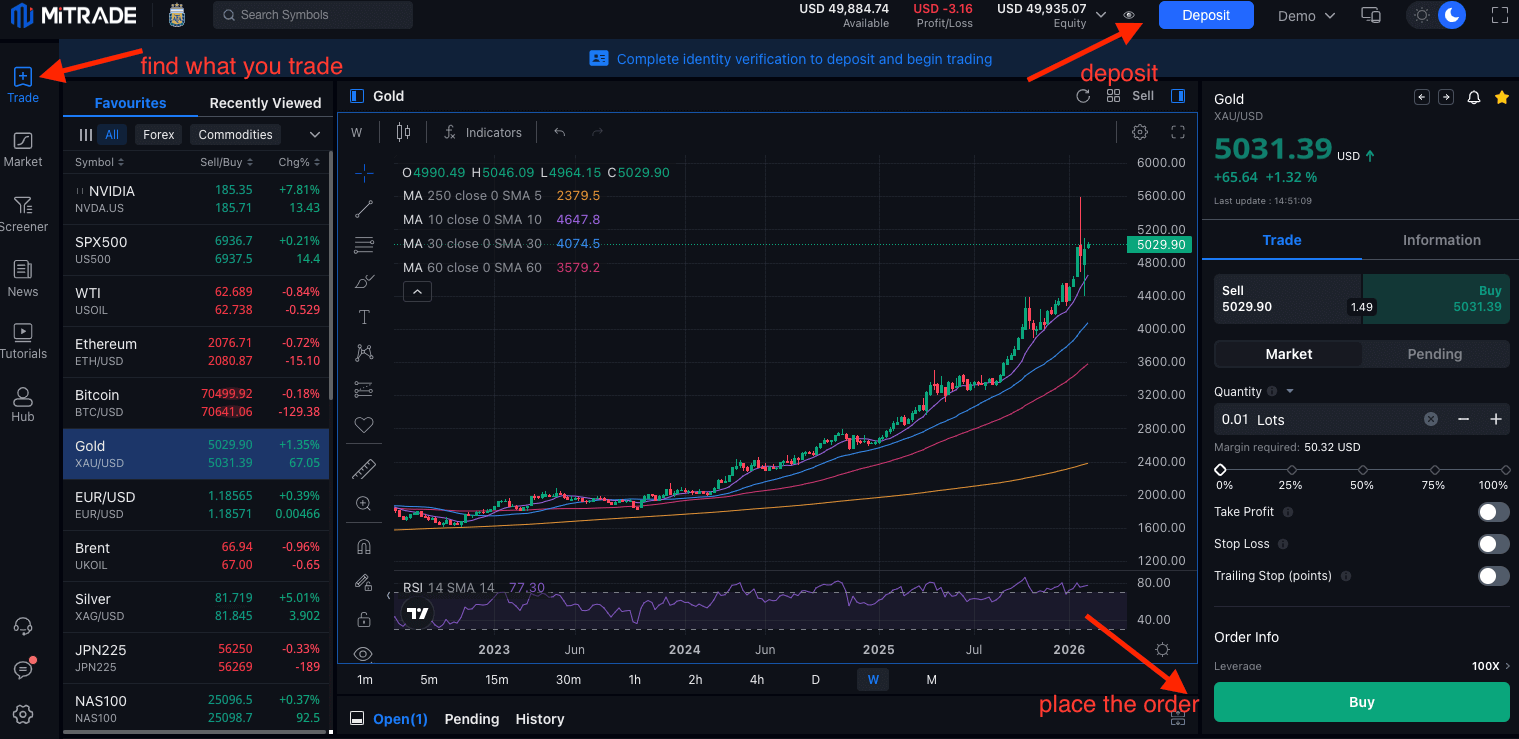
The position will appear instantly, with profit and loss updating in real time.
Step 5: Manage and Close Positions
Once trades are open, you can:
Monitor performance in real time
Close trades manually
Adjust stop-loss or take-profit levels
Use trailing stops to manage risk
These tools are identical to those used in live trading, which is why demo accounts are often used as a training environment.
Final Thoughts: Start Practicing, But Don’t Stay There Too Long
Paper trading is one of the safest ways to start. It gives you room to make mistakes without consequences. It builds confidence. It helps you understand how markets actually move. But it’s only the first step.
At some point, you need to experience real trades — even small ones — to truly grow.
If you’re just getting started, opening a free paper trading account on a platform like Mitrade is a practical first move.
👉 Not because it guarantees success, but because it gets you into the process.
And in trading, getting started — with the right foundation — is often what makes the difference.
What is the best free paper trading platform?
It depends on what you want to practice. Webull is often preferred for beginners due to its ease of use, while Interactive Brokers offers more advanced simulation tools. If you're focusing on forex or CFDs, Mitrade provides a more relevant environment.
Is paper trading really useful for beginners?
Yes, but only if you treat it seriously. If you use it casually, it becomes a game. If you use it to test ideas and build discipline, it becomes one of the most valuable learning tools.
How long should I paper trade before going live?
There’s no fixed timeline. What matters is whether you can follow a strategy consistently and understand your results. For some, this takes weeks. For others, months.
* The content presented above, whether from a third party or not, is considered as general advice only. This article should not be construed as containing investment advice, investment recommendations, an offer of or solicitation for any transactions in financial instruments.


