

Dollar Index Continues to Strengthen, Can Gold Hold the $4,500 Level?

Source Tradingkey

TradingKey - Recently, the US Dollar Index has continued to strengthen as the US-Iran conflict eases. Reports previously stated that both parties would reopen the Strait of Hormuz approximately 30 days after reaching an agreement to end hostilities, and the ceasefire established in early April will be extended by 60 days.

Since May, the US Dollar Index has trended upward, driven by rising expectations of Fed rate hikes. Spot gold, meanwhile, has been in a tug-of-war around the $4,500 mark, as market divergence grows over whether gold can maintain this key psychological support level.

What are the drivers behind the US dollar's strength?

The core drivers stem from two factors. First, April CPI surged to 3.8% year-over-year, with inflationary pressures far exceeding expectations as persistently high energy prices pushed up overall price levels. Second, U.S. economic resilience surpassed expectations, with April non-farm payrolls adding 115,000 jobs, far outstripping the market forecast of 62,000.

The CME FedWatch Tool shows that the market has priced in a 71.7% probability of the Federal Reserve raising interest rates once during 2026. The U.S. Dollar Index broke through the 99 level in early to mid-May and briefly approached 100, marking its highest level in nearly six months.

The Triple Headwinds Facing Gold

The strengthening U.S. dollar directly pushed up the cost of holding dollar-denominated gold; simultaneously, U.S. Treasury yields climbed, with the 10-year yield briefly reaching 4.6%, dampening the appeal of non-yielding assets. Furthermore, expectations of Federal Reserve interest rate hikes further compressed gold's valuation. These three factors combined to exert pressure, driving gold prices below $4,500 on May 19, touching a low of $4,464.

How strong is the support at $4,500?

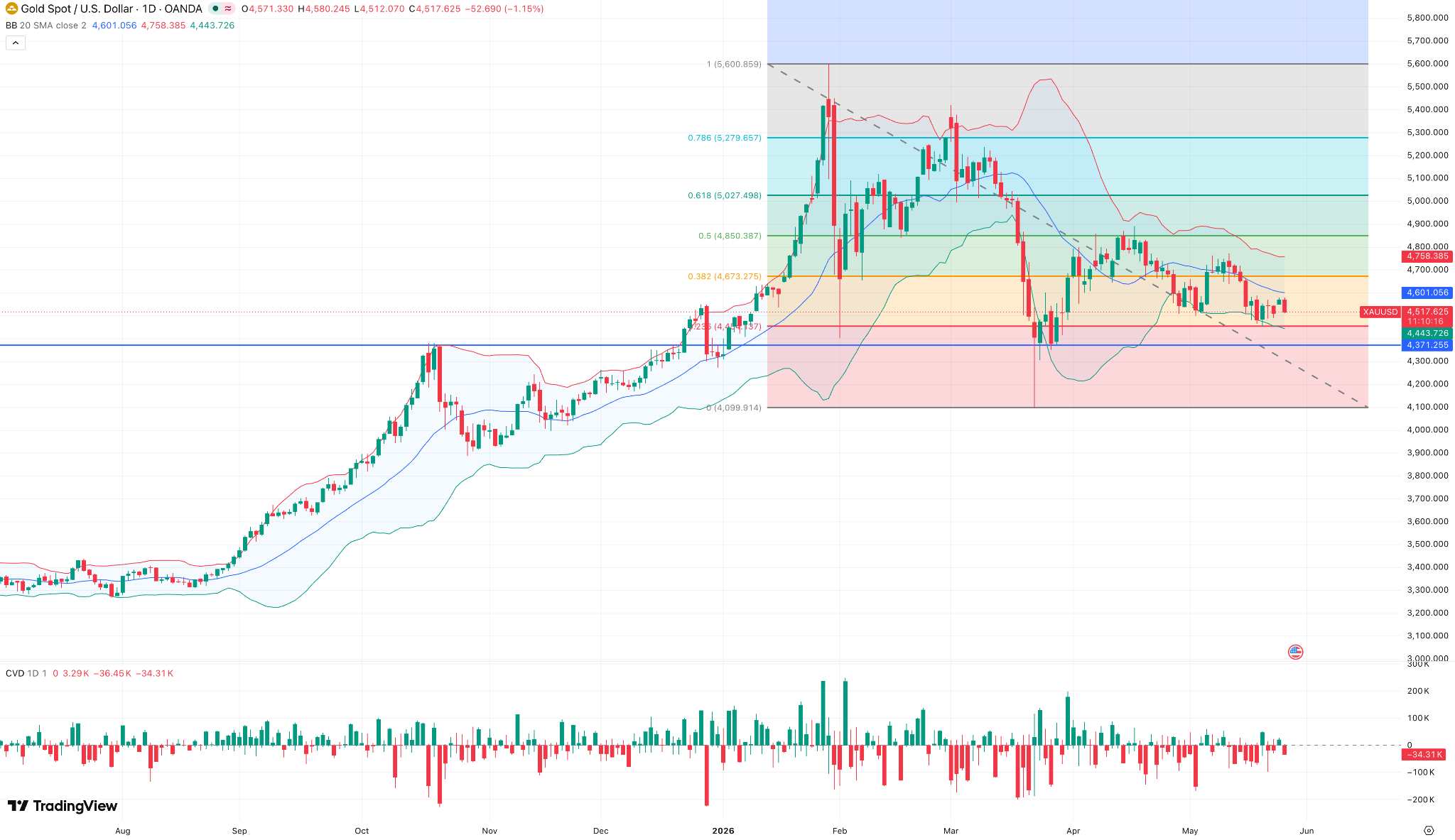
Technically, $4,500 is a key psychological level for gold and also serves as the base of the consolidation range from April 2026.

On May 20, gold prices opened lower but trended higher to reclaim $4,500, followed by several trading days of narrow range-bound fluctuations between $4,550 and $4,580. Strong buying support has emerged at the $4,500 level, with multiple intraday dips successfully rebounding above this mark, indicating that short-term technical support remains intact. If it breaks below the $4,500 psychological level, gold prices will likely test the next support level at $4,370.
xauusd-price-451b209d87b1482f9f983e41ca0a15e6

[Key support levels for gold and Bollinger Band ranges, Source: TradingView]

Looking ahead, the US-Iran negotiations remain the greatest uncertainty for the market.

During the Asian trading session on May 25, market risk appetite improved significantly on optimistic expectations for US-Iran negotiations, sending gold prices rebounding toward $4,575 with an intraday gain of over 1%. If the negotiations achieve a substantive breakthrough, a decline in oil prices would alleviate inflationary pressures, thereby easing the upward pressure on the US dollar and Treasury yields and providing gold with some breathing room.

Conversely, if negotiations stall again or the situation worsens, although safe-haven sentiment might push gold prices higher in the short term, it would simultaneously drive up oil prices and inflation expectations. This would limit the scope for interest rate cuts and exert periodic pressure on gold.

Conclusion

Short-term volatility and a persistent tug-of-war at the 4,500 mark remain the norm.

CSC Financial notes that the area near $4,500 remains a favorable entry point for dollar-cost averaging in gold. The medium-to-long-term logic supporting gold prices—rising global sovereign credit risks, the wave of global de-dollarization, and continuous central bank gold purchases—remains unchanged.

Overall, the $4,500 level offers strong short-term psychological and technical support, though pressure from the U.S. dollar and Treasury yields has yet to subside. The likelihood of a break below this mark and a rapid descent toward $4,100 is low; defending the $4,500 mark will depend on substantive progress in U.S.-Iran negotiations and a marginal easing of inflationary pressures. For long-term investors, the area near $4,500 provides a certain margin of safety and allocation value.

Disclaimer: For information purposes only. Past performance is not indicative of future results.
placeholder
Bitcoin CME gaps at $35,000, $27,000 and $21,000, which one gets filled first?Prioritize filling the $27,000 gap and even try higher.
Author  FXStreet
Aug 22, 2023
Prioritize filling the $27,000 gap and even try higher.
placeholder
Pinduoduo Earnings Incoming: Morgan Stanley Sees Long-Term Profit Potential​Insights – On November 21, Chinese e-commerce giant Pinduoduo (PDD) will release its Q3 2024 earnings.
Author  Mitrade
Nov 20, 2024
​Insights – On November 21, Chinese e-commerce giant Pinduoduo (PDD) will release its Q3 2024 earnings.
placeholder
Elon Musk’s xAI and Neuralink Launch New Funding Rounds​Billionaire Elon Musk recently raised funds for his two high-profile tech companies, xAI and Neuralink.
Author  Insights
Jun 03, 2025
​Billionaire Elon Musk recently raised funds for his two high-profile tech companies, xAI and Neuralink.
placeholder
Bitcoin briefly loses 2025 gains as crypto plunges over the weekend.Bitcoin experienced a sharp decline this weekend, briefly erasing its 2025 gains and dipping below its year-opening value of $93,507. The cryptocurrency fell to a low of $93,029 on Sunday, representing a 25% drop from its all-time high in October. Although it has rebounded slightly to around $94,209, the pressures on the market remain significant. The downturn occurred despite the reopening of the U.S. government on Thursday, which many had hoped would provide essential support for crypto markets. This year initially appeared promising for cryptocurrencies, particularly after the inauguration of President Donald Trump, who has established the most pro-crypto administration thus far. However, ongoing political tensions—including Trump's tariff strategies and the recent government shutdown, lasting a historic 43 days—have contributed to several rapid price pullbacks for Bitcoin throughout the year. Market dynamics are also being influenced by Bitcoin whales—investors holding large amounts of Bitcoin—who have been offloading portions of their assets, consequently stalling price rallies even as positive regulatory developments emerge. Despite these sell-offs, analysts from Glassnode argue that this behavior aligns with typical patterns seen among long-term investors during the concluding stages of bull markets, suggesting it is not indicative of a mass exodus. Notably, Bitcoin is not alone in its struggles, as Ethereum and Solana have also recorded declines of 7.95% and 28.3%, respectively, since the start of the year, while numerous altcoins have faced even steeper losses. Looking ahead, questions linger regarding the viability of the four-year cycle thesis, particularly given the increasing institutional support and regulatory frameworks now in place in the crypto landscape. Matt Hougan, chief investment officer at Bitwise, remains optimistic, suggesting a potential Bitcoin resurgence in 2026 driven by the “debasement trade” thesis and a broader trend toward increased adoption of stablecoins, tokenization, and decentralized finance. Hougan emphasized the soundness of the underlying fundamentals, pointing to a positive outlook for the sector in the longer term.
Author  Mitrade
Nov 17, 2025
Bitcoin experienced a sharp decline this weekend, briefly erasing its 2025 gains and dipping below its year-opening value of $93,507. The cryptocurrency fell to a low of $93,029 on Sunday, representing a 25% drop from its all-time high in October. Although it has rebounded slightly to around $94,209, the pressures on the market remain significant. The downturn occurred despite the reopening of the U.S. government on Thursday, which many had hoped would provide essential support for crypto markets. This year initially appeared promising for cryptocurrencies, particularly after the inauguration of President Donald Trump, who has established the most pro-crypto administration thus far. However, ongoing political tensions—including Trump's tariff strategies and the recent government shutdown, lasting a historic 43 days—have contributed to several rapid price pullbacks for Bitcoin throughout the year. Market dynamics are also being influenced by Bitcoin whales—investors holding large amounts of Bitcoin—who have been offloading portions of their assets, consequently stalling price rallies even as positive regulatory developments emerge. Despite these sell-offs, analysts from Glassnode argue that this behavior aligns with typical patterns seen among long-term investors during the concluding stages of bull markets, suggesting it is not indicative of a mass exodus. Notably, Bitcoin is not alone in its struggles, as Ethereum and Solana have also recorded declines of 7.95% and 28.3%, respectively, since the start of the year, while numerous altcoins have faced even steeper losses. Looking ahead, questions linger regarding the viability of the four-year cycle thesis, particularly given the increasing institutional support and regulatory frameworks now in place in the crypto landscape. Matt Hougan, chief investment officer at Bitwise, remains optimistic, suggesting a potential Bitcoin resurgence in 2026 driven by the “debasement trade” thesis and a broader trend toward increased adoption of stablecoins, tokenization, and decentralized finance. Hougan emphasized the soundness of the underlying fundamentals, pointing to a positive outlook for the sector in the longer term.
placeholder
Forex Today: Risk flows dominate markets on US-Iran deal hopesHere is what you need to know on Monday, May 25:
Author  FXStreet
Yesterday 09: 45
Here is what you need to know on Monday, May 25:
goTop
quote