


Retail Investors Front-Run SpaceX IPO. $33 Million Traded in SPCX Perpetual Contracts on First Day as Valuation Surges to 2.4 Trillion
TradingKey - Although the SpaceX (SPCX) IPO has not yet been finalized, retail investors have already flooded the market. On May 17, perpetual contract exchange Trade.xyz launched SpaceX pre-IPO perpetual contracts on the Hyperliquid blockchain, tracking the implied valuation of SpaceX. This allows investors to place directional bets on its price movements before the official IPO and provides ample leverage to amplify profits and losses.
Perpetual contracts are cryptocurrency derivatives without expiry dates or settlement cycles. Investors purchasing SpaceX pre-IPO perpetual contracts do not receive actual shares; they are betting on the implied valuation and trajectory of SpaceX. Following SpaceX's listing, these contracts will automatically convert into U.S. common stock perpetual contracts, allowing positions to transition directly into real secondary market trading.
Cryptocurrency industry authority The Defiant reported that the contract opened at $150, corresponding to a SpaceX valuation of approximately $1.78 trillion. It surged to $216 within hours before closing at roughly $202.89. Based on the share count benchmark used by Trade.xyz, this price represents a SpaceX valuation of about $2.4 trillion, higher than the $2 trillion previously expected by the media. The contract's 24-hour volume on its first day reached $33 million, with open interest at $21.8 million, reflecting intense retail enthusiasm for the SpaceX IPO.
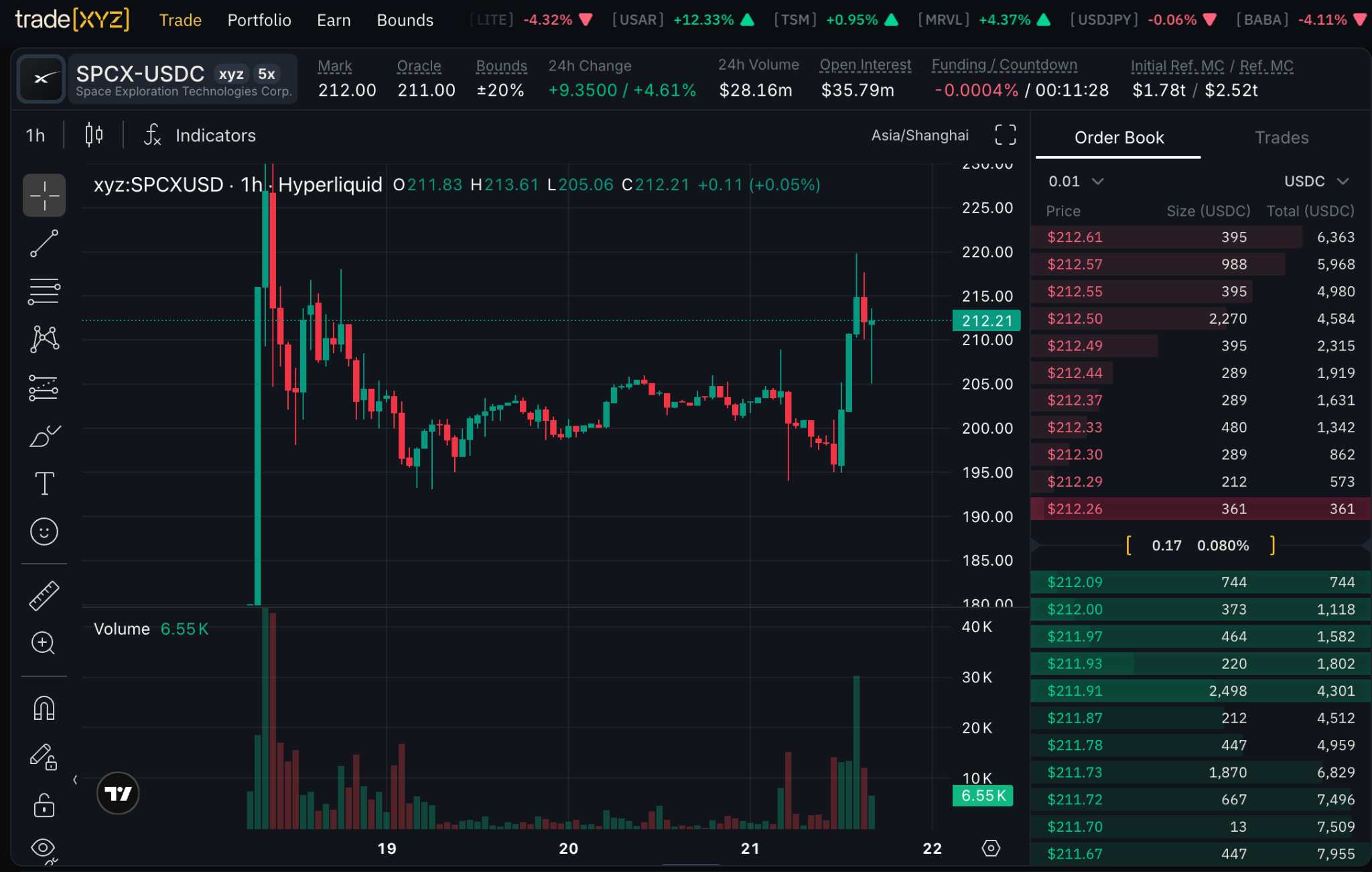
Image source: Trade.xyz
Stephen Coltman, Head of Macro at 21shares, stated that the Hyperliquid ecosystem, which Trade.xyz relies on, has become a core venue for price discovery for assets that cannot be traded through other means. In short, Hyperliquid is a highly democratized exchange where retail investors can price assets through trading. He also noted that even institutional investors and high-net-worth individuals generally struggle to obtain share allocations before SpaceX goes public.
Perpetual Contracts vs. Tokenized Equity: How to Invest in SpaceX?
In fact, beyond perpetual contracts, another investment method open to the public in the crypto market is even more widely known: tokenized equities. Issuers of tokenized equities typically purchase and lock up a corresponding amount of real shares from U.S. brokers, then perform tokenized splits on these shares to sell them to retail investors in the form of fractional shares. However, this model was recently disavowed by some equity owners.
Earlier this month, the crypto exchange PreStocks launched tokens linked to equity in OpenAI and Anthropic on the Solana blockchain. However, OpenAI and Anthropic subsequently issued statements declaring they do not recognize equity transferred to third parties through Special Purpose Vehicles (SPVs), and the prices of tokens associated with OpenAI and Anthropic plummeted immediately thereafter.
In contrast, SPCX perpetual contracts do not claim to hold any SpaceX shares; they are purely cash-settled synthetic assets that are not subject to skepticism due to official regulatory intervention. After SpaceX goes public, they can be directly converted into conventional U.S. stock perpetual contracts, pegged to real-time secondary market share prices post-listing, and remain continuously valid.
What are the risks of trading SpaceX perpetual contracts before the SpaceX IPO?
Although perpetual contracts are a relatively safer trading vehicle compared to tokenized equities, the high-risk nature of these crypto-financial derivatives must still be considered. Primarily, these platforms permit high-leverage trading, which amplifies both gains and losses; furthermore, driven by on-chain sentiment, they are prone to extreme volatility and frequent liquidations.
Given that on-chain trading is heavily influenced by retail sentiment, it often carries an exaggerated valuation premium. For instance, the SPCX perpetual contract launched by the Trade.xyz exchange implies a SpaceX valuation exceeding $2 trillion, which is higher than its private market valuation. If the actual IPO valuation falls short of $2.4 trillion, the perpetual contract price could face a significant drawdown.
In addition, because perpetual contracts lack an expiry date, prices can easily lose parity, leading to the use of funding rates for price regulation. When market participants are overwhelmingly long on SPCX, funding rates can spike, meaning that maintaining a position requires the continuous payment of high interest costs.
Therefore, investors intending to trade SPCX perpetual contracts ahead of the SpaceX IPO must understand all associated risks and be prepared for the possibility of a total loss.
Recommended Articles


