


If You Invest $200 per Month in the S&P 500 Right Now, Here's What You Might Have After 30 Years
Key Points
S&P 500 index funds and ETFs are low-maintenance investments with plenty of growth potential.
A long-term outlook is key to maximizing your earnings.
While there are plenty of perks, there's one potential drawback to consider.
- 10 stocks we like better than S&P 500 Index ›
Investing in the stock market can build lifelong wealth, and the S&P 500 (SNPINDEX: ^GSPC) is a powerhouse index with decades of history generating positive long-term returns.
To be clear, past performance doesn't predict future returns, so there's no way to know for certain how any investment will perform over time. That said, the longer your timeline, the more likely you are to experience consistent growth. Here's how far $200 per month in the S&P 500 could go over 30 years.
Will AI create the world's first trillionaire? Our team just released a report on the one little-known company, called an "Indispensable Monopoly" providing the critical technology Nvidia and Intel both need. Continue »
Image source: Getty Images.
Building wealth with next to no effort
S&P 500 index funds and exchange-traded funds (ETFs) are among the safest investments out there, and they require minimal effort on your part. Each fund contains stocks from 500 of the largest U.S. companies, and it performs best when given decades of uninterrupted time to grow.
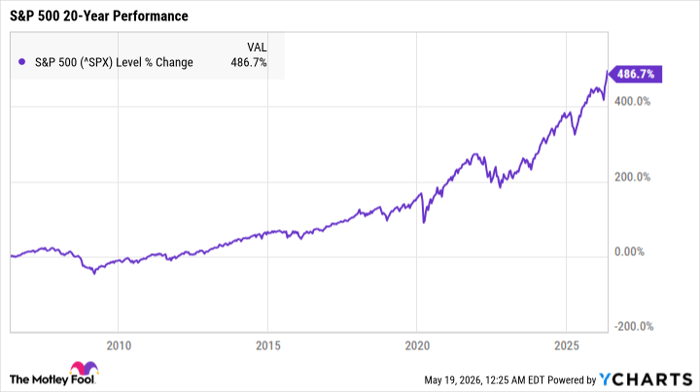
With enough time, it's incredibly likely you'll earn positive total returns with an S&P 500-tracking fund. In fact, every 20-year period in the S&P 500's history has ended in positive total returns, according to Crestmont Research.
^SPX data by YCharts
Again, nothing is guaranteed in the stock market. Historically, though, the S&P 500 has earned an average annual return of around 10%. It's unlikely you'll earn 10% returns every year, as some years you'll experience significant growth, while others you may experience losses. Over decades, though, the S&P 500's annual returns have averaged out to around 10% per year.
If you're investing $200 per month, here's approximately how your money might accumulate over time if you're earning a 10% average annual return:
| Number of Years | Total Portfolio Value |
|---|---|
| 15 | $76,000 |
| 20 | $137,000 |
| 25 | $236,000 |
| 30 | $395,000 |
Data source: author's calculations via investor.gov.
Time is your most valuable asset in the stock market, so the earlier you can begin investing, the easier it will be to generate substantial wealth.
How to earn even more in the stock market
Investing in an S&P 500 index fund or ETF can help you generate substantial wealth over decades, potentially reaching close to $400,000 after 30 years with just a couple of hundred dollars per month. However, because it's designed to mirror the market, it can't earn above-average returns.
This may not be a dealbreaker for everyone. However, investing in individual stocks or even a growth-focused ETF could help you earn average returns much higher than 10% per year. These investments may be more volatile or require more research than an S&P 500 fund, so whether that's a worthwhile trade-off will depend on your risk tolerance and personal preferences.
Regardless of where you invest, a long-term outlook can help supercharge your earnings in the stock market. By getting started now, you could earn more than you might think.
Should you buy stock in S&P 500 Index right now?
Before you buy stock in S&P 500 Index, consider this:
The Motley Fool Stock Advisor analyst team just identified what they believe are the 10 best stocks for investors to buy now… and S&P 500 Index wasn’t one of them. The 10 stocks that made the cut could produce monster returns in the coming years.
Consider when Netflix made this list on December 17, 2004... if you invested $1,000 at the time of our recommendation, you’d have $481,750!* Or when Nvidia made this list on April 15, 2005... if you invested $1,000 at the time of our recommendation, you’d have $1,352,457!*
Now, it’s worth noting Stock Advisor’s total average return is 990% — a market-crushing outperformance compared to 206% for the S&P 500. Don't miss the latest top 10 list, available with Stock Advisor, and join an investing community built by individual investors for individual investors.
See the 10 stocks »
*Stock Advisor returns as of May 20, 2026.
Katie Brockman has no position in any of the stocks mentioned. The Motley Fool has no position in any of the stocks mentioned. The Motley Fool has a disclosure policy.
Recommended Articles


