


OpenAI Launches “Compute Annual Pass” Before IPO to Lock in Long-Term Revenue: Can It Counter Anthropic to Achieve IPO Valuation Recovery?
TradingKey - On Tuesday, May 19 (ET), OpenAI announced the official launch of a new product called "Guaranteed Capacity." The offering allows customers to secure long-term access to computing resources to support their AI products, agents, and workflows. Enterprise customers can enter into 1-, 2-, or 3-year capacity agreements, with steeper discounts available for longer commitments.
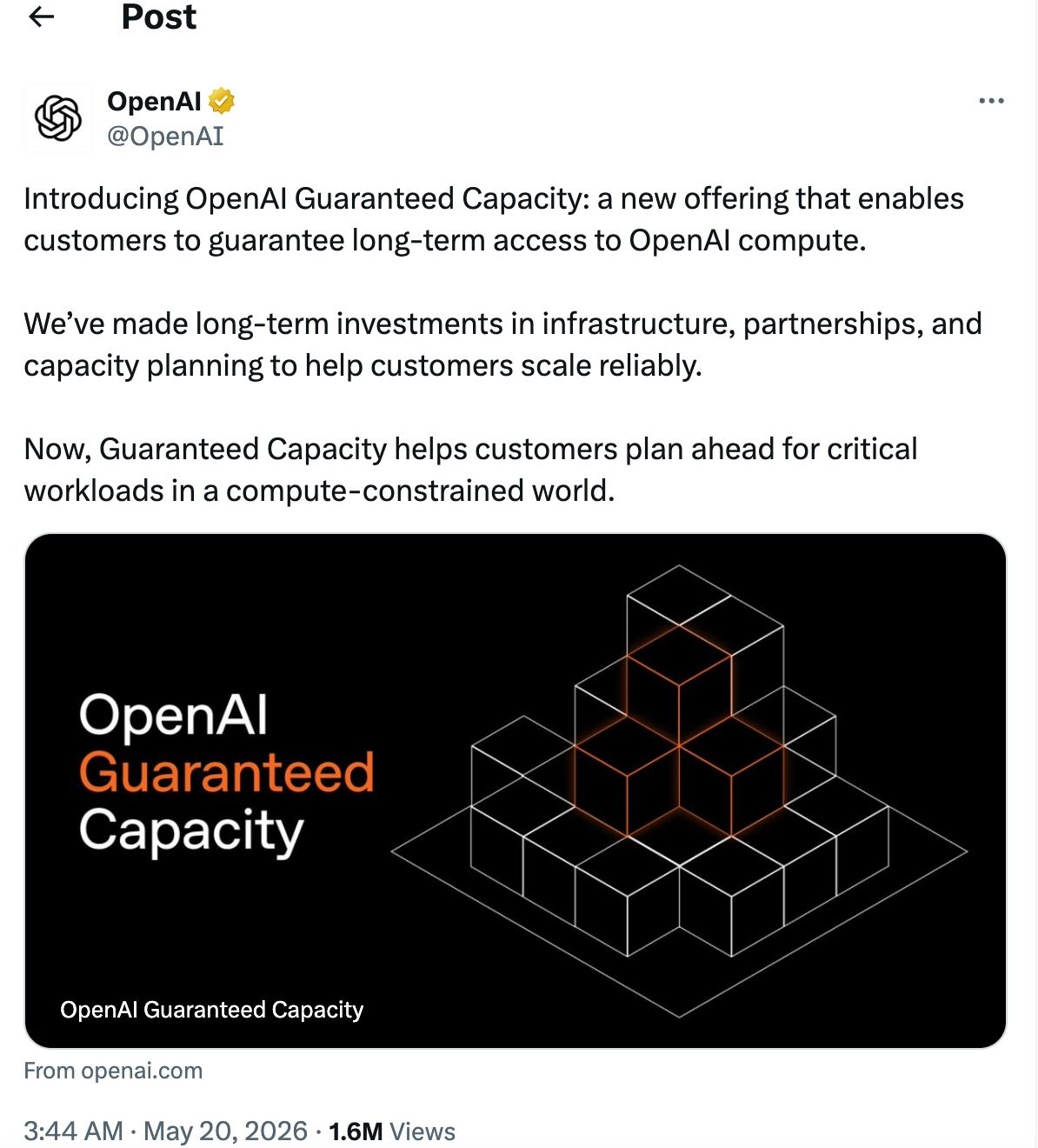
OpenAI CEO Sam Altman stated that the service was launched because customers are increasingly seeking capacity certainty, adding that he expects global capacity constraints to persist for some time. He noted that OpenAI will offer the service until current quotas are sold out, with plans to reopen it in the future. CNBC previously reported that OpenAI aims for total computing expenditures to reach approximately $600 billion by 2030.
Altman said the new service is designed to be a "win-win," allowing customers to lock in capacity while enabling OpenAI to plan more effectively. However, OpenAI will continue to prioritize its own products, such as ChatGPT and the coding assistant Codex, to ensure they have sufficient computing power.
Why OpenAI also needs long-term compute contracts.
This is not uncommon in the tech industry, especially in the recently booming memory sector. In April this year, South Korean media reported that supply contracts for Samsung and SK Hynix are shifting toward long-term structures. Previously, Samsung accepted ultra-short-term quarterly contracts as recently as last year. However, starting this year, Samsung will apply a minimum three-year LTA framework to all new contracts with major customers, while SK Hynix is negotiating a long-term supply contract for general-purpose DRAM with Google for up to five years, with talks expected to conclude within the first half of the year.
Tech hardware analyst Shawn Kim pointed out the advantages of these Long-Term Agreements (LTAs) for memory: against the backdrop of memory becoming a key bottleneck in AI infrastructure, LTAs signed by customers to ensure supply are transforming memory—a traditionally cyclical business—into a more secure, high-margin, and long-term revenue stream.
However, this practice typically occurs in the upstream of the AI value chain; in addition to the aforementioned memory suppliers Samsung and SK Hynix, it also includes Nvidia ( NVDA ), Broadcom (AVGO) , among others. A Wall Street Journal report in May showed that Nvidia disclosed $95.2 billion in purchase commitments to suppliers in its latest quarterly report, a staggering 89% increase from three months prior. In its March earnings report, Broadcom also announced it had "locked in the necessary supply chain" to support its target of $100 billion in AI chip revenue next year.
The reason OpenAI’s launch of long-term compute contracts has become a market focus is that it is very rare for large model companies in the AI industry to introduce long-term agreements on the demand side. Typically, companies like OpenAI, which fall under the software application category, operate on a pay-as-you-go basis, such as paying per token. However, the AI industry has evolved beyond a low-cost, asset-light game. Although OpenAI has a lower proportion of infrastructure assets compared to hardware or cloud service companies, it still carries multi-billion dollar compute procurement orders and urgently needs to transfer the pressure of uncertainty to downstream enterprises.
By locking in users through long-term contracts, OpenAI can also effectively address one of the market's primary anxieties regarding the company: revenue falling short of expectations. According to a Wall Street Journal report in late April, OpenAI failed to meet its 2025 ChatGPT revenue target and its goal of reaching 1 billion weekly active users by the end of 2025. If long-term compute agreements are successfully implemented, they could lock in future revenue, reduce uncertainty, and provide more leverage for an IPO.
However, this is not something OpenAI can decide unilaterally. The key lies in whether OpenAI's customers—amid the current "triopoly" of large model companies OpenAI, Google, and Anthropic, and with Anthropic’s latest valuation of $900 billion already surpassing OpenAI—are willing to bet on OpenAI's future. It remains unclear how binding OpenAI's "Guaranteed Capacity" is for its customers, as the project's contract terms, default mechanisms, and prepayment arrangements have not been disclosed.
Recommended Articles


