


Here's What the Futures Markets Are Saying About Oil and the Conflict in the Persian Gulf
Key Points
Oil futures suggest current supply disruptions are temporary.
Energy stocks may benefit if oil prices remain high longer than expected, not least because oil companies aren't as yet ramping up investment in response to the closure of the Strait of Hormuz.
- 10 stocks we like better than Global X Funds - Global X Mlp & Energy Infrastructure ETF ›
It's time to revisit what the oil futures market is pricing in. The data make for fascinating reading and, arguably, positive news for investors in energy stocks such as Chevron (NYSE: CVX) and U.S.-focused energy infrastructure ETFs like the Global X MLP & Energy Infrastructure ETF (NYSEMKT: MLPX). Here's what it all means to investors.
Interpreting the oil futures data
In theory, at least, futures prices should trade in "contango," meaning that prices further out trade higher than near-term prices. This reflects the cost of storage, insurance, and cash tied up in holding it.
Will AI create the world's first trillionaire? Our team just released a report on the one little-known company, called an "Indispensable Monopoly" providing the critical technology Nvidia and Intel both need. Continue »
However, in practice, oil futures often trade in backwardation (as in the chart), whereby nearer-term prices are higher than longer-term prices. This is possibly due to a concerted preference to avoid the risk of a future price rise due to OPEC action or geopolitical factors by having oil to hand in the near term.
Backwardation also occurs when a scarcity of near-term supply stresses the oil market, but it is expected to normalize over time. That's pretty much what the chart says. You could think of it as the market signaling it's pricing in a near-term supply constraint that will normalize over time.
There are two things in the chart that imply that futures contracts are shown as being higher in early April than in mid-May:
- Both sets of data show backwardation with lower prices in the future.
- Note that the spread between the May and April series data is much larger earlier (for example, in June, July, and August 2026) than it is later (for example, in May, June, and July 2027); this implies the increase in the spot price of oil between April and May is being absorbed by the front end of the curve.
All told, the oil futures market is still implying that the conflict will be resolved and the disruption to oil supplies will prove temporary. Given the difficulties inherent in ramping up near-term oil production, changing demand patterns, and/or shifting to substitutes, this view also implies a reopening of the Strait of Hormuz.
For reference, the International Energy Agency estimates that 34% of global crude oil trade passed through the Strait in 2025. Traffic through the Strait is essential to the global oil industry.
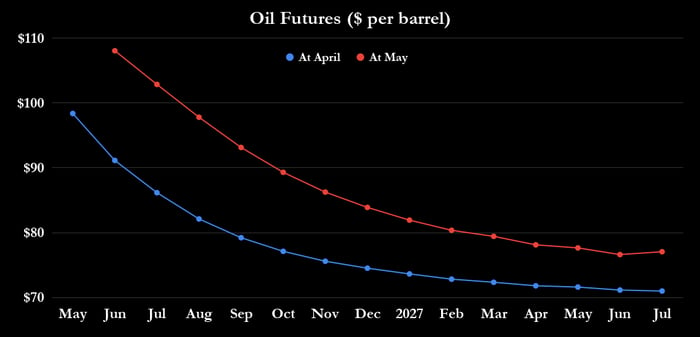
Data source: oilprice.com, accessed April 8 and May 19. Chart by author.
What oil companies are doing
If you extrapolate this conclusion to the equity markets, you could argue that they are pricing in a near-term profitability scenario for oil stocks, with normalization thereafter. It's a scenario that oil exploration management appears to believe in, too, because a survey of the leading oil and gas exploration and production companies' latest earnings presentations shows that only Diamondback Energy increased its capital spending plans for 2026, from $3.75 billion to $3.9 billion. In other words, don't expect an aggressive ramp-up in U.S. oil and gas production over the near term to save the day if global supplies remain curtailed.
All of this raises the question: What if the oil futures market, equity investors, and oil company management are wrong?
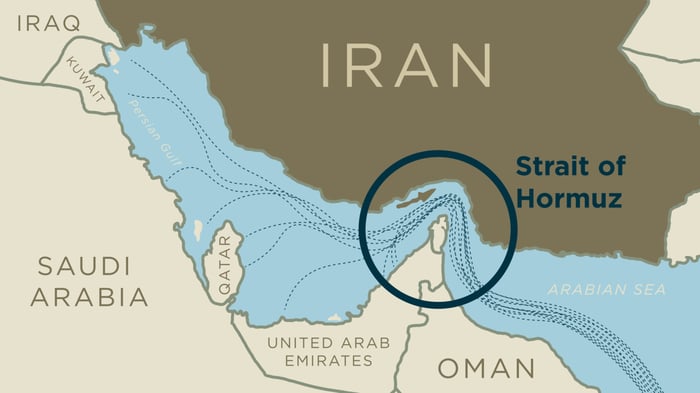
Image source: Getty Images.
Why it's bullish for energy stocks
If the markets are wrong and the price of oil stays higher for longer than implied by the futures market curve, then oil and related stocks are highly likely to go higher. It's an entirely plausible scenario because the ceasefires haven't held, the Strait remains closed, reports of imminent "deals" have only served to create oil price volatility, and it's far from clear when the conflict will be resolved.
In addition, it will take time to repair damage to infrastructure. For example, according to S&P Global Market Intelligence, QatarEnergy believes it will take three to five years to repair its liquefied natural gas (LNG) facilities. Meanwhile, there's also the question of a potentially increased risk premium and insurance cost of shipping through the Strait, not to mention the possibility that the willingness to invest in the region will be impaired.
As such, there's plenty of life left in the idea that you should buy energy stocks to protect against a higher-for-longer oil price scenario.
Should you buy stock in Global X Funds - Global X Mlp & Energy Infrastructure ETF right now?
Before you buy stock in Global X Funds - Global X Mlp & Energy Infrastructure ETF, consider this:
The Motley Fool Stock Advisor analyst team just identified what they believe are the 10 best stocks for investors to buy now… and Global X Funds - Global X Mlp & Energy Infrastructure ETF wasn’t one of them. The 10 stocks that made the cut could produce monster returns in the coming years.
Consider when Netflix made this list on December 17, 2004... if you invested $1,000 at the time of our recommendation, you’d have $483,476!* Or when Nvidia made this list on April 15, 2005... if you invested $1,000 at the time of our recommendation, you’d have $1,362,941!*
Now, it’s worth noting Stock Advisor’s total average return is 998% — a market-crushing outperformance compared to 207% for the S&P 500. Don't miss the latest top 10 list, available with Stock Advisor, and join an investing community built by individual investors for individual investors.
See the 10 stocks »
*Stock Advisor returns as of May 20, 2026.
Lee Samaha has no position in any of the stocks mentioned. The Motley Fool has positions in and recommends Chevron and S&P Global. The Motley Fool has a disclosure policy.
Recommended Articles


