

Dow Jones Industrial Average climbs 450 points after early AI shudders
- The Dow Jones tipped back into the bullish side on Wednesday.
- Equities caught an early dip after ADP jobs and AI-based sales targets both missed.
- Weak jobs figures, despite their volatile origin, are sparking fresh bets of a December rate cut.
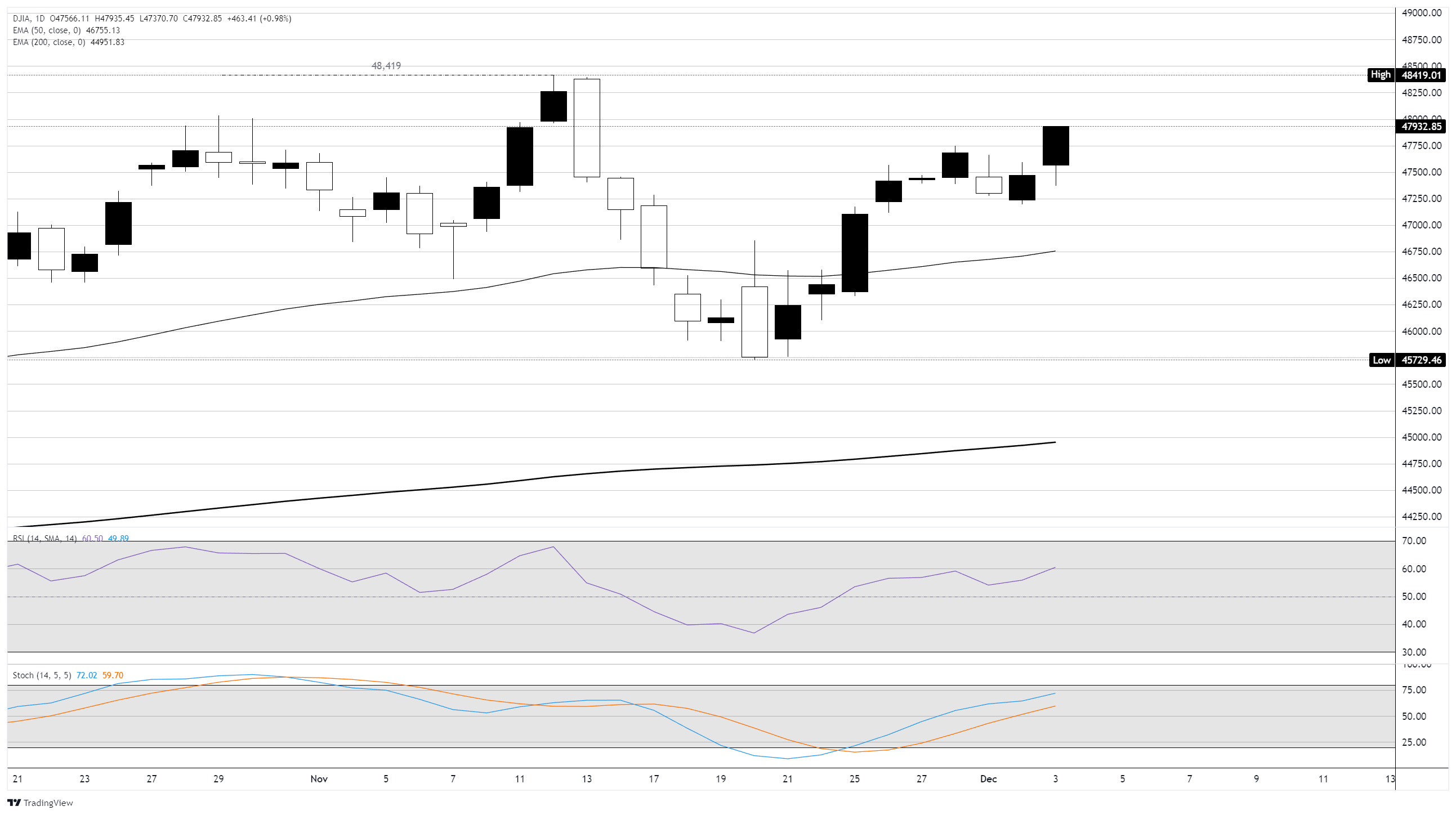
The Dow Jones Industrial Average (DJIA) rose 450 points on Wednesday, sparked by renewed market optimism that the US economy is performing so poorly that the Federal Reserve (Fed) will be forced to deliver a third straight interest rate cut in December. Equities caught a bearish tilt earlier in the day after a sharp contraction in ADP jobs figures and downside revisions for Microsoft’s (MSFT) AI-focused sales divisions delivered a sharp one-two punch to stock traders. However, the glimmer of another quarter-point interest rate cut in the face of a crumbling labor market stoked bullish sentiment heading through the midweek market session.
US private jobs data sinks again, bolsters rate cut bets
ADP Employment Change showed a 32K contraction in the net change in payrolled jobs through November, a sharp reversal from the previous month’s 47K output and well below the modest median forecast of 5K. ADP jobs data has remained volatile for years, struggling to maintain even a hint of a correlation to official datasets on a per-release basis. However, with official figures still delayed following the US government’s funding shutdown, markets and Fed officials have access to few other figures than private datapoints like sketchy jobs data from private payroll companies.
According to the CME’s FedWatch Tool, rate traders are now pricing in nearly 90% odds that the Fed will be pushed to deliver a third straight interest rate cut on December 10. Odds that the Fed might pull back from the brink and wait until January still sit high at 80%, but investors are tilting further into bets of a December rate trim as US jobs data continues to crumble.
US Industrial Production managed to eke out a 0.1% gain in September, however the march of back-dated revisions continues with the previous month’s figure slumping to -0.3%. S&P Global posted its latest Composite Purchasing Managers Index (PMI), which also showed a contraction in business expectations, with the aggregate index survey results falling to 54.2 from 54.8.
AI sales expectations continue to crash against the hard wall of reality
Multiple divisions within Microsoft that are associated with the tech giant’s AI ventures are lowering their sales expectations heading into the end of the year. Despite most of the AI segment declaring 2025 the year of the AI agent in the early months, the tone is quietly shifting lower inside companies that are struggling to hit lofty sales benchmarks as end-user demand for AI projects continues to run well below executives’ collective hopes and dreams. According to sources within Microsoft, sales quotas are getting lowered across the board on AI projects. It is allegedly rare for companies like Microsoft to lower sales targets, and it has highlighted how consumers and businesses are all growing increasingly resistant to paying more for attempts to automate the world with AI.
Microsoft shares tumbled 2.28% on the news, falling to a one-week low of $475.22 before staging a meager recovery back above $486 per share, but still ending down overall on the day.
Dow Jones daily chart
Dow Jones FAQs
The Dow Jones Industrial Average, one of the oldest stock market indices in the world, is compiled of the 30 most traded stocks in the US. The index is price-weighted rather than weighted by capitalization. It is calculated by summing the prices of the constituent stocks and dividing them by a factor, currently 0.152. The index was founded by Charles Dow, who also founded the Wall Street Journal. In later years it has been criticized for not being broadly representative enough because it only tracks 30 conglomerates, unlike broader indices such as the S&P 500.
Many different factors drive the Dow Jones Industrial Average (DJIA). The aggregate performance of the component companies revealed in quarterly company earnings reports is the main one. US and global macroeconomic data also contributes as it impacts on investor sentiment. The level of interest rates, set by the Federal Reserve (Fed), also influences the DJIA as it affects the cost of credit, on which many corporations are heavily reliant. Therefore, inflation can be a major driver as well as other metrics which impact the Fed decisions.
Dow Theory is a method for identifying the primary trend of the stock market developed by Charles Dow. A key step is to compare the direction of the Dow Jones Industrial Average (DJIA) and the Dow Jones Transportation Average (DJTA) and only follow trends where both are moving in the same direction. Volume is a confirmatory criteria. The theory uses elements of peak and trough analysis. Dow’s theory posits three trend phases: accumulation, when smart money starts buying or selling; public participation, when the wider public joins in; and distribution, when the smart money exits.
There are a number of ways to trade the DJIA. One is to use ETFs which allow investors to trade the DJIA as a single security, rather than having to buy shares in all 30 constituent companies. A leading example is the SPDR Dow Jones Industrial Average ETF (DIA). DJIA futures contracts enable traders to speculate on the future value of the index and Options provide the right, but not the obligation, to buy or sell the index at a predetermined price in the future. Mutual funds enable investors to buy a share of a diversified portfolio of DJIA stocks thus providing exposure to the overall index.
Recommended Articles


