

Hyperliquid adds native oracles to power HIP-4 outcome markets

Source Cryptopolitan

Hyperliquid has shifted its approach to prediction markets, offering native oracles and resolutions. HIP-4 also switched to using USDC as its main liquidity source. 

Hyperliquid announced it will support canonical outcome markets based on off-chain events, as outlined on its Telegram channel. As Cryptopolitan reported earlier, HIP-4 took 0.7% of the prediction market on its first day of trading. As of May 2026, HIP-4 achieved 1% of the volumes of Polymarket, based on still limited outcome pairs. 

Existing Hyperliquid validators will run specialized software that automates newsfeeds as event outcomes. The newsfeed will become a part of the regular Hyperliquid chain operations. 

Unlike on Polymarket, the platform will not depend on third-party oracles or outcome voting systems. Polymarket’s reliance on UMA oracles and voting has led to several heavily contested markets and discussions of market manipulation.

Validators themselves will vote on the deployment and settlement of the new type of canonical markets. The current network supporters will resolve the potentially subjective and ambiguous markets. The outcomes will depend on 24 existing validators, which produce Hyperliquid L1 blocks in under a second, and secure $3B in liquidity.

Canonical markets do not guarantee objectivity, but protect from exposure to external voting systems. Validators will still vote on outcomes, and are one possible vector of subjectivity. However, smaller resolution systems have shown a risk of whale influence, allowing the manipulation of some markets. 

HIP-4 offers real-world outcome markets

Initially, HIP-4 started with outcomes for crypto price movements, converging perpetual futures with prediction markets. Recently, the platform offered macro outcomes, with predictions on Fed interest rates or inflation levels.

The platform’s goal is to automate the workflows, adding AI agents as proposers of new markets. Validators will then have the task of approving those markets and tracking the outcomes.

Prediction markets launched on May 2, and are still in their early stages, with a limited number of outcomes. For now, Hyperliquid is still in control on new market launches. In the future, HIP-4 will follow the model of HIP-3, allowing third-party validators to create outcome pairs. To date, the platform has carried 1M trades, and hosts around 500 traders.
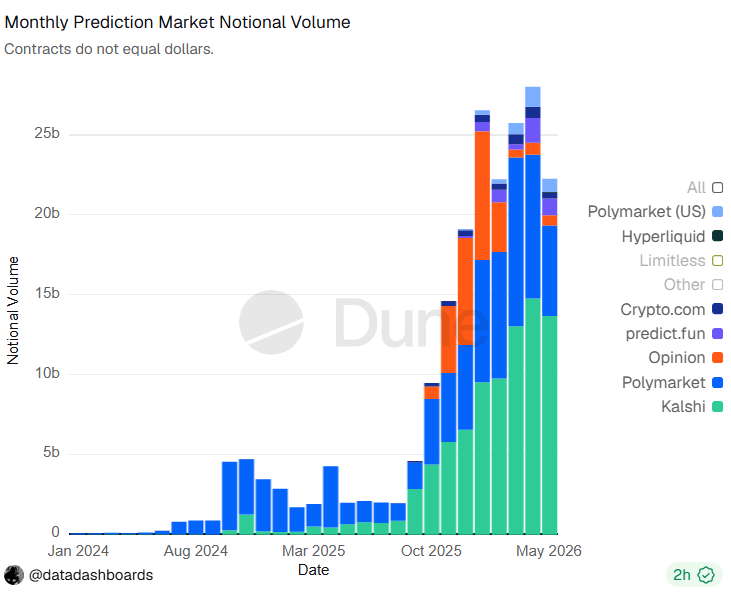
Hyperliquid offers native oracles for HIP-4 outcome markets.
HIP-4 is already on the map of prediction market platforms, and is now preparing for third-party prediction pair deployment. | Source: Dune Analytics.

HIP-4 will depend on builders, and some of the top HIP-3 deployers may create new markets. With this approach, the prediction market may converge with perpetual futures. The positioning of all markets in a single ecosystem may allow cross-margin trading and a concentration of liquidity.

Builders will create a competitive environment, trying to launch the most in-demand and liquid prediction pairs.

HIP-4 will also allow a novel approach to on-chain insurance, with transparent payouts in the case of predetermined outcomes. The markets can also serve as binary options, using the simplified binary outcome infrastructure.

Hyperliquid recovers value locked

Hyperliquid is one of the main ecosystems to resist the weakening sentiment of the crypto market. The platform now carries $5.53B in total value locked, down from $5.93M in October 2025.

Up to 40% of the newly active volumes come from HIP-3, onboarding flexible trading for traditional assets. Outcome markets may further boost volumes and fees.

As a result of the increased activity, the native HYPE token set a series of new price records. HYPE traded at $59.58, after peaking at $63.70, becoming one of the top growth tokens. The recent HYPE rally got a boost from whales, but was also an indicator of the positive view of Hyperliquid and its growth expectations.

If you're reading this, you’re already ahead. Stay there with our newsletter.

Disclaimer: For information purposes only. Past performance is not indicative of future results.
placeholder
Bitcoin CME gaps at $35,000, $27,000 and $21,000, which one gets filled first?Prioritize filling the $27,000 gap and even try higher.
Author  FXStreet
Aug 22, 2023
Prioritize filling the $27,000 gap and even try higher.
placeholder
Pinduoduo Earnings Incoming: Morgan Stanley Sees Long-Term Profit Potential​Insights – On November 21, Chinese e-commerce giant Pinduoduo (PDD) will release its Q3 2024 earnings.
Author  Mitrade
Nov 20, 2024
​Insights – On November 21, Chinese e-commerce giant Pinduoduo (PDD) will release its Q3 2024 earnings.
placeholder
Elon Musk’s xAI and Neuralink Launch New Funding Rounds​Billionaire Elon Musk recently raised funds for his two high-profile tech companies, xAI and Neuralink.
Author  Insights
Jun 03, 2025
​Billionaire Elon Musk recently raised funds for his two high-profile tech companies, xAI and Neuralink.
placeholder
Bitcoin briefly loses 2025 gains as crypto plunges over the weekend.Bitcoin experienced a sharp decline this weekend, briefly erasing its 2025 gains and dipping below its year-opening value of $93,507. The cryptocurrency fell to a low of $93,029 on Sunday, representing a 25% drop from its all-time high in October. Although it has rebounded slightly to around $94,209, the pressures on the market remain significant. The downturn occurred despite the reopening of the U.S. government on Thursday, which many had hoped would provide essential support for crypto markets. This year initially appeared promising for cryptocurrencies, particularly after the inauguration of President Donald Trump, who has established the most pro-crypto administration thus far. However, ongoing political tensions—including Trump's tariff strategies and the recent government shutdown, lasting a historic 43 days—have contributed to several rapid price pullbacks for Bitcoin throughout the year. Market dynamics are also being influenced by Bitcoin whales—investors holding large amounts of Bitcoin—who have been offloading portions of their assets, consequently stalling price rallies even as positive regulatory developments emerge. Despite these sell-offs, analysts from Glassnode argue that this behavior aligns with typical patterns seen among long-term investors during the concluding stages of bull markets, suggesting it is not indicative of a mass exodus. Notably, Bitcoin is not alone in its struggles, as Ethereum and Solana have also recorded declines of 7.95% and 28.3%, respectively, since the start of the year, while numerous altcoins have faced even steeper losses. Looking ahead, questions linger regarding the viability of the four-year cycle thesis, particularly given the increasing institutional support and regulatory frameworks now in place in the crypto landscape. Matt Hougan, chief investment officer at Bitwise, remains optimistic, suggesting a potential Bitcoin resurgence in 2026 driven by the “debasement trade” thesis and a broader trend toward increased adoption of stablecoins, tokenization, and decentralized finance. Hougan emphasized the soundness of the underlying fundamentals, pointing to a positive outlook for the sector in the longer term.
Author  Mitrade
Nov 17, 2025
Bitcoin experienced a sharp decline this weekend, briefly erasing its 2025 gains and dipping below its year-opening value of $93,507. The cryptocurrency fell to a low of $93,029 on Sunday, representing a 25% drop from its all-time high in October. Although it has rebounded slightly to around $94,209, the pressures on the market remain significant. The downturn occurred despite the reopening of the U.S. government on Thursday, which many had hoped would provide essential support for crypto markets. This year initially appeared promising for cryptocurrencies, particularly after the inauguration of President Donald Trump, who has established the most pro-crypto administration thus far. However, ongoing political tensions—including Trump's tariff strategies and the recent government shutdown, lasting a historic 43 days—have contributed to several rapid price pullbacks for Bitcoin throughout the year. Market dynamics are also being influenced by Bitcoin whales—investors holding large amounts of Bitcoin—who have been offloading portions of their assets, consequently stalling price rallies even as positive regulatory developments emerge. Despite these sell-offs, analysts from Glassnode argue that this behavior aligns with typical patterns seen among long-term investors during the concluding stages of bull markets, suggesting it is not indicative of a mass exodus. Notably, Bitcoin is not alone in its struggles, as Ethereum and Solana have also recorded declines of 7.95% and 28.3%, respectively, since the start of the year, while numerous altcoins have faced even steeper losses. Looking ahead, questions linger regarding the viability of the four-year cycle thesis, particularly given the increasing institutional support and regulatory frameworks now in place in the crypto landscape. Matt Hougan, chief investment officer at Bitwise, remains optimistic, suggesting a potential Bitcoin resurgence in 2026 driven by the “debasement trade” thesis and a broader trend toward increased adoption of stablecoins, tokenization, and decentralized finance. Hougan emphasized the soundness of the underlying fundamentals, pointing to a positive outlook for the sector in the longer term.
placeholder
Forex Today: Risk flows dominate markets on US-Iran deal hopesHere is what you need to know on Monday, May 25:
Author  FXStreet
Yesterday 09: 45
Here is what you need to know on Monday, May 25:
goTop
quote