




2 Game-Changing AI Stocks That Can Plunge 48% and 54%, According to Select Wall Street Analysts
Key Points
AI has been the stock market’s leading catalyst over the last four years, with investors wanting their piece of a multitrillion-dollar opportunity.
According to one analyst, the wind could leave the sails of Wall Street’s hottest initial public offering in short order.
Meanwhile, valuation is an unmistakable concern for a high-flying AI applications stock.
- 10 stocks we like better than Space Exploration Technologies ›
Over the last four years, the artificial intelligence (AI) revolution has reshaped Wall Street. Providing software and systems with the tools to make autonomous, split-second decisions is a multitrillion-dollar global opportunity, and investors want their piece of the pie.
While most Wall Street analysts are overwhelmingly bullish regarding the AI infrastructure build-out, optimism isn't universal. According to select analysts, two of the most widely owned AI stocks, Space Exploration Technologies (SpaceX) (NASDAQ:SPCX) and Palantir Technologies (NASDAQ:PLTR), can plunge 48% and 54%, respectively, over the next year.
Missed Nvidia in 2009? This Rare Signal Is Flashing Again. In 2009, a "Double Down" signal flashed for a little-known chipmaker called Nvidia. For the first time in years, that same "Total Conviction" signal is flashing for a company 1/100th the size of Nvidia. Continue »

Image source: Getty Images.
SpaceX: Implied downside of 48%
Considering that Elon Musk's space infrastructure and AI conglomerate had 21 underwriters, all of which received shares, it's not surprising that buy ratings outpace sell ratings by a substantial sum. Nevertheless, analyst Glenn Thum of Phillip Securities slapped a sell rating and a $75 price target on shares of SpaceX.
Thum's low-water price target for Space Exploration Technologies primarily concerns its AI-driven operations. Although SpaceX's mile-long prospectus assigned a $28.5 trillion addressable market to AI, Thum notes that this segment's otherworldly spending and steep losses aren't yet worthy of a valuation premium.
$SPCX SpaceX Q2 FY26:
— App Economy Insights (@EconomyApp) August 4, 2026
• Revenue +92% Y/Y to $7.8B ($1.0B beat).
• Operating margin -2% (+22pp Y/Y).
• CapEx $18.4B (including $15.8B for AI).
• GAAP EPS -$0.09 ($0.20 beat). pic.twitter.com/Kak4BAlKft
Additionally, Thum's research note cautions that SpaceX's major compute deals with Alphabet (NASDAQ:GOOGL)(NASDAQ:GOOG) and Anthropic will expire in late 2029 and can be terminated by either party after this year with 90 days' notice. In other words, xAI's long-term growth and profitability are far from assured.
Don't overlook SpaceX's staggered and accelerated share-unlock period, either. Whereas most initial public offerings prohibit insiders from selling shares for 180 calendar days post-debut, early-release-eligible SpaceX insiders can sell some of their shares to retail investors at several earnings- and time-based events. The steady increase in the company's float would be expected to weigh on its share price through at least mid-December.

Image source: Getty Images.
Palantir Technologies: Implied downside of 54%
The other game-changing AI stock that can plunge, according to at least one Wall Street analyst, is AI-driven software-as-a-service (SaaS) provider Palantir Technologies.
Jefferies (NYSE:JEF) analyst Brent Thill raised his firm's price target on Palantir in early August from $70 to $80. The problem is that Palantir shares ended the Sept. 15 trading session at $172.56, implying 54% downside from Thill's call.
Thill's primary issue with Palantir is a common theme among Palantir skeptics: its valuation.
On the one hand, Palantir brings clearly defined competitive advantages to the table. Its Gotham SaaS platform has no large-scale competitors and assists the U.S. government and its allies in planning and overseeing military operations. This contract gravy train has allowed Palantir CEO Alex Karp to raise full-year sales guidance every quarter.
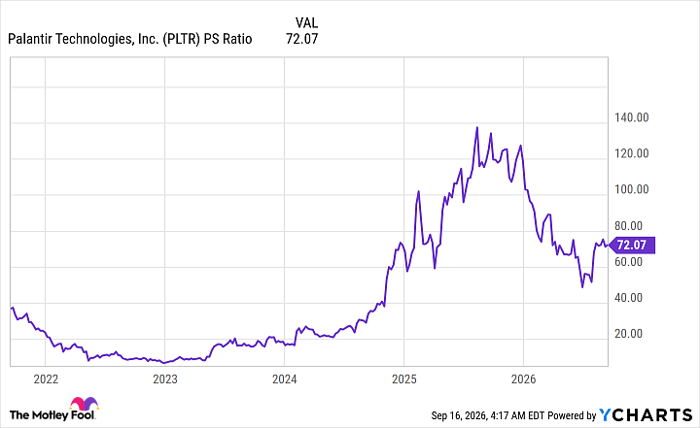
PLTR PS Ratio data by YCharts
On the flipside, history shows that price-to-sales (P/S) ratios above 30 aren't sustainable for companies at the forefront of innovative trends. Palantir entered 2026 with a P/S ratio above 100, and even with its outsize revenue growth is still sporting a trailing 12-month P/S ratio of 72. This is indicative of a bubble.
While Gotham's multiyear contracts would temporarily buoy Palantir if an AI bubble were to form and burst, the company's stratospheric valuation would make it a prime target during a bubble-bursting event.
Should you buy stock in Space Exploration Technologies right now?
Before you buy stock in Space Exploration Technologies, consider this:
The Motley Fool Stock Advisor analyst team just identified what they believe are the 10 best stocks for investors to buy now… and Space Exploration Technologies wasn’t one of them. The 10 stocks that made the cut could produce monster returns in the coming years.
Consider when Netflix made this list on December 17, 2004... if you invested $1,000 at the time of our recommendation, you’d have $412,074!* Or when Nvidia made this list on April 15, 2005... if you invested $1,000 at the time of our recommendation, you’d have $1,314,319!*
Now, it’s worth noting Stock Advisor’s total average return is 932% — a market-crushing outperformance compared to 209% for the S&P 500. Don't miss the latest top 10 list, available with Stock Advisor, and join an investing community built by individual investors for individual investors.
See the 10 stocks »
*Stock Advisor returns as of September 18, 2026.
Sean Williams has positions in Alphabet. The Motley Fool has positions in and recommends Alphabet, Jefferies Financial Group, and Palantir Technologies. The Motley Fool has a disclosure policy.
Recommended Articles


