




SK Hynix ADRs Rise Over 5% to Record High as S&P Expects Up to 40 Trillion Won Buyback in Q4
TradingKey - On September 9, US Eastern Time, SK Hynix ADR (SKHY) shares rose to a record high of $196.48, gaining over 5% intraday. Its total market capitalization reached $1.42 trillion, placing it less than a 5% gain away from Tesla's market capitalization ($1.47 trillion).
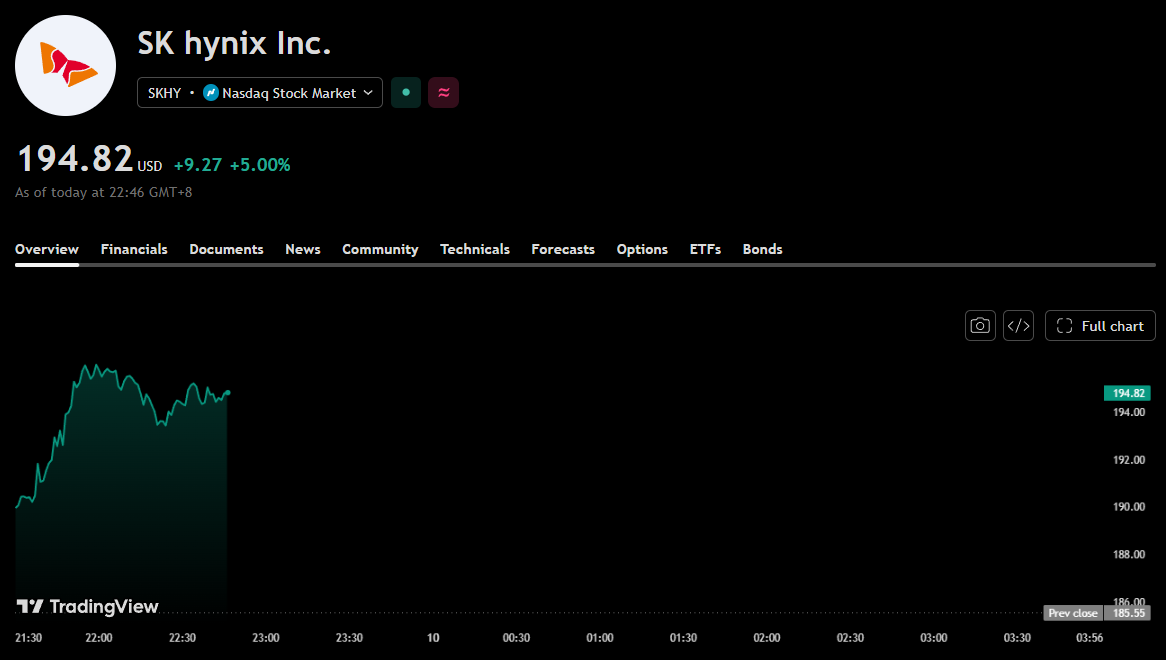
Source: TradingView
According to the latest forecast from S&P Global Market Intelligence, driven by strong demand in AI memory chips, SK Hynix is expected to announce a new share buyback plan in the fourth quarter of this year, with an estimated size between 20 trillion and 40 trillion Korean won (approximately $28 billion).
Furthermore, even after completing the large-scale buyback, the company will still have the capacity to pay generous dividends, adding a strong catalyst to the South Korean government's "Corporate Value-up" program and the rally driven by restructured shareholder returns.
Mohammad Hassan, Head of Asia-Pacific Equity Dividend Forecasting at S&P Global Market Intelligence, stated in an interview that the lower limit of SK Hynix's new round of buybacks is expected to be 20 trillion won, and "it could potentially hit the upper limit of 40 trillion won again."
In addition, South Korean brokerage KB Securities recently warned that memory semiconductor inventories at Samsung Electronics and SK Hynix have dropped to less than 10 days of supply, pointing to a significant shortage of available supply next year.
KB Securities pointed out in a report released on Monday that as artificial intelligence infrastructure investment expands at an unprecedented rate, the memory chip market is facing a severe supply shortage. A key factor exacerbating the shortage is the transition to next-generation High Bandwidth Memory, HBM4.
The firm noted that HBM4 requires approximately three times the wafer capacity of traditional DRAM. Given limited wafer capacity, full-scale mass production of HBM4 will inevitably reduce the available capacity for traditional DRAM. As a result, KB Securities expects DRAM and NAND demand to exceed supply by more than 10 percentage points next year.
Recommended Articles


