




Musk Says Cybercab Production Is Over 5x Faster, Cathie Wood’s ARK Bullish on Robotaxi Outlook: How Big Is Tesla’s Cost Advantage?
TradingKey - On September 8 Eastern Time, Tesla (TSLA) shares rose nearly 4% to close at $368.16, before edging down 0.13% in overnight trading.
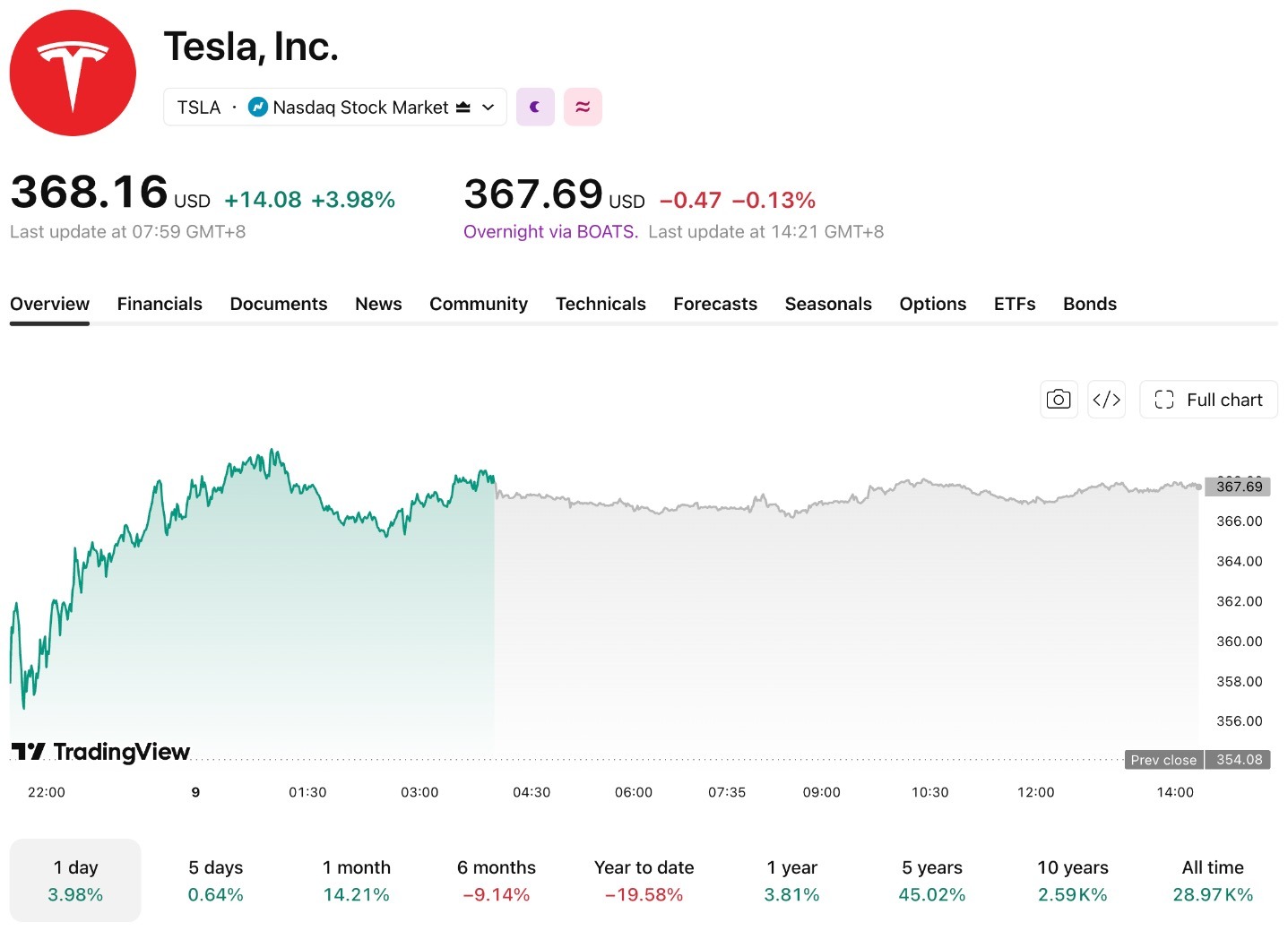
[Source: TradingView]
The Cybercab has joined the Robotaxi fleet in Austin, Texas. As the vehicles transition from production to active operations, market attention has shifted further toward mass production efficiency, FSD performance, and Robotaxi operating costs.
Cybercab Targets Higher Production Efficiency
On September 8, Eastern Time, Musk stated on X, "We redesigned the Cybercab production process to make its production speed more than 5 times faster than traditional automotive manufacturing!"
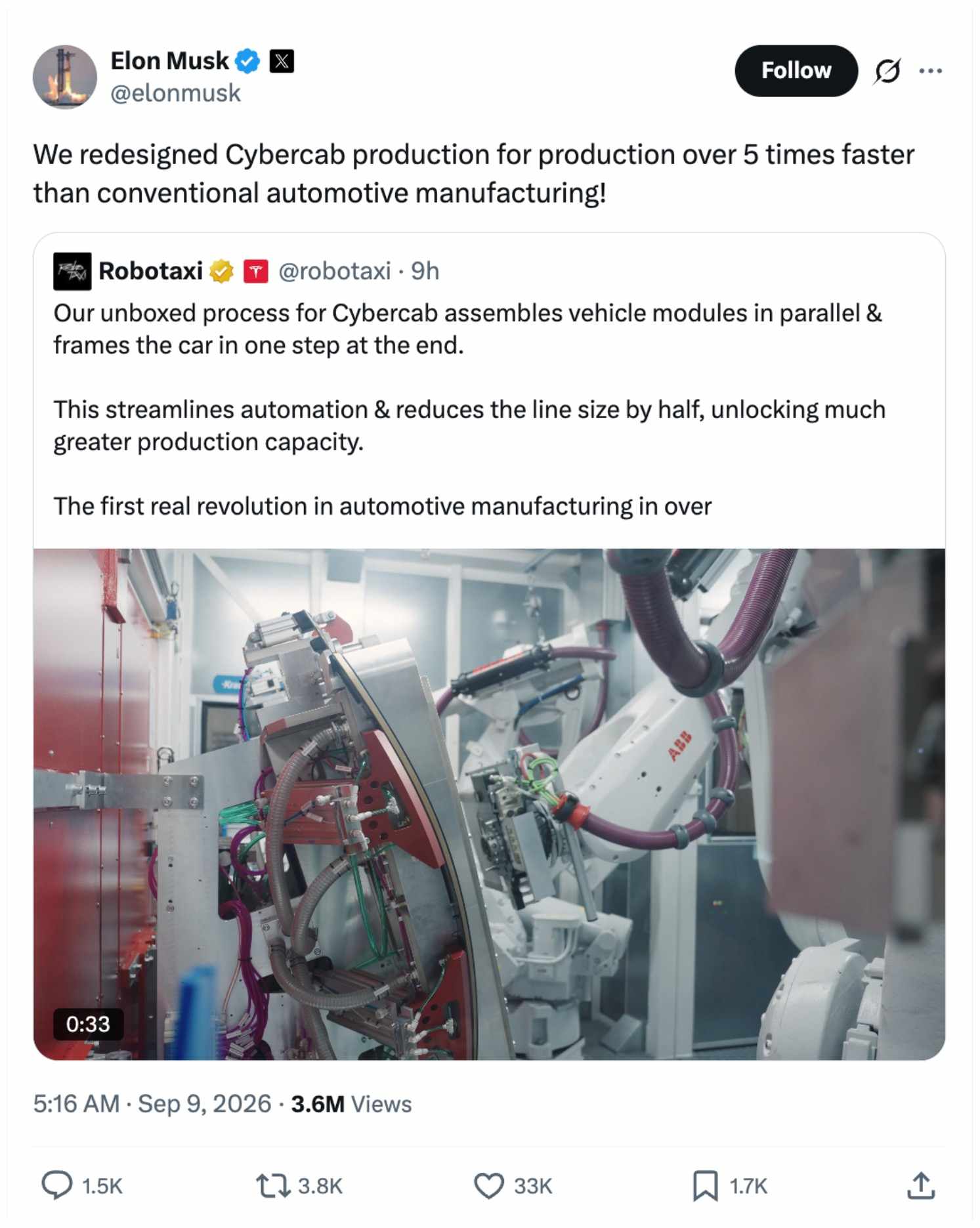
[Source: X platform]
The Cybercab adopts Tesla's so-called "Unboxed" manufacturing process, producing different vehicle modules in parallel and completing full vehicle assembly in the final stage. Tesla said this method can reduce the production line footprint by about half while increasing production output capacity.
On the technical front, the Cybercab uses a dry brake-by-wire system, controlling brake calipers through electromechanical actuators and eliminating traditional hydraulic brake lines and brake fluid.
Musk also stated that the Cybercab's drive motor does not use rare earth materials, adding that achieving this without sacrificing range performance is "extremely difficult."
FSD Adds Automatic Collision Avoidance Feature
Meanwhile, Tesla has begun publicly rolling out FSD (Supervised) v14.3.9, which adds the Automatic Collision Evasion feature.
According to the v14.3.9 release notes, during manual driving, if the system determines that a frontal collision is imminent and braking alone may not be sufficient to avoid it, FSD (Supervised) can automatically engage to attempt evasion.
In addition, the system can also proactively intervene when it detects that the driver is not paying sufficient attention to the road or determines that FSD (Supervised) might be accidentally disengaged.
It should be noted that FSD currently remains a driver-supervised driving system. Automatic Collision Evasion adds active safety intervention capabilities in specific scenarios, but this does not mean that standard Tesla vehicles equipped with FSD have achieved fully autonomous driving.
How Big Is the Robotaxi Cost Advantage?
ARK Investment Management, led by Cathie Wood, projects that once Robotaxis reach scale, the fare per mile could drop to around $0.25, less than one-tenth of the current cost of human-driven ride-hailing services in the U.S. ARK also estimates that by 2030, global Robotaxi platforms as a whole could represent an enterprise value opportunity of approximately $34 trillion, and believes Tesla is poised to capture a significant share of it.
Goldman Sachs (GS) takes a relatively cautious view. If the per-vehicle cost of Cybercab at scale can reach $20,000 to $30,000, while competitors' autonomous vehicles have upfront costs of roughly $50,000 to $100,000, Goldman Sachs estimates Cybercab could achieve a cost advantage of about $0.05 to $0.30 per mile.
However, Goldman Sachs believes that compared to vehicle manufacturing costs, autonomous driving software performance and whether Robotaxis can expand to more markets are more critical to business scaling. The bank maintains a "Neutral" rating on Tesla with a price target of $360.
Morningstar maintains its fair value estimate for Tesla at $450. Based on the closing price of $368.16 on September 8, this corresponds to a valuation upside of approximately 22%. Morningstar expects Tesla's Robotaxi service could ultimately be about 25% cheaper than human-driven ride-hailing, while assigning Tesla a "Very High" uncertainty rating.
Mass Production and Operational Data Become the Next Focus
The Cybercab has entered actual operation, but currently offers services only in a limited area of Austin, with a relatively small fleet size. Whether the "more than 5x" production speed claimed by Musk can be sustainably achieved in mass production remains to be verified by actual output data.
Beyond production volume, subsequent focus should also be on FSD safety performance, fleet size, and whether Tesla will disclose operational metrics in the future, such as average daily orders per vehicle, vehicle utilization rates, and revenue and cost per mile, while monitoring regulatory progress regarding the expansion of Robotaxis into more regions.
Therefore, what the Cybercab needs to validate at this stage is not only production efficiency, but also whether this manufacturing method can reduce per-vehicle manufacturing costs, support rapid capacity expansion, and whether Robotaxis can achieve competitive operating costs once scaled up.
Recommended Articles


