




Goldman Sachs Just Added Vertex Pharmaceuticals to Its Conviction List. Here's the Bull Case for the Big Biotech Stock
Key Points
Vertex Pharmaceuticals' core business is rock-solid, but it is also slowly expanding into new areas.
The company should see improved top-line growth over the next few years, driven by new launches.
The biotech arguably makes a lot of sense as a high-conviction stock to buy.
- 10 stocks we like better than Vertex Pharmaceuticals ›
Analysts are fairly divided on Vertex Pharmaceuticals (NASDAQ: VRTX). The biotech's shares are currently trading at $546, but price targets range from $350 to $672. Analysts at Goldman Sachs are comfortably in the bull camp. Not only does the bank have a "buy" rating and a $653 price target on the stock, but it also recently added Vertex Pharmaceuticals to its highest-conviction list. Should investors be equally excited about Vertex's prospects? Let's discuss the bull case for the drugmaker.
Image source: The Motley Fool.
Missed Nvidia in 2009? This Rare Signal Is Flashing Again. In 2009, a "Double Down" signal flashed for a little-known chipmaker called Nvidia. For the first time in years, that same "Total Conviction" signal is flashing for a company 1/100th the size of Nvidia. Continue »
Vertex's expanding portfolio
Vertex's strategy is simple. The company develops innovative medicines for diseases with high unmet needs, particularly (though not always) rare conditions. There are advantages and disadvantages to this approach. On the one hand, Vertex's addressable opportunity within some areas can be small. However, the company also faces less competition than it would in larger, more competitive markets. Vertex currently generates most of its revenue from its drugs that treat cystic fibrosis (CF), a rare disease that causes thick, sticky mucus to form in the lungs, disrupting breathing, trapping germs and bacteria, and leading to chronic infections.
CF patients need to take Vertex's treatments indefinitely, and since the company has virtually no competition, it benefits from tremendous pricing power. The result is a core CF business that generates consistent revenue and earnings and could continue to do so until Vertex's most important drugs lose patent exclusivity in the late 2030s. Though it is always possible that another biotech will develop a competing therapy, none has done so yet, and it isn't for lack of trying.
Still, Vertex has been seeking to diversify its lineup to mitigate the risk posed by competition to its prospects. It has had limited success so far. Newer launches like Casgevy, a gene-editing medicine that treats two rare blood diseases, and Journavx, a therapy for acute pain, have not yet generated significant revenue. But Vertex still has an attractive pipeline, which has recently become even more compelling following an acquisition. Vertex recently bought out Crinetics Pharmaceuticals for $10 billion in cash.
The company's portfolio now features Palsonify, a medicine approved last year for acromegaly, a rare disorder that causes patients' bones and organs to grow larger than normal, leading to various health problems. Vertex also inherited atumelnant through the acquisition. Atumelnant is an investigational medicine in phase 3 clinical trials for congenital adrenal hyperplasia, a rare, genetic hormonal disease. Vertex estimates that Palsonify and atumelnant could generate more than $5 billion in combined peak sales.
The important thing here is that the company is casting a wide net. Between Casgevy, Journavx, and Palsonify, its portfolio of approved products is slowly expanding beyond CF, and there is a good chance it will add povetacicept to that list by year-end. Povetacicept is an investigational medicine for IgA nephropathy for which Vertex has requested regulatory approval in the U.S.
Vertex should make clinical progress elsewhere, too. The company's pipeline also includes inaxaplin, a potential medicine for APOL-1-mediated kidney disease. It boasts additional assets in phase 2 and phase 3 clinical trials, too. That's in addition to its rock-solid CF portfolio that still has a solid growth runway.
A table-pounding buy
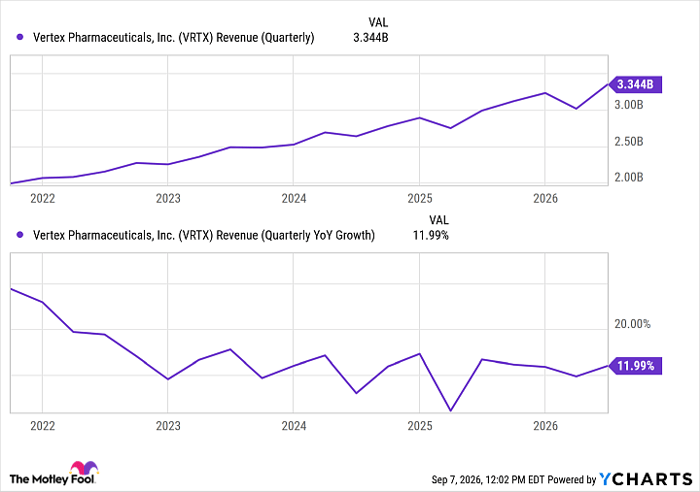
Vertex Pharmaceuticals' revenue growth has slowed in recent years as it has achieved deeper penetration within its core CF market.
VRTX Revenue (Quarterly) data by YCharts
But top-line growth should jump as Journavx and Casgevy start generating more revenue (the latter recently earned an important label expansion), and it launches brand-new medicines across several therapeutic areas. There is always the risk of clinical and regulatory setbacks.
And some other pharmaceutical company might still launch competing CF therapies. But Vertex now has a large and diversified pipeline that helps mitigate these risks. Even the occasional clinical trial failure (and Vertex has experienced several in recent years) shouldn't be catastrophic for its prospects. For all those reasons, Vertex is also among my highest-conviction holdings. Long-term investors should seriously consider purchasing this stock.
Should you buy stock in Vertex Pharmaceuticals right now?
Before you buy stock in Vertex Pharmaceuticals, consider this:
The Motley Fool Stock Advisor analyst team just identified what they believe are the 10 best stocks for investors to buy now… and Vertex Pharmaceuticals wasn’t one of them. The 10 stocks that made the cut could produce monster returns in the coming years.
Consider when Netflix made this list on December 17, 2004... if you invested $1,000 at the time of our recommendation, you’d have $421,997!* Or when Nvidia made this list on April 15, 2005... if you invested $1,000 at the time of our recommendation, you’d have $1,413,876!*
Now, it’s worth noting Stock Advisor’s total average return is 978% — a market-crushing outperformance compared to 213% for the S&P 500. Don't miss the latest top 10 list, available with Stock Advisor, and join an investing community built by individual investors for individual investors.
See the 10 stocks »
*Stock Advisor returns as of September 8, 2026.
Prosper Junior Bakiny has positions in Vertex Pharmaceuticals. The Motley Fool has positions in and recommends Goldman Sachs Group and Vertex Pharmaceuticals. The Motley Fool has a disclosure policy.
Recommended Articles


