




Prediction: Oracle's $638 Billion Cloud Infrastructure Backlog Could Make It One of the Best-Performing AI Stocks Through 2028
Key Points
Oracle's massive revenue backlog explains why the company's growth rate is poised to get better over the next three years.
The company anticipates an uptick in its margins once it begins converting a larger portion of its remaining performance obligations into revenue.
Oracle's earnings growth potential indicates that the stock is on track to jump significantly.
- 10 stocks we like better than Oracle ›
The past year has been a forgettable one for Oracle (NYSE: ORCL) investors, as shares of the cloud computing infrastructure provider have slipped 32% over this period. The tech-laden Nasdaq Composite index, meanwhile, has gained 22% over the past year.
Oracle's poor returns during this period can be attributed to its rising debt and dwindling free cash flow. The company is aggressively building artificial intelligence (AI) data centers to meet the tremendous demand for its cloud infrastructure, which runs AI workloads and database services.
Missed Nvidia in 2009? This Rare Signal Is Flashing Again. In 2009, a "Double Down" signal flashed for a little-known chipmaker called Nvidia. For the first time in years, that same "Total Conviction" signal is flashing for a company 1/100th the size of Nvidia. Continue »
While Oracle's rising capital spending has been a source of concern for investors, I won't be surprised to see it coming out of the rut it is in because of one simple reason -- a massive revenue backlog. Let's see why Oracle's backlog can make it one of the top-performing AI stocks on the market for the next couple of years.

Image source: Getty Images.
Oracle's enormous backlog is going to supercharge growth
Oracle released its fiscal 2026 results (for the year ended May 31) on June 10. The company reported a 17% jump in annual revenue to a record $67.4 billion, driven primarily by a 77% increase in its cloud infrastructure revenue to $18.1 billion.
However, the most important metric in Oracle's fiscal 2026 earnings report was its remaining performance obligation (RPO), the total value of contracts the company has yet to fulfill. Oracle's RPO shot up to $638 billion in fiscal Q4, up by a whopping $500 billion from the year-ago period.
Oracle CFO Hilary Maxson remarked on the company's June earnings call:
This unprecedented level of RPO provides exceptional visibility into our future revenue growth, all supported by long term contractual customer commitments and reflects the strong customer demand we see across both AI infrastructure and cloud services. To give a bit more detail on our RPO, we expect 12% to be recognized in the next 12 months and another 34% between 13 and 36 months.
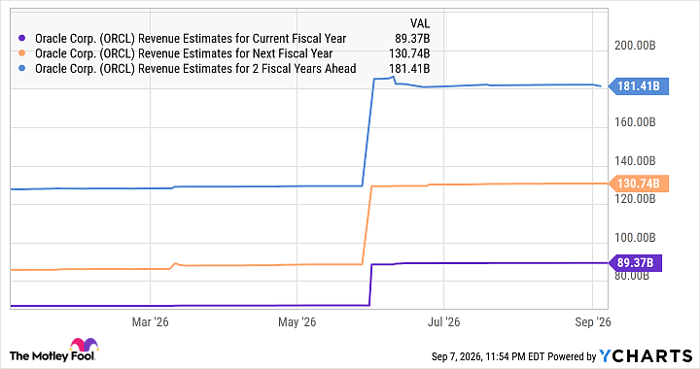
So, Oracle is on track to accelerate the conversion of its backlog into revenue over the next three years. Maxson's estimate suggests that Oracle will recognize nearly $77 billion in revenue from its RPO in fiscal 2027. It then expects to convert $217 billion of the RPO into revenue in fiscal 2028 and 2029, translating into an annual run rate of $108 billion.
So, Oracle's aggressive infrastructure investments will bear fruit over the next couple of years, setting the company up for healthy growth in revenue and earnings as it accelerates the conversion of RPO into revenue. Not surprisingly, Oracle anticipates that its revenue in fiscal 2027 will increase by 34% to just over $90 billion. That's double Oracle's growth rate in fiscal 2026.
Analysts anticipate Oracle's growth rate to accelerate in fiscal 2028, which isn't surprising, followed by another strong improvement in fiscal 2029.
Data by YCharts
At the same time, Oracle is taking steps to ensure that it keeps capital expenses under check going forward. That's the reason why the company is now asking customers for prepayment or to bring their own hardware. Oracle signed $67 billion in new contracts in the fourth quarter of fiscal 2026, and noted that the majority of that figure was either prepaid or fell under the bring-your-own-hardware category.
Oracle also pointed out that it has $75 billion in contracts in the prepaid and bring-your-own-hardware categories. More importantly, Oracle notes that these contracts have "no degradation in margin compared to our other contracts."
Also, Oracle expects its gross margin profile to improve in the future as it begins recognizing more revenue from its RPO. This should ideally translate into stronger growth in Oracle's earnings, paving the way for a solid jump in the company's stock price over the next couple of years.
Strong earnings growth and a cheap valuation point toward terrific upside
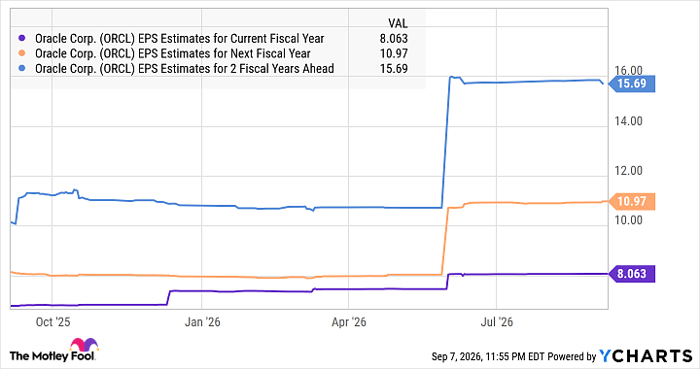
Analysts are expecting Oracle's earnings to increase by just 5% in fiscal 2027 to $8.06 per share. That's a step down from the 27% increase in the company's non-GAAP earnings per share in fiscal 2026. This near-term drop in Oracle's earnings growth can be attributed to the company's investments in AI data center infrastructure.
However, the good news is that Oracle's bottom-line growth is poised to accelerate next year, driven by its solid backlog.
Data by YCharts
The step-up in Oracle's earnings-per-share growth from just 5% this year to 43% in fiscal 2029 (ending in May 2029) could lead the market to reward the stock with a premium valuation. Oracle is trading at 19 times forward earnings, a discount to the Nasdaq-100 index's forward earnings multiple of 25.
Assuming Oracle stock trades in line with the index's forward earnings multiple after three years and its earnings per share reach $15.69, the company's share price could reach $396. That's almost 2.5x Oracle's current stock price, suggesting big upside over the next three years that could make it one of the best-performing AI stocks through 2028 and beyond.
However, larger gains can't be ruled out, as Oracle could command a premium valuation, so investors should consider buying the stock while it trades at an attractive level.
Should you buy stock in Oracle right now?
Before you buy stock in Oracle, consider this:
The Motley Fool Stock Advisor analyst team just identified what they believe are the 10 best stocks for investors to buy now… and Oracle wasn’t one of them. The 10 stocks that made the cut could produce monster returns in the coming years.
Consider when Netflix made this list on December 17, 2004... if you invested $1,000 at the time of our recommendation, you’d have $421,997!* Or when Nvidia made this list on April 15, 2005... if you invested $1,000 at the time of our recommendation, you’d have $1,413,876!*
Now, it’s worth noting Stock Advisor’s total average return is 978% — a market-crushing outperformance compared to 213% for the S&P 500. Don't miss the latest top 10 list, available with Stock Advisor, and join an investing community built by individual investors for individual investors.
See the 10 stocks »
*Stock Advisor returns as of September 8, 2026.
Harsh Chauhan has no position in any of the stocks mentioned. The Motley Fool has positions in and recommends Oracle. The Motley Fool has a disclosure policy.
Recommended Articles


