




Palantir Selects Nebius as Preferred AI Infrastructure Partner as Sovereign AI Extends from Software to Compute
TradingKey - On September 8 ET, Palantir Technologies (PLTR) and Nebius Group (NBIS) announced a strategic partnership. Palantir designated Nebius as its preferred sovereign AI infrastructure partner. As of press time, NBIS rose 2.61% in pre-market trading.
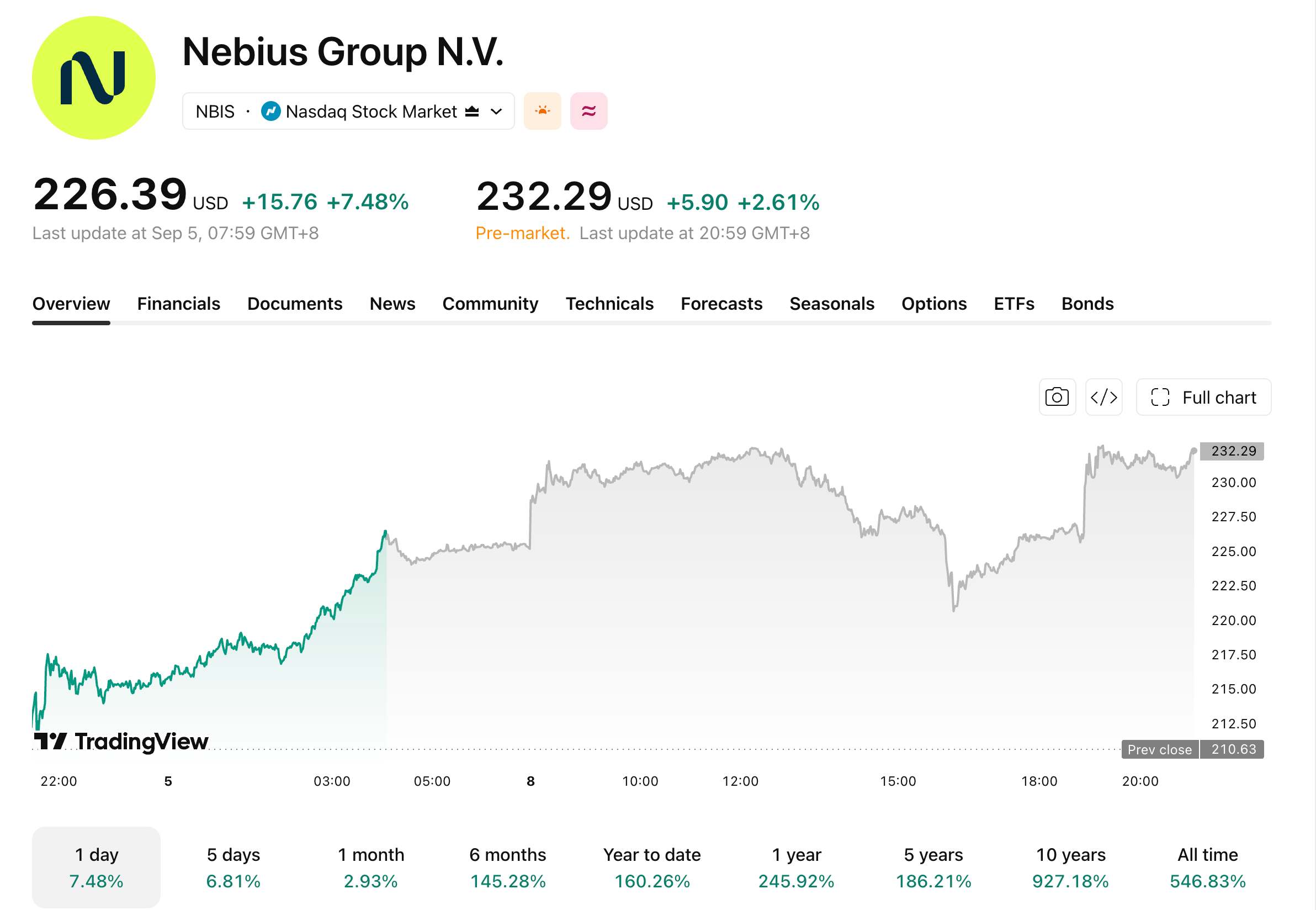
[Source: TradingView]
According to the plans disclosed by both parties, Nebius's compute capacity and inference endpoints will be integrated into Palantir's enterprise security boundary. Eligible Palantir customers can deploy open models using Nebius's cloud and inference infrastructure while retaining control over compute, data, and models, as well as using their proprietary data to train and fine-tune models on an ongoing basis.
Palantir's sovereign AI operating system is built on AIP, Ontology, Foundry, and Apollo, controlling access to data, models, and compute through authorization and isolation mechanisms.
Following the integration with Nebius, enterprises previously lacking sovereign AI deployment solutions will gain new infrastructure options, enabling them to run AI models while maintaining control over their data and models.
Palantir stated that a key reason for selecting Nebius is that its infrastructure was designed for AI workloads from the ground up, rather than repurposed from legacy general-purpose computing platforms. Nebius's infrastructure and software are co-designed for intensive AI workloads and can directly connect to Palantir's sovereign AI operating system.
Beyond platform integration, the two companies also plan to accelerate the deployment of additional AI compute capacity, including constructing modular data centers at sites with existing power supplies.
Alex Karp, co-founder and CEO of Palantir, stated that Nebius's infrastructure allows customers to run their AI models in environments where they maintain autonomous control, and the combination of Palantir's Ontology with Nebius's infrastructure can support customer requirements for sovereign AI deployments.
Arkady Volozh, founder and CEO of Nebius, stated that enterprises require both the performance of large-scale AI infrastructure and control over their data and models. The partnership will enable enterprises to run optimized open models on trusted infrastructure.
Neither party disclosed specific contract amounts, minimum compute procurement scales, or projected revenue contributions in the text of the announcement.
Recommended Articles


