




Is Micron Technology Stock Running Out of Steam?
Key Points
Micron's stock is down close to 20% from its 52-week high.
Trading volumes are down significantly, a possible sign that excitement is waning.
The stock's valuation may seem low, but it hinges on a highly bullish growth story.
- 10 stocks we like better than Micron Technology ›
Memory and storage stocks have been on a tear in 2026, with Micron Technology (NASDAQ:MU) perhaps the most emblematic of that rally. This year, the stock crossed $1 trillion in market cap, making it among the most valuable companies in the world.
Micron's business has been growing at an incredibly fast rate, as not only has demand been robust, but a shortage in the industry has enabled the company to raise prices, giving its top line a boost from not just more products sold but also higher prices.
Missed Nvidia in 2009? This Rare Signal Is Flashing Again. In 2009, a "Double Down" signal flashed for a little-known chipmaker called Nvidia. For the first time in years, that same "Total Conviction" signal is flashing for a company 1/100th the size of Nvidia. Continue »
The company's growth has been exceptional, and growth investors have been loading up on the stock. Year-to-date, it's up around 260%. But lately, the stock's been trading sideways and has struggled to get back to the highs it reached a few months ago. Could this be a sign that it's running out of room to rise higher?

Image source: Getty Images.
Trading volumes are down significantly
Micron's stock crossed above the $1,000 mark last week again, but it remains down nearly 20% from its 52-week high of $1,255. Many investors may be taking out profits; the stock's five-year gains are now around 1,300%. Micron's had a very good run over that time frame.
Another factor that may indicate waning excitement in the stock is a significant decline in trading volume.
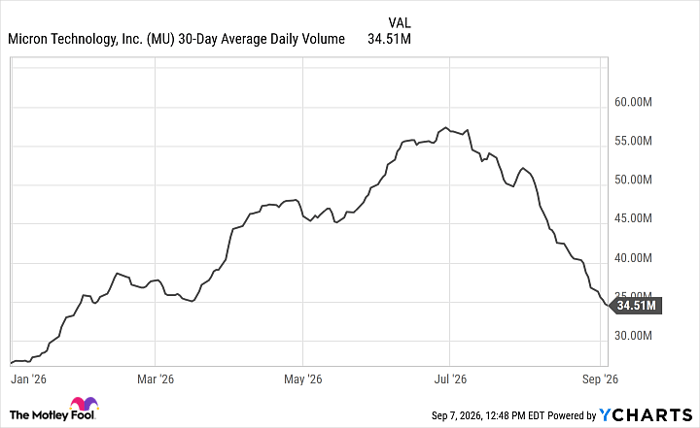
MU 30-Day Average Daily Volume data by YCharts
Average trading volumes haven't been this low since around early April, and that was right around the time Micron's stock started to take off. Back then, it was worth less than $400. It may be a sign that investors don't see a major catalyst in either direction to push the stock much higher or lower.
I wouldn't buy Micron's stock for this reason
Micron may look cheap with respect to earnings -- its price-to-earnings multiple is 23, which is slightly lower than the S&P 500 average of 24.
However, the reason I'd steer clear of it today is that there is simply too much optimism priced in for demand to remain exceptionally high, for the shortage to continue for multiple years, and for big tech to continue spending heavily on memory and all things related to artificial intelligence. It's an overly bullish scenario that leaves no margin for error. If any cracks appear in the growth story, then Micron's stock, which has historically been cyclical and gone through these types of booms and busts in the past, could be due for a sharp decline.
Investors who remain invested should tread carefully with Micron's stock because its seemingly low earnings multiple can create a false sense of security and safety for what's historically been a highly volatile stock.
Should you buy stock in Micron Technology right now?
Before you buy stock in Micron Technology, consider this:
The Motley Fool Stock Advisor analyst team just identified what they believe are the 10 best stocks for investors to buy now… and Micron Technology wasn’t one of them. The 10 stocks that made the cut could produce monster returns in the coming years.
Consider when Netflix made this list on December 17, 2004... if you invested $1,000 at the time of our recommendation, you’d have $421,997!* Or when Nvidia made this list on April 15, 2005... if you invested $1,000 at the time of our recommendation, you’d have $1,413,876!*
Now, it’s worth noting Stock Advisor’s total average return is 978% — a market-crushing outperformance compared to 213% for the S&P 500. Don't miss the latest top 10 list, available with Stock Advisor, and join an investing community built by individual investors for individual investors.
See the 10 stocks »
*Stock Advisor returns as of September 7, 2026.
David Jagielski, CPA has no position in any of the stocks mentioned. The Motley Fool has positions in and recommends Micron Technology. The Motley Fool has a disclosure policy.
Recommended Articles


