




Is Greg Abel Betting on Lower Interest Rates? The Berkshire Hathaway CEO Just Trimmed Bank Stocks Like Bank of America and Bought 3 Stocks That Would Benefit From Lower Yields.
Key Points
Berkshire reduced several of its bank positions in the second quarter.
Berkshire added to one of its airline positions and also bought homebuilders in the quarter.
Both airlines and homebuilders could benefit from lower interest rates.
- 10 stocks we like better than Berkshire Hathaway ›
Berkshire Hathaway (NYSE: BRKA) (NYSE: BRKB) has now revealed two full quarters of stock purchases and sales since Greg Abel became chief executive officer of the enormous conglomerate. He's stepping into the large shoes left by Warren Buffett, who remains executive chairman of the company and actively involved in stock picking, according to various reports.
Abel has not been afraid to shake things up, quickly making Alphabet one of the largest stocks in the portfolio and buying and selling many other stocks. In the second quarter, Berkshire trimmed many of its bank stocks, including Bank of America, while increasing or adding new positions in companies that can benefit from lower yields.
Missed Nvidia in 2009? This Rare Signal Is Flashing Again. In 2009, a "Double Down" signal flashed for a little-known chipmaker called Nvidia. For the first time in years, that same "Total Conviction" signal is flashing for a company 1/100th the size of Nvidia. Continue »
Is Abel betting on lower interest rates?
Image source: The Motley Fool.
Trimming banks
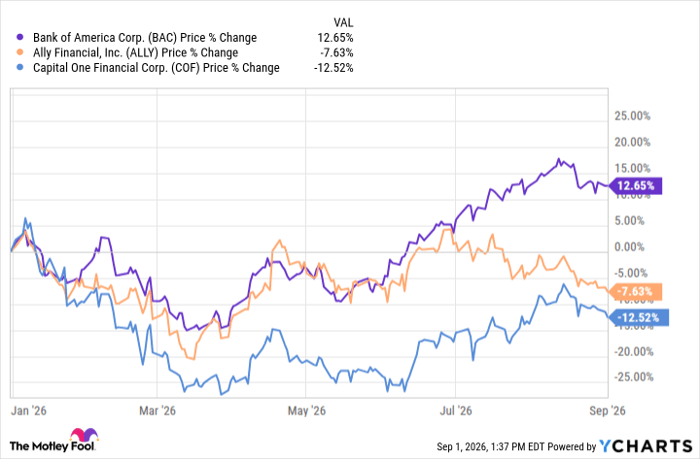
In Q2, Berkshire Hathaway trimmed its Bank of America position by 6% and slashed its positions in Ally Financial and Capital One by 7% and 58%, respectively.
Bank of America is a money-center bank involved in all aspects of banking, from commercial lending to investment banking. Ally and Capital One are large banks as well, but heavily involved in consumer lending, such as auto and credit card lending.
Generally, bank stocks have performed relatively well this year. Not only have banks seemed to serve as diversification away from artificial intelligence, but the yield curve has steepened, meaning shorter-dated bonds yield less than long-term ones.
This is an ideal setup for most banks, which borrow money at the short part of the yield curve and lend toward the longer end. Ally and Capital One haven't performed as well, partly due to investor concerns that consumers are starting to feel the pinch and that loan losses will rise.
Borrowing costs are also high now, which could be stunting loan demand.
BAC data by YCharts.
Still, if the yield curve keeps steepening, that could, in theory, be good for banks, although I do think longer-term yields at current levels could be starting to spook bank investors as well. Still, in theory, as long as the curve stays steep, that should be good for bank profits, assuming credit stays in check.
Buying sectors that would benefit from lower interest rates
In Q2, Berkshire increased its positions in Delta Air Lines (NYSE: DAL) and Lennar Corp and initiated a new position in D.R. Horton.
Delta is one of the largest U.S. Airlines tend to perform better in a lower-rate environment because most airlines carry significant debt, some of which is tied to variable interest rates that are affected by broader interest rate changes.
At the end of Q2, Delta carried $13.6 billion in debt, 22% of which is subject to variable interest rates, so lower rates would mean lower interest payments.
Additionally, a lower-rate environment tends to stimulate economic activity and spending, benefiting airlines.
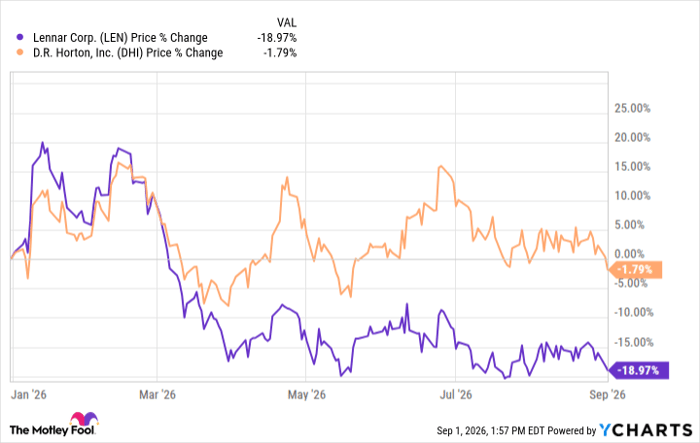
Lennar and D.R. Horton are two of the largest homebuilders in the U.S. The mortgage and real estate industries have been absolutely hammered by high rates, particularly at the longer end of the curve, such as the 10-year yield, which directly influences mortgage rates.
Higher rates combined with high home values have made buying a home difficult for much of the country's consumers. Both of these stocks have struggled this year.
LEN data by YCharts.
You don't buy housing stocks in a rising-rate environment. Although concerns about persistent inflation are certainly real, nobody can say for certain what will happen.
There have been some signs that inflation is softening, perhaps clearing the way for lower rates. An end to the Iran war would surely help this cause, not that anyone knows when that is coming either.
It's worth noting that, aside from Bank of America, the other stocks mentioned in this article are relatively small positions in Berkshire's vast equity portfolio, so they may not be very indicative of anything.
Furthermore, Berkshire typically tries to buy stocks that will perform well throughout the economic cycle.
Should you buy stock in Berkshire Hathaway right now?
Before you buy stock in Berkshire Hathaway, consider this:
The Motley Fool Stock Advisor analyst team just identified what they believe are the 10 best stocks for investors to buy now… and Berkshire Hathaway wasn’t one of them. The 10 stocks that made the cut could produce monster returns in the coming years.
Consider when Netflix made this list on December 17, 2004... if you invested $1,000 at the time of our recommendation, you’d have $445,833!* Or when Nvidia made this list on April 15, 2005... if you invested $1,000 at the time of our recommendation, you’d have $1,402,153!*
Now, it’s worth noting Stock Advisor’s total average return is 993% — a market-crushing outperformance compared to 214% for the S&P 500. Don't miss the latest top 10 list, available with Stock Advisor, and join an investing community built by individual investors for individual investors.
See the 10 stocks »
*Stock Advisor returns as of September 5, 2026.
Ally is an advertising partner of Motley Fool Money. Bank of America is an advertising partner of Motley Fool Money. Bram Berkowitz has no position in any of the stocks mentioned. The Motley Fool has positions in and recommends Alphabet, Berkshire Hathaway, D.R. Horton, and Lennar. The Motley Fool recommends Capital One Financial and Delta Air Lines. The Motley Fool has a disclosure policy.
Recommended Articles


