




Jensen Huang Just Sent a Signal That Could Matter More Than the September Effect
Key Points
Nvidia expects fiscal 2028 revenue growth of about 70%, even though customer forecasts point to stronger demand.
Nvidia has increased its supply and capacity commitments from $119 billion to $279 billion as it prepares for future AI infrastructure demand.
Nvidia's revenue opportunity per gigawatt could rise from about $18 billion with Hopper GPUs to $40 billion with Vera Rubin systems.
- 10 stocks we like better than Nvidia ›
Historically, September has been a difficult month for Wall Street. The S&P 500 has fallen by an average of about 1.1% during the month from 1926 through 2024. Yet Nvidia (NASDAQ: NVDA) stock has gained ground in seven of the past 10 Septembers, with a median return of about 1.5%. Hence, while the September Effect may offer a reason for some caution around the overall stock market, it hasn't been such a negative indicator for Nvidia's stock.
And recently, CEO Jensen Huang also gave investors a potentially more important signal. He said Nvidia expects revenue to grow about 70% in its fiscal 2028, which begins Jan 31, 2027. But management says even that forecast doesn't reflect the full scope of demand for its offerings; it's constrained by the limited supply of components required to build its artificial intelligence (AI) platforms.
Missed Nvidia in 2009? This Rare Signal Is Flashing Again. In 2009, a "Double Down" signal flashed for a little-known chipmaker called Nvidia. For the first time in years, that same "Total Conviction" signal is flashing for a company 1/100th the size of Nvidia. Continue »
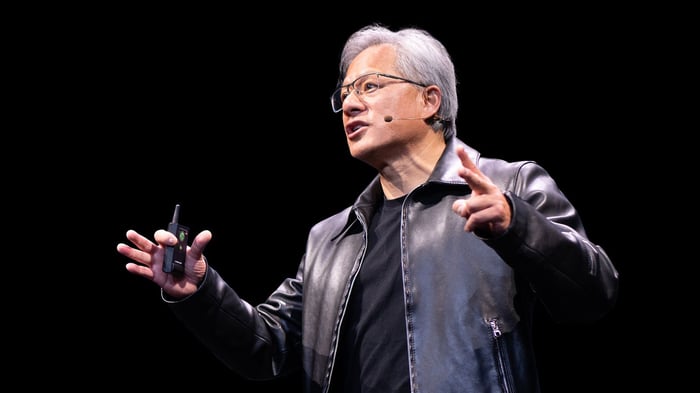
Nvidia CEO Jensen Huang. Image source: Nvidia.
Nvidia's visibility into future demand is sharpening
In its fiscal 2027 second quarter (which ended July 26), Nvidia's revenue soared by 106% year over year to $96.2 billion, including $89 billion in sales from the data center segment. However, management's long-term outlook was even more impressive.
Wall Street analysts had previous expected the company to deliver fiscal 2028 revenue of about $570 billion, translating to growth of roughly 44%. Nvidia's guidance, however, implies revenue of close to $700 billion.
CEO Jensen Huang said that Nvidia has never offered revenue guidance for a full year in advance before. However, this time, the company has much better visibility into memory and manufacturing capacity, as well as the land, power, and data-center infrastructure needed to deploy its products. Some of this infrastructure needs to be secured two to three years in advance.
Supply constraints could limit Nvidia's fiscal 2028 growth
CFO Colette Kress highlighted that customer forecasts currently indicate Nvidia's revenue may double next year. Huang also said Nvidia's revenue growth could be "a lot higher" if the company were not supply-constrained.
Nvidia exited the fiscal second quarter with $279 billion of supply and capacity commitments, up sequentially from $119 billion. These commitments are primarily related to memory purchases and manufacturing capacity. Of that total, $92 billion is scheduled for the rest of fiscal 2027, $87 billion for fiscal 2028, and $88 billion for fiscal 2029.
Nvidia's largest customers are also continuing to spend heavily on AI infrastructure. Amazon (NASDAQ: AMZN) Web Services plans to deploy another 2 million Nvidia GPUs in calendar years 2027 and 2028. Nvidia also expects the combined capital expenditures of the top five hyperscalers to approach $800 billion in 2026 and $1.3 trillion in 2027.
The demand trends look impressive, even when the company is not factoring any data center compute revenue from China into its current outlook. Hence, a meaningful recovery of its position in the Chinese market is not currently part of Nvidia's growth expectations.
Nvidia's revenue opportunity per AI data center is expanding
Nvidia is also expanding its revenue opportunity from each gigawatt (power capacity) of AI infrastructure. Management estimates that this opportunity has increased from roughly $18 billion with Hopper GPUs to $25 billion with Blackwell systems and $40 billion with Vera Rubin systems. These increases are partly a result of the fact that Nvidia is selling more components of the overall AI system, including CPUs, GPUs, NVLink (Nvidia's high-speed technology for connecting GPUs and other processors), and other networking products. Hence, the company benefits not only from the construction of more AI data centers, but also because it is generating more revenue per gigawatt of new capacity deployed.
Increasing adoption of agentic AI could further drive demand for compute capacity. Huang said AI agents can require roughly 15 to 100 times more compute than direct human use of AI, depending on the task. These agents can also run continuously and interact with other agents. Hence, future demand for Nvidia's wares may increasingly depend on the actual use of AI applications rather than on the computing power required to train AI models.
Nvidia's growth outlook also comes with risks
Nvidia, however, has warned that customer demand forecasts can prove inaccurate. Its customers may also delay purchases because of constraints related to data center infrastructure or capital availability. In such a scenario, Nvidia's large commitments to its own suppliers could result in higher costs.
Nvidia is also providing support for some large AI infrastructure projects. In August, the company agreed to provide guarantees of up to $105 billion for a data center project in Ohio. That campus will exclusively host Nvidia computing systems under 20-year leases to OpenAI. Huang also said AI labs for which Nvidia expects to use its balance sheet could account for roughly one-quarter of the company's business in fiscal 2028.
Rising memory costs could also pressure profitability. Nvidia expects its gross margins to fall from 75% in the fiscal second quarter to around 71% to 72% in the fiscal fourth quarter, before improving to around 72% to 73% in fiscal 2028. Management attributed much of this pressure to sharp increases in memory prices.
Nvidia's stock also faces near-term pressure. On Sept. 1, rising Treasury yields and oil prices pushed the Nasdaq Composite down by 1%. Besides these marketwide risks, Nvidia is also facing concerns about some of its AI financing arrangements. Its stock slipped by 1.5% during the session.
September could still bring volatility for Nvidia investors. However, it is obvious that Nvidia now has much greater visibility into demand several years ahead. If that visibility holds, short-term weaknesses could matter far less than the scale of the growth opportunity the company is preparing for.
Should you buy stock in Nvidia right now?
Before you buy stock in Nvidia, consider this:
The Motley Fool Stock Advisor analyst team just identified what they believe are the 10 best stocks for investors to buy now… and Nvidia wasn’t one of them. The 10 stocks that made the cut could produce monster returns in the coming years.
Consider when Netflix made this list on December 17, 2004... if you invested $1,000 at the time of our recommendation, you’d have $445,833!* Or when Nvidia made this list on April 15, 2005... if you invested $1,000 at the time of our recommendation, you’d have $1,402,153!*
Now, it’s worth noting Stock Advisor’s total average return is 993% — a market-crushing outperformance compared to 214% for the S&P 500. Don't miss the latest top 10 list, available with Stock Advisor, and join an investing community built by individual investors for individual investors.
See the 10 stocks »
*Stock Advisor returns as of September 5, 2026.
Manali Pradhan, CFA has no position in any of the stocks mentioned. The Motley Fool has positions in and recommends Amazon and Nvidia. The Motley Fool has a disclosure policy.
Recommended Articles


