




Apple Stock Price Prediction: As Cook Ends 15-Year Tenure, Can Ternus Lead AAPL to New Highs?
TradingKey - On September 1, 2026, Apple (AAPL) officially completed its top management transition. Tim Cook, who led the company for 15 years, stepped down as CEO and transitioned to Executive Chairman, while John Ternus, former Senior Vice President of Hardware Engineering, took over as CEO and joined Apple's Board of Directors.
Apple previously stated that this adjustment stems from a long-prepared succession plan and received unanimous approval from the board of directors. Unlike the power transition during the Jobs era that was fraught with uncertainty, Cook has not left the company completely, but will continue to participate in certain key matters, including communicating with global policymakers.
Cook Leaves Behind a $4.6 Trillion Apple
When Tim Cook succeeded Steve Jobs in 2011, there were widespread concerns that Apple would lose its capacity for product innovation. Over the following 15 years, although Apple never launched another product that could fully replicate the iPhone's impact, it transformed into one of the world's most profitable tech companies through supply chain management, services, and ecosystem expansion.
During Cook's tenure, Apple's annual revenue grew from $108 billion in fiscal year 2011 to over $416 billion in fiscal year 2025, while its market capitalization expanded from approximately $350 billion to more than $4 trillion.
The Apple Watch and AirPods became new hardware categories, while services such as Apple Pay, Apple Music, iCloud, and Apple TV established a stable recurring revenue stream. Currently, annual revenue from Apple's services business has exceeded $100 billion, with the number of active devices worldwide topping 2.5 billion.
Apple's latest financial results remain strong. For the quarter ended June 27, 2026, the company's revenue reached $109.42 billion, up 16.4% year-over-year; net income was $29.79 billion, with diluted earnings per share of $2.02. Of this, iPhone revenue rose to $54.25 billion, while services revenue reached $30.74 billion.
These figures indicate that Ternus is not taking over a company in an operational crisis, but rather a commercial machine with massive cash flows, a robust supply chain network, and a vast user base. However, Apple's market capitalization of nearly $4.7 trillion also raises the bar for growth, meaning that simply keeping existing operations stable will be insufficient to drive sustained and significant share price gains.
Can Ternus Reignite Apple's Hardware Innovation?
The 51-year-old Ternus joined Apple in 2001, was promoted to Vice President of Hardware Engineering in 2013, and joined the company's executive team in 2021. Over the past 25 years, he has participated in the launch of product lines such as the iPad and AirPods, and has also been responsible for the hardware development of multiple generations of the iPhone, Mac, and Apple Watch.
Compared with Cook, who excels at operations and supply chain management, Ternus is closer to a traditional product engineer. Apple selecting a hardware chief as CEO may signal that the company hopes its next phase of growth will once again be driven by product form-factor innovation.
Apple is exploring foldable iPhones, smart glasses, AirPods with environmental sensing capabilities, home robots, and other wearable devices. The iPhone Air, MacBook Neo, and Vision Pro previously led by Ternus demonstrate Apple's attempts to expand its product boundaries, though the market performance of these products has been mixed. In particular, Vision Pro and iPhone Air, despite breakthroughs in design and engineering, have yet to achieve large-scale commercial success comparable to the iPhone and AirPods.
However, compared to its hardware business, artificial intelligence may be a more pressing issue for Apple at present. Since the surge of the generative AI wave, Microsoft, Google, Meta, and Amazon have all invested heavily in building models and data centers, whereas Apple's Apple Intelligence and new Siri have suffered repeated delays, with product experiences failing to meet initial market expectations.
Apple subsequently adjusted its AI management architecture and leveraged Google's Gemini technology to rebuild Siri's underlying model. While this approach can shorten catch-up time, it also shows that Apple still relies on external partners in the foundation model space.
Ternus's hardware background may therefore be both a weakness and an opportunity. While he is not a large model or software expert, he may be better suited to embedding AI into new device form factors. Whether foldable iPhones, smart glasses, and AirPods equipped with cameras can form new interaction gateways will determine whether Apple continues to chase existing AI products or opens up an alternative competitive route through its hardware ecosystem.
Apple Stock Technical Analysis: Can AAPL Keep Rising?
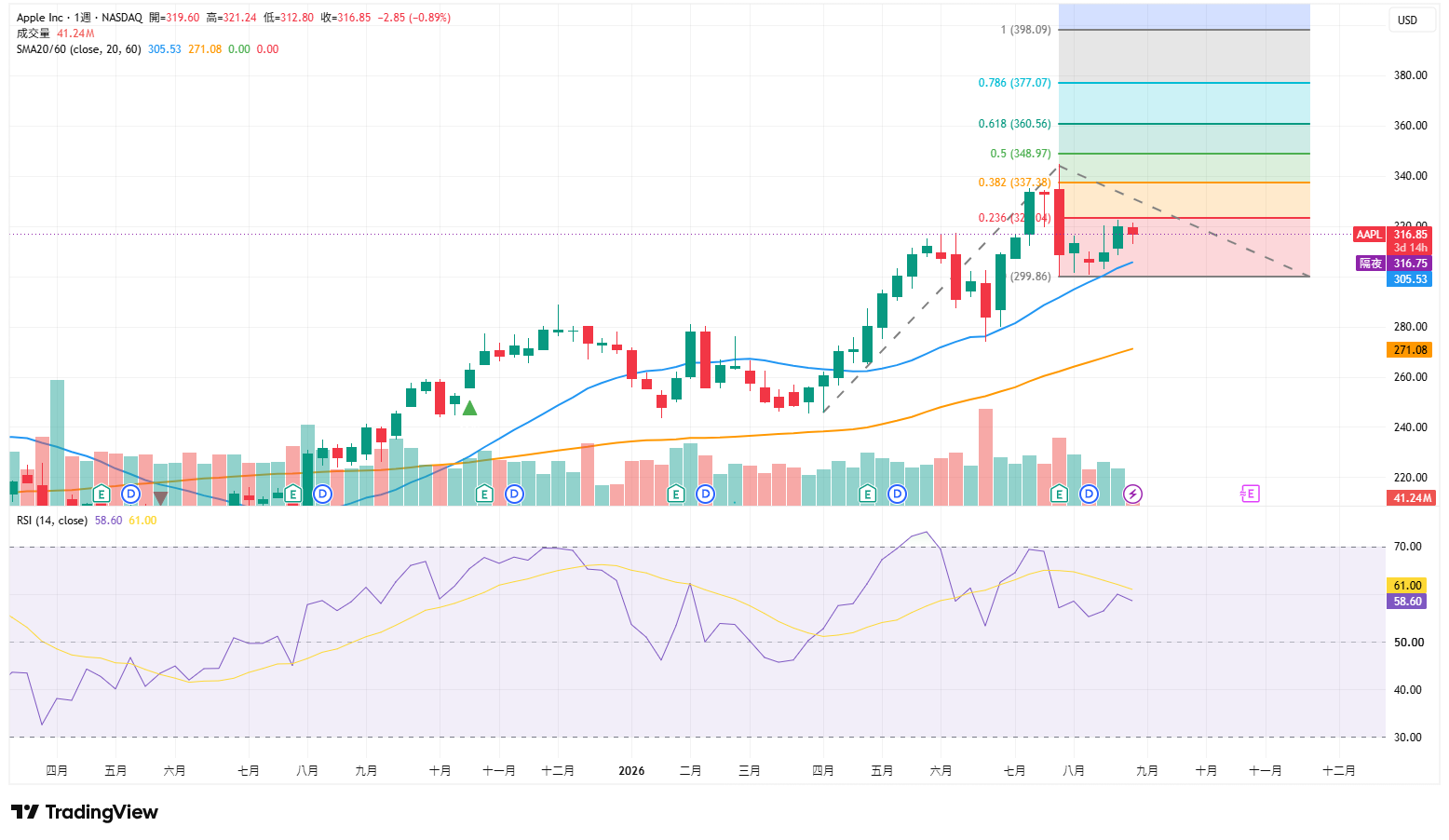
Source: TradingView
On the weekly chart, AAPL closed at $316.85 on the 31st, remaining above its 20-week moving average of $305.53 and 60-week moving average of $271.08. Both moving averages continue to trend upward, indicating that the medium-to-long-term bullish trend remains intact. However, the stock price currently remains in a consolidation phase following its earlier surge, and a new breakout has yet to be confirmed.
To the upside, initial resistance lies near $323. If a weekly breakout occurs on heavy volume, the next target could be $337.38. Holding firmly above $337 would mean the stock price is poised to hit new highs, with subsequent targets at $348.97, $360.56, and $377.07.
The RSI is currently at 58.60, above 50 but below its signal line of 61.00, suggesting overall momentum remains bullish while short-term upward momentum has slowed. If the RSI reclaims the signal line and breaks above 60 alongside expanding volume, it will bolster the credibility of the stock breaking above $323 and $337.
On the downside, initial attention should be paid to support at the 20-week moving average of $305.53 and $299.86. As long as the stock price stays above $300, the current price action can still be seen as a normal consolidation after an advance. If it breaks below $300 on the weekly chart, the pullback could deepen to $285, with focus then turning to the 60-week moving average at $271.08.
Recommended Articles


