




Vertex vs. Regeneron: Which Biotech Giant Is the Better Buy Right Now?
Key Points
Vertex Pharmaceuticals is slowly but surely expanding beyond its highly successful core therapeutic area.
Regeneron has successfully rebounded after facing biosimilar competition for a key growth driver, and it boasts several attractive pipeline candidates.
One of these stocks has a stronger core business.
- 10 stocks we like better than Vertex Pharmaceuticals ›
The biotech industry is experiencing a strong rebound in 2026 after lagging the market in recent years. Based on several ongoing developments -- including breakthroughs in oncology and chronic weight management -- we may see a sustained run from the industry over the next few years. Even if we don't, several individual biotech companies look like strong medium-term options right now, including Vertex Pharmaceuticals (NASDAQ: VRTX) and Regeneron (NASDAQ: REGN). There is a lot to like about both of these drugmakers, but which one is the better buy? Let's find out.
Image source: The Motley Fool.
Missed Nvidia in 2009? This Rare Signal Is Flashing Again. In 2009, a "Double Down" signal flashed for a little-known chipmaker called Nvidia. For the first time in years, that same "Total Conviction" signal is flashing for a company 1/100th the size of Nvidia. Continue »
Vertex's core area is the backbone of a healthy business
Vertex Pharmaceuticals doesn't have a long list of products like many of its similarly sized peers in the biotech industry. That's because it doesn't need to. The company famously dominates the market for cystic fibrosis (CF) drugs, a rare disease that causes difficulty breathing and recurrent infections.
Vertex makes consistent revenue and earnings thanks to its portfolio in this field. There is always the risk that another drugmaker will launch competing medicines and challenger Vertex. But so far, no one has been able to. Sionna Therapeutics (NASDAQ: SION), a small-cap biotech, recently added yet another name to the long list of candidates that have tried -- and failed -- to challenge Vertex's core franchise.
Here's the best part. Vertex Pharmaceuticals won't lose patent exclusivity for its most important CF products until the late 2030s. In the meantime, the company is diversifying its lineup. It has earned approval for Journavx, a non-opioid medicine for acute pain, and Casgevy, a gene-editing therapy for two rare diseases.
It should also earn approval for povetacicept, a drug for IgA nephropathy (a kidney disease), by the end of November. Further, Vertex has several promising mid and late-stage candidates. As the company continues to generate significant sales in its core area and launches new products, it could deliver solid returns.
Regeneron's rebound is in full swing
Regeneron faced some challenges a couple of years ago due to biosimilar competition for Eylea, a medicine for several eye-related disorders that was one of its main growth drivers. However, the company has largely moved past that headwind thanks to a new, higher-dose (HD) version of Eylea that can be administered fewer times per year. The convenience of the new formulation is attracting many patients. Sales of the original Eylea are still dropping, but Eylea HD is making up for that.
Elsewhere, Regeneron's most important growth driver is Dupixent, a medicine for COPD and eczema that it co-markets with Sanofi (NASDAQ: SNY). This therapy continues to post solid sales growth. Although it could lose patent exclusivity in the U.S. in 2031, Regeneron and Sanofi plan to extend its patent life, notably by developing an HD version, just as Regeneron did with Eylea.
Regeneron also has several attractive pipeline candidates. Perhaps the most important are in the weight loss area. Regeneron is developing olatorepatide, a dual GLP-1 and GIP agonist that posted excellent phase 3 clinical trial results in China. Regeneron also has a highly differentiated weight loss medicine it is developing to help patients maintain muscle mass while they lose weight on GLP-1 drugs. Since the weight-loss market is one of the fastest-growing segments in the industry, investors should closely monitor Regeneron's progress. Between the drugmaker's current approved portfolio and pipeline, the future looks bright.
Which is the better buy?
My view is that Vertex Pharmaceuticals is the better buy between the two, even though Regeneron typically generates higher revenue. Here's why.
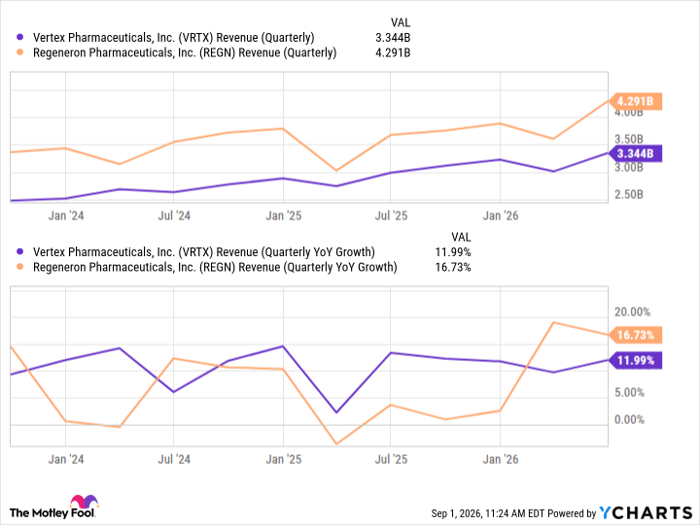
VRTX Revenue (Quarterly) data by YCharts
First, Vertex edges Regeneron when we consider margins and free cash flow.
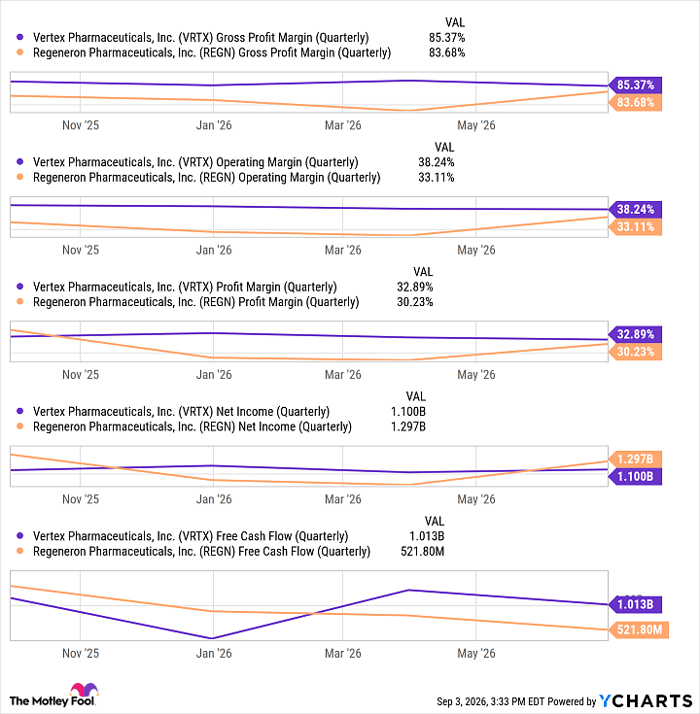
VRTX Gross Profit Margin (Quarterly) data by YCharts
Second, Vertex's core business has a much stronger competitive advantage. It has been defending its lead in the CF market for years, is still basically the only game in town, and benefits from substantial pricing power as a result. Dupixent is also a strong performer, but it operates in a much more competitive space, as does Eylea.
Third, although Regeneron's weight-loss candidates look promising, a clinical setback will significantly depress the stock price. And the company's strategy over the next decade also depends a lot on its ability to defend its Dupixent empire, which will be challenging.
Of note, even with Eylea HD's success, Regeneron faces stiff competition in this niche from Vabysmo, a medicine with overlapping indications and a friendlier dosing schedule than the original Eylea. Similarly, breakthroughs in immunology could pose a major challenge to Regeneron's long-term plans, even if it manages to extend Dupixent's patent life.
Meanwhile, Vertex's diversification plans are well underway, and it should make substantial progress over the next couple of years. Vertex isn't going after the weight-loss market (at least not yet). Instead, it is mostly targeting smaller areas with high unmet needs, where it will face little competition. Its success in the CF market shows the potential of this strategy. That's another reason Vertex is a better option.
Should you buy stock in Vertex Pharmaceuticals right now?
Before you buy stock in Vertex Pharmaceuticals, consider this:
The Motley Fool Stock Advisor analyst team just identified what they believe are the 10 best stocks for investors to buy now… and Vertex Pharmaceuticals wasn’t one of them. The 10 stocks that made the cut could produce monster returns in the coming years.
Consider when Netflix made this list on December 17, 2004... if you invested $1,000 at the time of our recommendation, you’d have $445,833!* Or when Nvidia made this list on April 15, 2005... if you invested $1,000 at the time of our recommendation, you’d have $1,402,153!*
Now, it’s worth noting Stock Advisor’s total average return is 993% — a market-crushing outperformance compared to 214% for the S&P 500. Don't miss the latest top 10 list, available with Stock Advisor, and join an investing community built by individual investors for individual investors.
See the 10 stocks »
*Stock Advisor returns as of September 4, 2026.
Prosper Junior Bakiny has positions in Vertex Pharmaceuticals. The Motley Fool has positions in and recommends Regeneron Pharmaceuticals and Vertex Pharmaceuticals. The Motley Fool has a disclosure policy.
Recommended Articles


