




3 Words From Fed Chair Kevin Warsh That Are Sending Shockwaves Through Wall Street
Key Points
It's been a history-packed year, with Wall Street welcoming Kevin Warsh as only the 17th head of the central bank since its creation in December 1913.
Although Warsh has repeatedly proclaimed that the Fed will deliver price stability, his Jackson Hole speech drew a proverbial line in the sand for the first time.
If the Federal Open Market Committee (FOMC) raises interest rates, it could be game over for Wall Street's historic AI-driven rally.
- 10 stocks we like better than S&P 500 Index ›
The Dow Jones Industrial Average (DJINDICES: ^DJI), S&P 500 (SNPINDEX: ^GSPC), and Nasdaq Composite (NASDAQINDEX: ^IXIC) rocketing to several new highs isn't the only important milestone of 2026. On May 22, we also welcomed a new Fed chair for only the 17th time since the central bank's creation in December 1913.
President Donald Trump's handpicked successor to Jerome Powell, Kevin Warsh, has come onto the scene with a bang. During Warsh's swearing-in ceremony, he promised to lead a reform-oriented Fed, and has thus far lived up to his word.
Missed Nvidia in 2009? This Rare Signal Is Flashing Again. In 2009, a "Double Down" signal flashed for a little-known chipmaker called Nvidia. For the first time in years, that same "Total Conviction" signal is flashing for a company 1/100th the size of Nvidia. Continue »
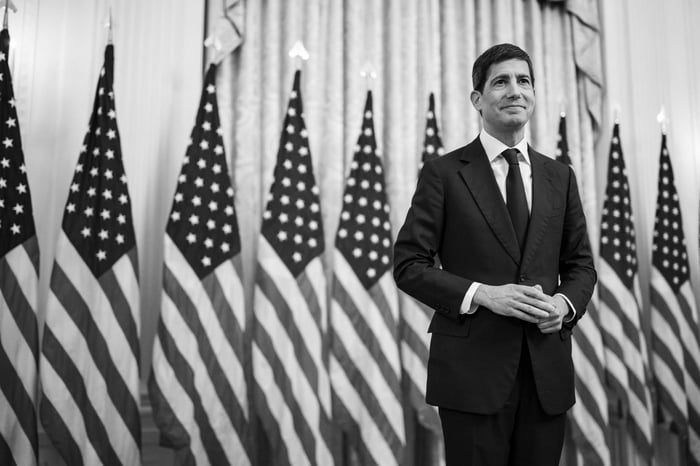
Fed Chair Kevin Warsh's Jackson Hole keynote address was a doozy. Image source: Official White House Photo by Daniel Torok.
Since taking the reins, he's shelved forward-looking guidance in Federal Open Market Committee (FOMC) meeting statements and commissioned five task forces to aid in the central bank's conduct of monetary policy.
But it's three words uttered by Fed Chair Kevin Warsh in his latest speech that are sending shockwaves through Wall Street.
Fed Chair Warsh effectively outlines an inflation ultimatum
For more than two decades, it had been customary for the FOMC to include forward-looking guidance in its meeting statements. The guidance would transparently convey to economists and investors what the Fed was likeliest to do next.
With Warsh removing this language from FOMC statements and favoring an environment in which the central bank takes a back seat and allows equity markets to react to economic data, investors have been craving any information Warsh or his colleagues may offer as to what the Fed may do next. Warsh's keynote remarks at the annual economic symposium in Jackson Hole, Wyoming, on Aug. 28 gave economists and investors what they were looking for.
Federal Reserve Chairman Kevin Warsh signaled the central bank may not be done fighting inflation, saying financing conditions didn't look restrictive to him and that better price readings recently hadn't convinced him the trend was improving.
-- Nick Timiraos (@NickTimiraos) August 28, 2026
"I would be hard pressed to...
Several of the Fed chair's comments echoed his previously stated promise to deliver price stability. He acknowledged that inflation is running well above the Fed's long-term target of 2%, lumped the blame for elevated inflation on the central bank, and signaled that "short-term interest rates are the predominant tool to achieve the dual mandate [maximum employment and price stability]."
But it's the summation of Kevin Warsh's Jackson Hole speech that's echoing through Wall Street. In wrapping things up, he laid out what he referred to as his "standard" by saying:
We must be confident that underlying inflation is moving to our objective, clearly and at sufficient speed. Otherwise, we have work to do.
While Fed Chair Warsh has repeatedly stated that the Fed will deliver price stability, it's the first time we've seen him draw a proverbial line in the sand. These three words, "at sufficient speed," leave the door wide open for rate hikes, even if the prevailing inflation rate is falling, just not fast enough to appease Warsh and FOMC policymakers.
As for Wall Street, Kevin Warsh's inflation ultimatum may lead to the ultimate bull market rug pull.
Nothing has powered the Dow Jones Industrial Average, S&P 500, and Nasdaq Composite higher quite like the artificial intelligence (AI) infrastructure build-out. If Warsh and the FOMC aren't satisfied with the pace of progress on the inflation front and choose to hike interest rates, it would make borrowing costlier and potentially slow the AI data center build-out. Given that the stock market is priced for perfection, any growth slowdown or valuation rerating could prove disastrous.
Should you buy stock in S&P 500 Index right now?
Before you buy stock in S&P 500 Index, consider this:
The Motley Fool Stock Advisor analyst team just identified what they believe are the 10 best stocks for investors to buy now… and S&P 500 Index wasn’t one of them. The 10 stocks that made the cut could produce monster returns in the coming years.
Consider when Netflix made this list on December 17, 2004... if you invested $1,000 at the time of our recommendation, you’d have $437,097!* Or when Nvidia made this list on April 15, 2005... if you invested $1,000 at the time of our recommendation, you’d have $1,355,077!*
Now, it’s worth noting Stock Advisor’s total average return is 978% — a market-crushing outperformance compared to 213% for the S&P 500. Don't miss the latest top 10 list, available with Stock Advisor, and join an investing community built by individual investors for individual investors.
See the 10 stocks »
*Stock Advisor returns as of September 2, 2026.
Sean Williams has no position in any of the stocks mentioned. The Motley Fool has no position in any of the stocks mentioned. The Motley Fool has a disclosure policy.
Recommended Articles


