




Retirees: Here's How to Ride Out the Artificial Intelligence (AI) Sell-Off Without Wrecking Your Portfolio
Key Points
Growth investors have been aggressively rotating capital away from AI stocks throughout 2026.
Retirement portfolios should avoid exposure to overly volatile stocks and seek out broad-based index funds.
The S&P 500 has proven a money-making vehicle for investors over decades of economic and market cycles.
- 10 stocks we like better than Invesco S&P 500 Equal Weight ETF ›
Financial headlines feel personal when you're retired. Every time a high-flying stock drops by double digits in a single trading session or a company's management revises its earnings guidance downward, the instinct is to act -- sell, rebalance, something.
But for retirees trying to protect what they've saved over decades of hard work, the most dangerous responses to market volatility are the ones rooted in emotion. The ongoing sell-off in artificial intelligence (AI) stocks isn't necessarily a warning sign that you need to act imminently.
Will AI create the world's first trillionaire? Our team just released a report on the one little-known company, called an "Indispensable Monopoly" providing the critical technology Nvidia and Intel both need. Continue »
Rather, it may be a much-needed reminder that you may have been positioned incorrectly at the outset. Here's what to do.

Image source: Getty Images.
Chasing narratives is a big problem when building durable wealth
Retirees who indexed heavily on AI-adjacent names -- semiconductors, cloud infrastructure companies, or enterprise software platforms -- likely did so because the story appeared compelling. To be fair, the returns from the tech sector validated this thesis for most of the last few years.
However, smart investors understand that concentrated exposure to a single theme brings fragility to your portfolio. That's the last thing you want for retirement.
When a high-growth sector enters a correction, it rarely does so gradually. Over the last few months, growth stocks have shown harsh gap downs upon capex surprises and a shift in sentiment around the pace of AI monetization.
Retirees are at risk of locking in these valuation de-ratings more permanently compared to the paper losses a beginner investor has to endure. In turn, poorly timed losses in retirement can diminish a portfolio's durability and longevity. Luckily, the solution isn't to abandon equities entirely. It's simply to widen your aperture.
How the S&P 500 does the heavy lifting for retirees
The S&P 500 is one of the most resilient instruments available to long-term investors. The index gives you exposure to the largest U.S. companies and automatically rebalances as winners thrive and laggards get replaced.
If AI someday delivers on its promises, the S&P 500 is positioned to capture the upside, because the companies developing, monetizing, and purchasing AI are all included in its holdings. In contrast, if AI disappoints over the coming years, the index's diversification insulates your portfolio from feeling downside pressure in concentrated doses.
Notably, the S&P 500 has an unmatched long-term track record when benchmarked against any single sector thesis. The index has survived the dot-com bubble, the 2008 financial crisis, a global pandemic, and every macro-driven scare in between.
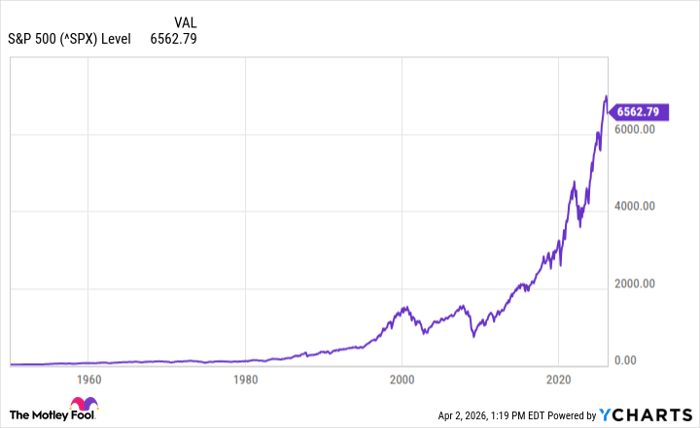
^SPX data by YCharts.
Retirees who stayed the course and invested in broad index funds through these cycles didn't just recover -- they managed to compound their wealth. Time in the market -- not timing the market -- is the key pillar supporting wealth preservation at a stage when capital protection matters most.
How should retirees invest right now?
If you are a retiree sitting on AI positions that are in the red, the question isn't whether to sell. It's whether you're comfortable lowering your cost basis and adding to those positions today.
If the answer is no, it may be time to trim this concentrated exposure and rotate toward broader index funds such as the SPDR S&P 500 ETF Trust (NYSEMKT: SPY), the Vanguard S&P 500 ETF (NYSEMKT: VOO), or the Invesco S&P 500 Equal Weight ETF (NYSEMKT: RSP). As a sweetener, you may be able to use any losses from AI stocks to offset your tax liability.
In addition to these rebalancing efforts, it would behoove retirees to hold short-duration bonds or money market funds to help finance basic living expenses. This approach provides a liquidity buffer and allows you to avoid selling equities to raise cash during market downturns.
The AI revolution could still play out as its most enthusiastic advocates contest. But a retirement portfolio shouldn't bet the house on this, or any, narrative. Retirement funds need to be constructed to survive every economic cycle -- euphoric and brutal ones alike. This is exactly what broad market exposure through the S&P 500 is designed for.
Should you buy stock in Invesco S&P 500 Equal Weight ETF right now?
Before you buy stock in Invesco S&P 500 Equal Weight ETF, consider this:
The Motley Fool Stock Advisor analyst team just identified what they believe are the 10 best stocks for investors to buy now… and Invesco S&P 500 Equal Weight ETF wasn’t one of them. The 10 stocks that made the cut could produce monster returns in the coming years.
Consider when Netflix made this list on December 17, 2004... if you invested $1,000 at the time of our recommendation, you’d have $533,522!* Or when Nvidia made this list on April 15, 2005... if you invested $1,000 at the time of our recommendation, you’d have $1,089,028!*
Now, it’s worth noting Stock Advisor’s total average return is 930% — a market-crushing outperformance compared to 185% for the S&P 500. Don't miss the latest top 10 list, available with Stock Advisor, and join an investing community built by individual investors for individual investors.
See the 10 stocks »
*Stock Advisor returns as of April 7, 2026.
Adam Spatacco has no position in any of the stocks mentioned. The Motley Fool has positions in and recommends Vanguard S&P 500 ETF. The Motley Fool has a disclosure policy.
Recommended Articles


