




If You Buy OLLI Right Now and Hold Forever, Here's What Could Happen
Key Points
Consumers under financial pressure are flocking to deep-discount retailers, giving Ollie's a natural demand tailwind.
The company’s closeout, ever-changing inventory model creates a “treasure hunt” experience that keeps shoppers loyal and engaged.
With no long-term debt, strong cash flow, and a plan to double its store footprint, Ollie's combines defensive qualities with meaningful growth potential.
- 10 stocks we like better than Ollie's Bargain Outlet ›
Money is tight for many American households right now. Groceries cost more. Interest rates make borrowing more expensive. Discretionary spending is under real pressure. And when that happens, people start shopping differently. They trade down. They look for value. They drive an extra 10 minutes to save $20.
That's the kind of consumer Ollie's Bargain Outlet (NASDAQ: OLLI) was built to serve.
Will AI create the world's first trillionaire? Our team just released a report on the one little-known company, called an "Indispensable Monopoly" providing the critical technology Nvidia and Intel both need. Continue »
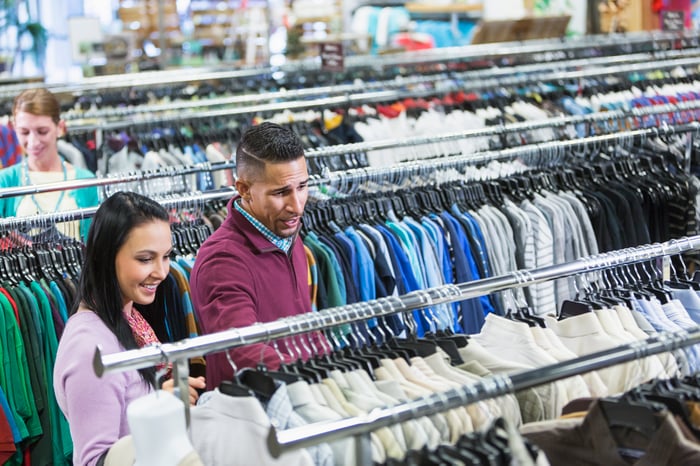
Image source: Getty Images.
Why Ollie's business model is important
Ollie's is a closeout retailer. It buys excess inventory, overstocked merchandise, packaging changes, and liquidated goods from manufacturers and other retailers, then sells them in its warehouse-style stores at deep discounts. It sells typically 20% to 70% below regular retail prices. The product mix rotates constantly, which creates a treasure-hunt dynamic that keeps people coming back. The loyalty program, called Ollie's Army, now has 16.6 million members and grew 11.8% year over year.
This close-out model benefits from disruption. When retailers go bankrupt, when manufacturers overproduce, when tariffs force product changes, Ollie's gets more to sell. The current environment, with shifting tariffs, supply chain realignments, and ongoing retail consolidation, is a feast for a company like this.
When Big Lots filed for bankruptcy, Ollie's acquired 63 former Big Lots locations at the bankruptcy auction. Those stores are moving into territories with established value-shopping customer bases already conditioned to buy home goods on the cheap. That customer conversion alone could drive meaningful market share gains over the next couple of years.
On the tariff question specifically, Ollie's management said it plainly on the Q4 2025 earnings call. "Tariffs are just another form of disruption and we benefit from disruption." When tariffs force manufacturers to change packaging, source from new regions, or discontinue product lines, goods flow toward the closeout market. Ollie's is well-positioned to capture a lot of that merchandise.
The store count story is a long-term thesis
In fiscal 2025, Ollie's opened a record 86 new stores, beating its initial target of 75 and expanding to 658 total locations across 35 states. For 2026, management is targeting another 75 stores, and the company's stated long-term goal is more than 1,300 locations. To put that in context, the company has essentially half the store count it believes it can sustainably reach. That's not a mature business. That's a growth story in a defensive wrapper.
Net sales for fiscal 2025 hit $2.65 billion, with full-year revenue growing at double-digit rates. For fiscal 2026, management is guiding toward nearly $3 billion in net sales and an EPS range of $4.40 to $4.48, along with a long-term earnings model targeting roughly 15% annual EPS growth.
The balance sheet is also worth mentioning: no long-term debt, strong free cash flow, and accelerating share repurchases.
Ollie's Bargain Outlet is a rare "hold forever" retailer, benefiting from all the current economic stress and a scalable 1,300-store vision. It's a simple, repeatable model that could drive meaningful value over the next decade. I'd gradually build a position in this ticker over the next one to two years of economic disruption. It has the potential to become a cornerstone, retirement-defining holding.
Should you buy stock in Ollie's Bargain Outlet right now?
Before you buy stock in Ollie's Bargain Outlet, consider this:
The Motley Fool Stock Advisor analyst team just identified what they believe are the 10 best stocks for investors to buy now… and Ollie's Bargain Outlet wasn’t one of them. The 10 stocks that made the cut could produce monster returns in the coming years.
Consider when Netflix made this list on December 17, 2004... if you invested $1,000 at the time of our recommendation, you’d have $532,066!* Or when Nvidia made this list on April 15, 2005... if you invested $1,000 at the time of our recommendation, you’d have $1,087,496!*
Now, it’s worth noting Stock Advisor’s total average return is 926% — a market-crushing outperformance compared to 185% for the S&P 500. Don't miss the latest top 10 list, available with Stock Advisor, and join an investing community built by individual investors for individual investors.
See the 10 stocks »
*Stock Advisor returns as of April 7, 2026.
Micah Zimmerman has no position in any of the stocks mentioned. The Motley Fool recommends Ollie's Bargain Outlet. The Motley Fool has a disclosure policy.
Recommended Articles


