




Investing in an S&P 500 Index Fund? Beware of This Sneaky Risk Right Now.
Key Points
S&P 500 index funds and ETFs are known for their relative safety and stability.
However, they could be more volatile now than they were a decade ago.
For investors concerned about a market downturn, there's a potentially safer alternative.
- 10 stocks we like better than Invesco S&P 500 Equal Weight ETF ›
The S&P 500 (SNPINDEX: ^GSPC) is a powerhouse index that tracks 500 of the largest U.S.-based companies. S&P 500 index funds and exchange-traded funds (ETFs) aim to mirror the index's performance over time, providing diversified exposure to the large-cap market.
Historically, S&P 500 funds have been on the safer side when it comes to investing in the stock market. While that hasn't necessarily changed, they now carry more risk than they did in the past for one specific reason.
Will AI create the world's first trillionaire? Our team just released a report on the one little-known company, called an "Indispensable Monopoly" providing the critical technology Nvidia and Intel both need. Continue »

Image source: Getty Images.
The hidden risk of the S&P 500 index fund
Traditionally, S&P 500-tracking funds are market-cap-weighted investments, meaning larger companies are weighted more heavily. In theory, this should help mitigate risk. Larger companies tend to be more established than smaller corporations, providing greater stability.
Over the last couple of decades, however, the S&P 500 has become increasingly dominated by tech stocks. In fact, the "Magnificent Seven" -- which includes Nvidia, Apple, Microsoft, Amazon, Alphabet, Meta Platforms, and Tesla -- collectively make up around one-third of the S&P 500's value. Just 10 years ago, these stocks accounted for only about 12% of the S&P 500.
Tech stocks are especially vulnerable to volatility and often face steeper drawdowns than stocks in more mature industries. This means that S&P 500 index funds may experience increased turbulence now than they would have a decade ago under similar circumstances.
To be clear, this isn't necessarily a bad thing all around. The S&P 500's heavy tilt toward tech has also resulted in staggering growth in recent years. But if you're investing in an S&P 500-tracking fund because of the safety and stability it can provide during periods of volatility, your investment may be hit harder than expected.
A potentially safer alternative
If you're looking for exposure to the S&P 500, with less tech-centric risk, an equal-weight S&P 500 fund may be a smart choice right now.
The Invesco S&P 500 Equal Weight ETF (NYSEMKT: RSP), for example, holds stocks from all the companies within the S&P 500. However, rather than weighting them by market cap, each stock makes up roughly the same percentage of the fund.
The advantage of this type of investment is that well-established companies from stable industries carry the same weight as volatile tech giants, reducing the chances that turbulent companies will significantly sway the fund's performance. The downside, though, is that underperforming stocks also carry the same weight as the fast-growing superstars.
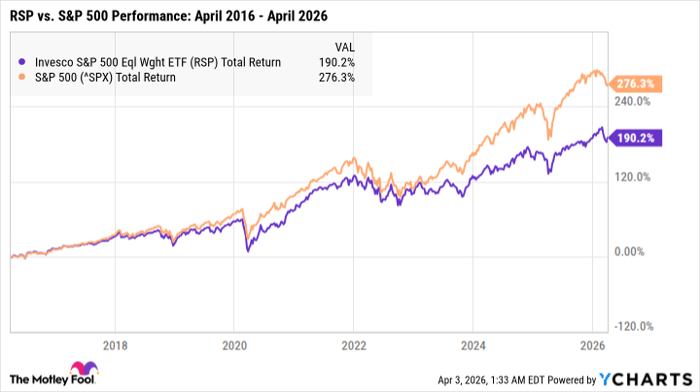
RSP Total Return Level data by YCharts.
Over the last 10 years, the Invesco ETF has underperformed the S&P 500 in total returns. The upside, though, is that the equal-weight fund has experienced smaller drawdowns during periods of volatility -- such as the bear market throughout 2022.
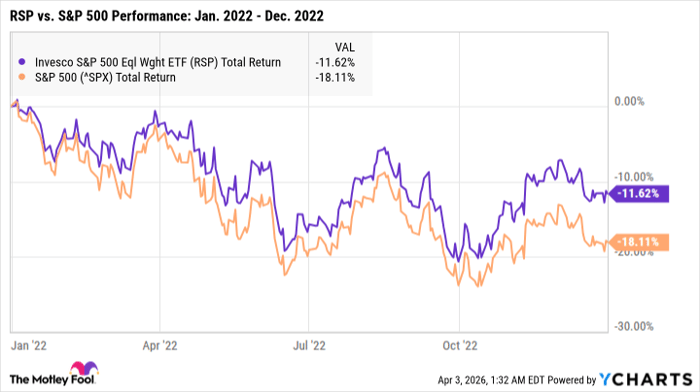
RSP Total Return Level data by YCharts.
A traditional market-cap-weighted S&P 500 index fund or ETF can still be a strong investment, especially if you can afford to stay in the market for at least five to 10 years and ride out any potential volatility.
That said, if a recession or bear market is on the horizon, an equal-weight fund may fare better due to its smaller emphasis on tech stocks.
Should you buy stock in Invesco S&P 500 Equal Weight ETF right now?
Before you buy stock in Invesco S&P 500 Equal Weight ETF, consider this:
The Motley Fool Stock Advisor analyst team just identified what they believe are the 10 best stocks for investors to buy now… and Invesco S&P 500 Equal Weight ETF wasn’t one of them. The 10 stocks that made the cut could produce monster returns in the coming years.
Consider when Netflix made this list on December 17, 2004... if you invested $1,000 at the time of our recommendation, you’d have $532,066!* Or when Nvidia made this list on April 15, 2005... if you invested $1,000 at the time of our recommendation, you’d have $1,087,496!*
Now, it’s worth noting Stock Advisor’s total average return is 926% — a market-crushing outperformance compared to 185% for the S&P 500. Don't miss the latest top 10 list, available with Stock Advisor, and join an investing community built by individual investors for individual investors.
See the 10 stocks »
*Stock Advisor returns as of April 4, 2026.
Katie Brockman has no position in any of the stocks mentioned. The Motley Fool has positions in and recommends Alphabet, Amazon, Apple, Meta Platforms, Microsoft, Nvidia, and Tesla and is short shares of Apple. The Motley Fool has a disclosure policy.
Recommended Articles


