




Where Will Nvidia Stock Be in 5 Years?
Key Points
Over the last three years, demand for Nvidia's GPUs has propelled the company into the mainstream.
The AI narrative will feature much more than GPUs over the next five years as more sophisticated applications come online.
Nvidia is quietly turning into a full-stack platform featuring hardware, software, and networking services -- positioning the company across all layers of the AI value chain.
- 10 stocks we like better than Nvidia ›
Over the past three years, Nvidia (NASDAQ: NVDA) has evolved from a graphics chipmaker to the undisputed king of the artificial intelligence (AI) realm. The company's graphics processing units (GPUs) have become essential infrastructure for training generative AI models -- driving one of the most explosive stock rallies in recent history.
What if I told you this was just the beginning? Over the next five years, Nvidia is poised to extend its dominance from model training into inference, enterprise software, physical-world applications, and next-generation infrastructure.
Will AI create the world's first trillionaire? Our team just released a report on the one little-known company, called an "Indispensable Monopoly" providing the critical technology Nvidia and Intel both need. Continue »

Image source: Nvidia.
Catalyst 1: Enterprise AI adoption
Through its partnership with Palantir Technologies, Nvidia is quietly moving beyond selling hardware for AI data centers to becoming a developer of full-stack AI solutions for commercial businesses. Fortune 500 companies are increasingly building proprietary AI systems that combine Nvidia's accelerated computing expertise with sophisticated data analytics platforms.
These dynamics create predictable, high-margin recurring revenue through software licensing, optimized inference services, and professionally designed ecosystems. What began as cyclical hardware procurement is swiftly transforming into long-term, sticky relationships as AI integration becomes a core pillar supporting every major business process.
Catalyst 2: The inference and infrastructure era has arrived
While training captured headlines in the early days of the AI revolution, industry experts are now discussing the next big phase, called inference. As more sophisticated applications such as agentic AI move from experimentation into production, the need for greater AI inference is exploding.
What investors may be overlooking is that Nvidia is not only supplying GPUs for AI workloads, but also a comprehensive software stack across platforms such as CUDA, TensorRT, and NIM.
This model creates a powerful flywheel for Nvidia: Rising inference capacity fuels more AI development, underscoring a need for even more sophisticated types of infrastructure. Nvidia is uniquely positioned to take advantage of the ongoing AI capex supercycle thanks to its savvy relationships with neocloud providers CoreWeave and Nebius.
Catalyst 3: Physical AI applications are the next frontier
Perhaps the most lucrative growth frontier for Nvidia is the company's role in bringing intelligence into the physical world. Nvidia's platforms are increasingly central to the acceleration of robotics, autonomous vehicles, and quantum computing.
In the future, AI maximalists contend that warehouses and supply chain networks will deploy fleets of AI-powered robots. Meanwhile, autonomous systems will process enormous volumes of real-time data streams in an effort to improve transport safety. Lastly, quantum-classical hybrid computing environments could pave the way to medical breakthroughs that were previously rendered impossible.
Each of these domains requires a complete platform featuring hardware, networking, simulation, and software -- creating a deeply embedded, long-duration revenue cycle for Nvidia's dense ecosystem.
How much will Nvidia stock be worth in five years?
If Nvidia is successful across these new vectors, I think it's reasonable to forecast the company's earnings power could compound at 25% annually over the next five years.
With this type of growth, investors may begin to reprice Nvidia stock at a forward price-to-earnings (P/E) multiple more aligned with its earlier peak levels -- reflecting sustained hypergrowth.
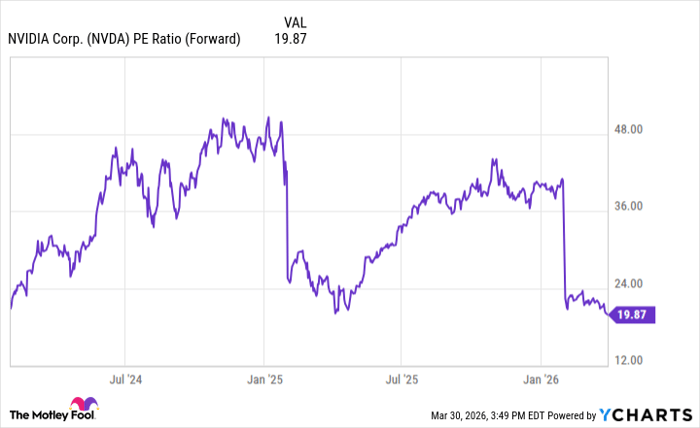
NVDA PE Ratio (Forward) data by YCharts
Given these parameters, Nvidia's share price could feasibly increase four- or fivefold from current levels. In a blue sky bull scenario, I think Nvidia could be valued north of $20 trillion by the early part of next decade.
Should you buy stock in Nvidia right now?
Before you buy stock in Nvidia, consider this:
The Motley Fool Stock Advisor analyst team just identified what they believe are the 10 best stocks for investors to buy now… and Nvidia wasn’t one of them. The 10 stocks that made the cut could produce monster returns in the coming years.
Consider when Netflix made this list on December 17, 2004... if you invested $1,000 at the time of our recommendation, you’d have $532,066!* Or when Nvidia made this list on April 15, 2005... if you invested $1,000 at the time of our recommendation, you’d have $1,087,496!*
Now, it’s worth noting Stock Advisor’s total average return is 926% — a market-crushing outperformance compared to 185% for the S&P 500. Don't miss the latest top 10 list, available with Stock Advisor, and join an investing community built by individual investors for individual investors.
See the 10 stocks »
*Stock Advisor returns as of April 4, 2026.
Adam Spatacco has positions in Nvidia and Palantir Technologies. The Motley Fool has positions in and recommends Nvidia and Palantir Technologies. The Motley Fool has a disclosure policy.
Recommended Articles


