




Better Healthcare Stock to Own in a Recession: Defensive or Growth?
Key Points
Defensive healthcare stocks such as Johnson & Johnson and CVS tend to outperform in recessions.
Growth healthcare stocks offer higher risk and potential reward, less tied to economic cycles.
Choosing between strategies depends on your risk tolerance and portfolio needs.
- 10 stocks we like better than Johnson & Johnson ›
The ongoing conflict in Iran is creating a risk that the economy could fall into a recession. Inflationary pressures from soaring energy and food prices stemming from the inability to transport crude oil, liquefied natural gas, and fertilizer through the Strait of Hormuz, as well as from the growing geopolitical conflict itself, make a coordinated response to global economic challenges extremely complicated.
In such conditions, investors often turn to healthcare stocks. But the question is: Which kind of healthcare stock should you buy?
Will AI create the world's first trillionaire? Our team just released a report on the one little-known company, called an "Indispensable Monopoly" providing the critical technology Nvidia and Intel both need. Continue »
How defensive is my defensive stock?
Large-cap healthcare stocks such as big pharma company Johnson & Johnson (NYSE: JNJ) and integrated healthcare company CVS Health (NYSE: CVS), covering insurance, pharmacy, and healthcare delivery, are often seen as defensive stocks to buy in a slowdown, and for good reason. While consumers can hold back on discretionary purchases in a slowdown, healthcare is often a non-negotiable. As such, healthcare stocks tend to hold up relatively well in a recession, not least because their earnings do too.

Image source: Getty Images.
They are, in investment manager parlance, "low beta" stocks; in other words, if the market moves in one direction, say a 1% move, low beta stocks will move in the same direction but by a factor less than one. In other words, less upside on the market's way up and less downside on the way down.
Those qualities can be seen in the following chart of their performance during the financial crisis of 2008-2010. As you can see, they significantly outperformed the market during the recessionary period, and would have arguably delivered a positive return had the recession not been so severe.
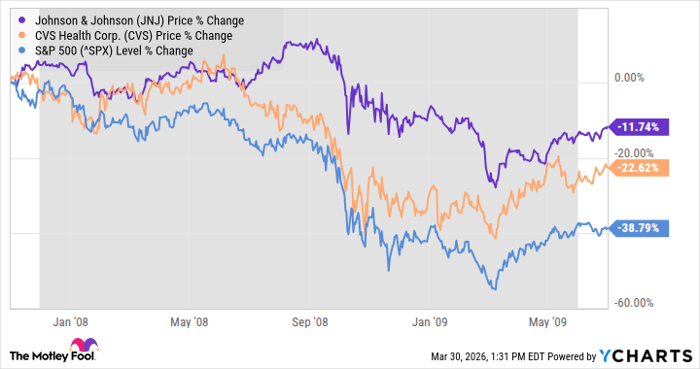
JNJ data by YCharts
Incidentally, you can see the beta for stocks on the summary page on Yahoo! Finance. For example, CVS's current beta is 0.46, and Johnson & Johnson's beta is 0.33. While these numbers are not set in stone (they rely on backward-looking data), they indicate that CVS will only lose 4.6% if the market declines 10%, and Johnson & Johnson will lose 3.3%
There is another option
Depending on your tolerance for risk, or your need to minimize drawdown or to generate income (both stocks pay good dividends), and based on what else you have in your portfolio, buying such low-beta defensive stocks may make sense. However, there is another strategy that enterprising investors can follow, which could deliver positive returns even in a recession.
The strategy involves buying into a collection of small- and mid-cap healthcare companies whose growth drivers depend almost entirely on binary events (clinical trial and test results, establishing product sales, etc.) that have little to do with the economy at large. While some may fail, some will not, and the upside potential in the ones that do can offset losses in the others.
One example of a high-risk, high-reward stock is the multi-cancer early detection test company Grail (NASDAQ: GRAL). If it can prove the efficacy of its Galleri test with follow-up data from its three-year trial with England's National Health Service, the stock will soar.
In a nutshell, the test failed in its primary endpoint of demonstrating a statistically meaningful reduction in stage 3 and stage 4 cancers, possibly because the trial was too short for cancers to develop in the control group. In other words, the test succeeded in detecting cancers in stage 3, but not meaningfully compared to the control group. However, the follow-up data could show more cancers developing in the control group.
Another example comes from Viking Therapeutics (NASDAQ: VKTX) and its lead GLP-1/GIP agonist, VK2735, which is in trials for obesity and diabetes in both subcutaneous and oral forms. VK2735 has excellent efficacy results across its trials, but some disappointing safety and tolerability in a phase 2 trial in obesity in oral form.
However, there's reason to believe those results were due to an overly aggressive titration, and the company continues to advance VK2735 into phase 3 in subcutaneous and oral forms. In addition, Viking is testing oral formulation as a maintenance dose after an initial subcutaneous treatment in a separate study with results due in the third quarter of 2026.
These two companies are merely examples, and it makes sense to build a broader portfolio of such companies to help diversify stock-specific risk, which is high in such companies.
Which strategy to follow?
All told, it's a classic risk question. Do you prefer a high probability of a small loss or gain, or do you take on the risk of a large gain or a large loss? Risk-averse investors will take the former, risk-seeking investors the latter. The key difference is that if you think there's a high chance of a recession, the former has an almost certain small loss, but the latter's upside and downside potential won't be affected much.
Should you buy stock in Johnson & Johnson right now?
Before you buy stock in Johnson & Johnson, consider this:
The Motley Fool Stock Advisor analyst team just identified what they believe are the 10 best stocks for investors to buy now… and Johnson & Johnson wasn’t one of them. The 10 stocks that made the cut could produce monster returns in the coming years.
Consider when Netflix made this list on December 17, 2004... if you invested $1,000 at the time of our recommendation, you’d have $532,066!* Or when Nvidia made this list on April 15, 2005... if you invested $1,000 at the time of our recommendation, you’d have $1,087,496!*
Now, it’s worth noting Stock Advisor’s total average return is 926% — a market-crushing outperformance compared to 185% for the S&P 500. Don't miss the latest top 10 list, available with Stock Advisor, and join an investing community built by individual investors for individual investors.
See the 10 stocks »
*Stock Advisor returns as of April 4, 2026.
Lee Samaha has no position in any of the stocks mentioned. The Motley Fool recommends CVS Health, Grail, Johnson & Johnson, and Viking Therapeutics. The Motley Fool has a disclosure policy.
Recommended Articles


